Why Florida Ranks #1 for Foreign Homebuyers in 2026
Canada, Mexico, China, India and the United Kingdom lead foreign U.S. home purchases, while Florida remains the top destination.
Florida remains the leading U.S. destination for foreign homebuyers.
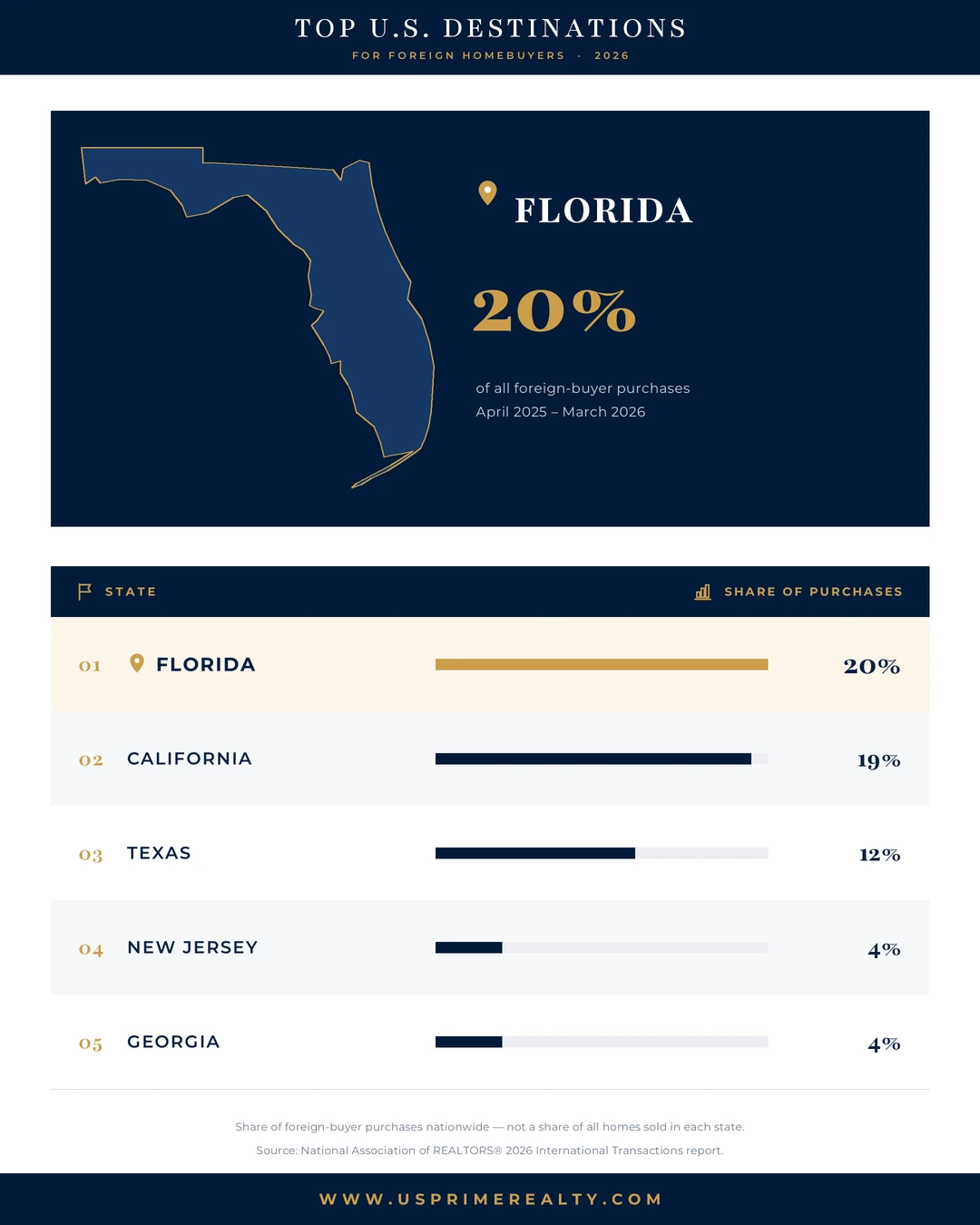
According to the latest National Association of REALTORS® international real estate report, Florida attracted 20% of all foreign-buyer purchases from April 2025 through March 2026. California followed at 19%, while Texas received 12%.
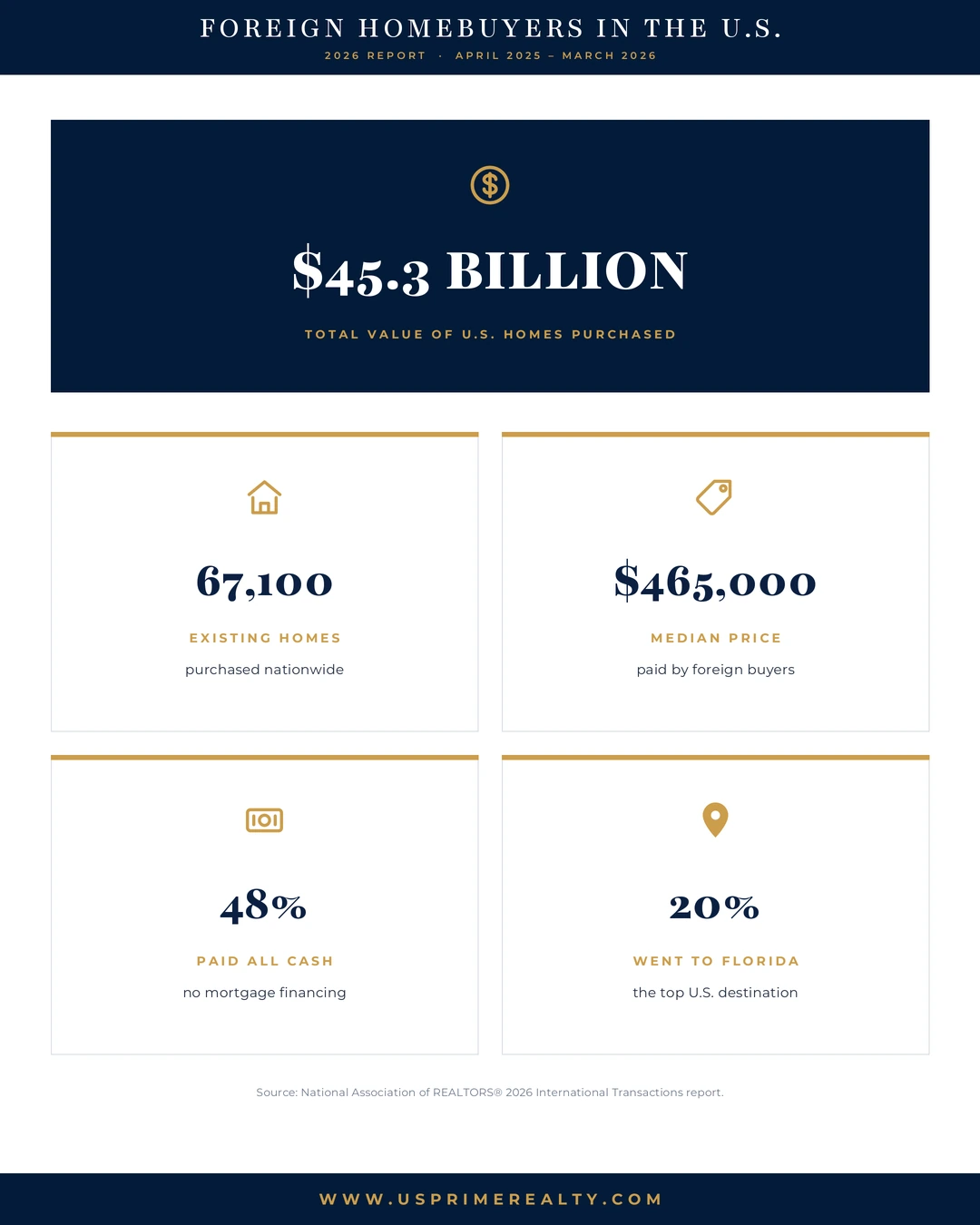
International buyers purchased 67,100 existing homes worth $45.3 billion across the United States during the 12-month reporting period. Nearly half of those transactions were completed entirely in cash.
Canada produced the largest number of foreign buyers nationwide. Mexico, China, India and the United Kingdom were also among the leading countries of origin. China ranked third by the number of properties purchased but generated the highest total dollar volume at $7.6 billion.
Although international purchases declined compared with the previous reporting period, Florida maintained its position as the country’s most popular destination for foreign buyers.
For international buyers, sellers and investors, the findings provide a clearer look at who is purchasing U.S. real estate, how they are financing their purchases and why Florida continues to attract global interest.
Here at U.S. Prime Realty, our goal is to help international buyers compare Florida communities, understand the purchasing process, prepare financially and make informed real estate decisions.
This guide explains why Florida ranks number one, which countries lead foreign U.S. home purchases and what international buyers should know before purchasing Florida property.
Quick Answer
Florida ranked as the number one U.S. destination for foreign homebuyers, receiving 20% of all international-buyer purchases from April 2025 through March 2026. Canada had the largest share of foreign buyers nationwide, followed by Mexico, China, India and the United Kingdom. International buyers purchased 67,100 U.S. existing homes worth $45.3 billion, and 48% of the purchases were completed entirely in cash.
What You’ll Learn
- Why Florida ranks number one for foreign homebuyers
- How many U.S. homes international buyers purchased
- Which countries lead foreign U.S. home purchases
- Which foreign buyers spent the most money
- Whether foreign buyers are moving permanently to Florida
- Why international buyers frequently pay cash
- Which Florida markets international buyers should explore
- What buyers should prepare before purchasing
- Common mistakes international buyers should avoid
- Questions appearing in Google’s People Also Ask results
Why Does Florida Rank #1 for Foreign Homebuyers?
Florida received 20% of all foreign-buyer purchases in the latest National Association of REALTORS® report.
That placed Florida ahead of every other state.
Florida led California by one percentage point and Texas by eight percentage points.
It is important to explain this statistic accurately. Florida’s 20% represents its share of the foreign-buyer purchases included in the NAR report. It does not mean that international buyers purchased 20% of all homes sold in Florida or 20% of all U.S. homes.
NAR Chief Economist Lawrence Yun identified Florida’s beaches and favorable winter climate as reasons the state continues to attract foreign buyers. However, Florida’s appeal extends beyond the weather.
The state offers several different real estate lifestyles, including:
- Oceanfront condominiums
- Beachfront properties
- Luxury waterfront estates
- Intracoastal residences
- Gulf-access homes
- Canal-front homes with private docks
- Vacation and seasonal properties
- Full-time residences
- Investment properties
- Central Florida lakefront homes
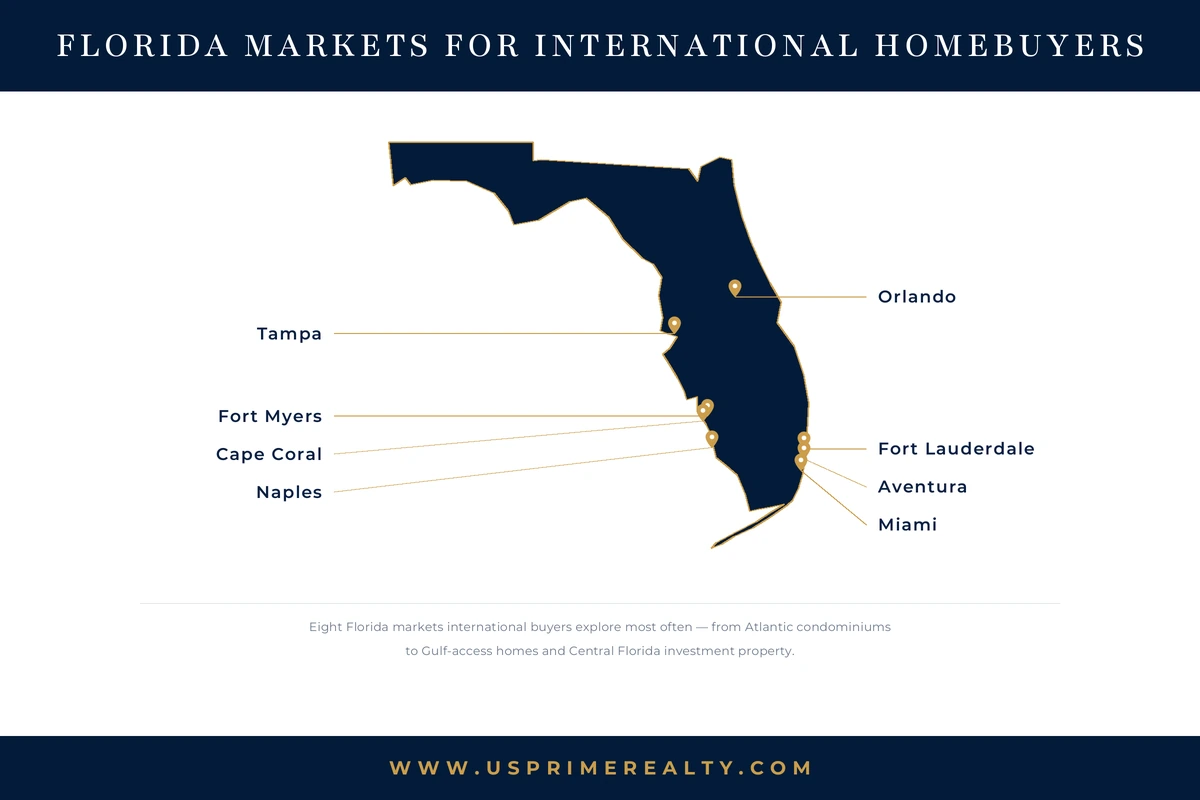
One buyer may want a Miami condominium close to business, dining and entertainment. Another may prefer a seasonal home in Naples, a boating property in Cape Coral or an investment home near Orlando.
The best Florida market depends on the buyer’s intended use, preferred lifestyle, budget and long-term ownership goals.
What Do the Latest Foreign Homebuyer Numbers Show?
Foreign buyers purchased 67,100 U.S. existing homes from April 2025 through March 2026.
Those purchases generated a total dollar volume of $45.3 billion.
Key Foreign Homebuyer Statistics
- $45.3 billion: Total purchase volume
- 67,100: Existing homes purchased
- $465,000: Median purchase price
- 48%: Share who paid entirely in cash
- 56%: Share purchased by resident foreign buyers
- 44%: Share purchased by buyers living abroad
- 20%: Share of foreign-buyer purchases going to Florida
The number of properties purchased fell by 14% from the previous reporting period, decreasing from 78,100 to 67,100.
Total dollar volume fell by 19.1%, decreasing from $56 billion to $45.3 billion.
NAR reported that the 67,100 purchases represented the second-lowest level recorded since it began tracking foreign-buyer activity in 2009.
These figures show that foreign buyers remain active in the U.S. housing market, but the latest report does not show a nationwide increase in activity.
Florida’s position is especially notable because the state remained the top destination during a period when international purchasing activity declined overall.
Which Countries Are Leading Foreign U.S. Home Purchases?
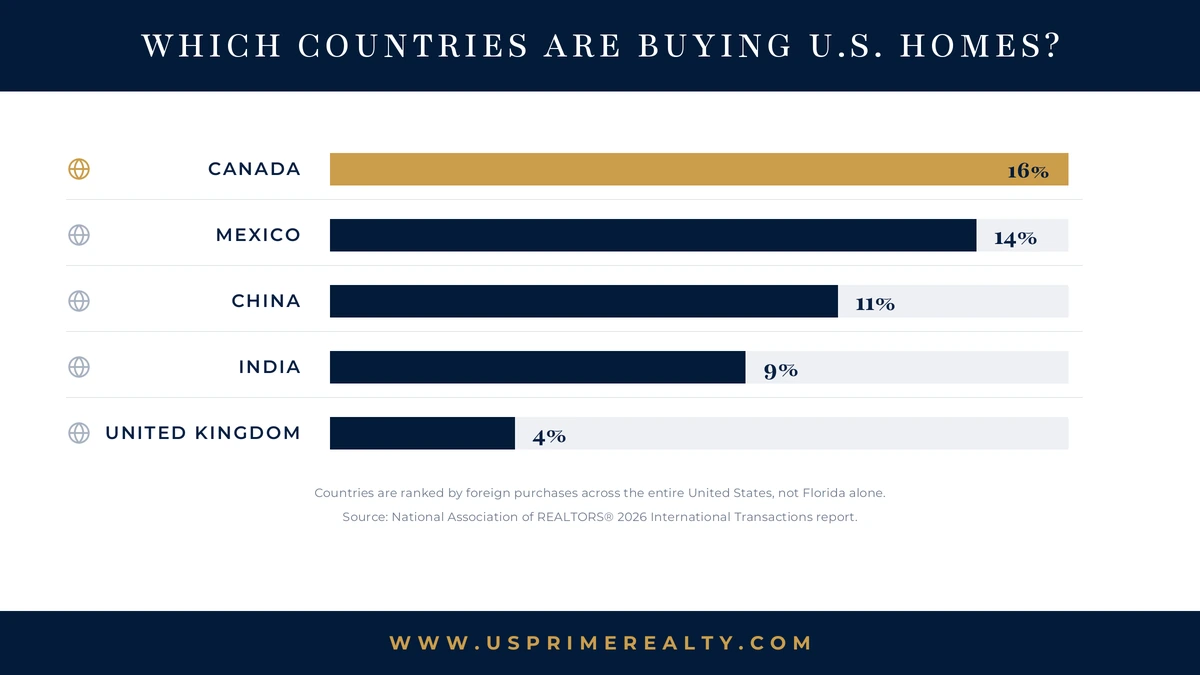
Canada returned as the leading country of origin based on the number of properties purchased.
Canadian buyers represented 16% of all foreign-buyer purchases, followed by Mexico, China, India and the United Kingdom.
10,700 homes
$5.2B
9,400 homes
$5.0B
7,400 homes
$7.6B
6,000 homes
$3.7B
2,700 homes
$1.2B
Canada ranked first based on purchase count, accounting for approximately 10,700 homes.
Mexico ranked second with approximately 9,400 purchases.
China ranked third by purchase count but generated the highest total dollar volume at $7.6 billion. NAR reported that Chinese buyers paid an average purchase price of approximately $1 million, partly because they purchased higher-priced properties, particularly in California.
India represented 9% of foreign purchases, while the United Kingdom represented 4%.
Canada and Mexico together accounted for 30% of the foreign purchases covered by the report.
Important Accuracy Note
The NAR release provides a national ranking of foreign buyers by country of origin and a national ranking of destination states. It does not provide a complete country-by-state breakdown showing exactly how many Canadian, Mexican, Chinese, Indian or British buyers purchased property in Florida.
Accurate wording: Canada, Mexico, China, India and the United Kingdom led foreign U.S. home purchases, while Florida ranked as the leading state destination.
Are Foreign Homebuyers Moving Permanently to Florida?
Some international buyers may relocate to Florida permanently. Others purchase vacation homes, seasonal residences, second homes or investment properties.
Purchasing a Florida property does not automatically mean that the buyer is moving to the state full time.
NAR separates international buyers into two broad categories.
Resident Foreign Buyers
Resident foreign buyers include recent immigrants and certain visa holders who already live in the United States.
- 37,600 homes
- 56% of all foreign-buyer purchases
- $21.8 billion in total purchase volume
Nonresident Foreign Buyers
Nonresident foreign buyers have their primary residence outside the United States.
- 29,500 homes
- 44% of all foreign-buyer purchases
- $23.5 billion in total purchase volume
The report therefore includes both people already living in the United States and people whose primary residence remains abroad.
A nonresident buyer may purchase Florida property as:
- A vacation home
- A seasonal residence
- A rental investment
- A future retirement property
- A second residence
- A home for relatives
The NAR report does not state how many foreign buyers permanently relocated to Florida.
For accuracy, the article should focus on which countries are purchasing U.S. homes and why Florida remains the leading destination rather than suggesting that every foreign buyer is permanently moving.
Why Do International Buyers Continue to Choose Florida?
Florida offers a combination of climate, lifestyle, property selection and internationally recognized real estate markets.
Warm Weather and Coastal Living
Florida’s beaches and favorable winter climate were specifically identified by NAR as reasons international buyers continue to choose the state.
Buyers can choose among Atlantic Ocean communities, Gulf Coast destinations, Intracoastal neighborhoods, residential canal systems and inland lakefront communities.
Different Types of Property
Florida’s real estate market includes:
- Luxury high-rise condominiums
- Single-family homes
- Waterfront estates
- New-construction residences
- Beachfront condominiums
- Canal-front properties
- Vacation homes
- Investment properties
- Golf-community homes
- Lakefront residences
Access to Waterfront Real Estate
International buyers interested in waterfront living can explore the Waterfront Homes in Florida Guide.
The guide compares oceanfront, beachfront, bayfront, Intracoastal, canal-front, Gulf-access, riverfront and lakefront properties. It also explains differences in boating access, ownership expenses, flood considerations and lifestyle.
Buyers ready to explore available properties can view current Florida waterfront homes for sale.
Support for International Buyers
International transactions may involve remote property tours, electronic documents, overseas funds, foreign-national financing and property-management planning.
The U.S. Prime Realty international buyers page explains common financing, tax, remote-purchase and property-selection considerations for buyers purchasing from outside the United States.
Which Florida Markets Should International Buyers Explore?
Every Florida market offers a different property selection and lifestyle.
Buyers should compare communities before selecting an individual property.
Miami Real Estate
Miami offers luxury condominiums, waterfront residences, new developments and urban coastal living.
International buyers interested in a globally recognized market can explore Miami real estate.
Aventura Real Estate
Aventura offers luxury high-rise condominiums, waterfront properties and access to nearby South Florida communities.
Explore available options through the Aventura real estate page.
Naples Real Estate
Naples offers Gulf Coast living, beachfront properties, golf communities and luxury residential options.
Visit the Naples real estate page to compare local homes and communities.
Cape Coral Real Estate
Cape Coral is especially appealing to buyers interested in canal-front properties, private docks and boating access.
Not every canal provides the same boating experience. Buyers should review bridge clearances, water depth, locks and travel time to open water.
Explore the Cape Coral real estate page.
Orlando Real Estate
Orlando offers residential homes, vacation properties, investment opportunities, new construction and inland lakefront communities.
Browse available homes through the Orlando real estate page.
Why Do Foreign Homebuyers Often Pay Cash?
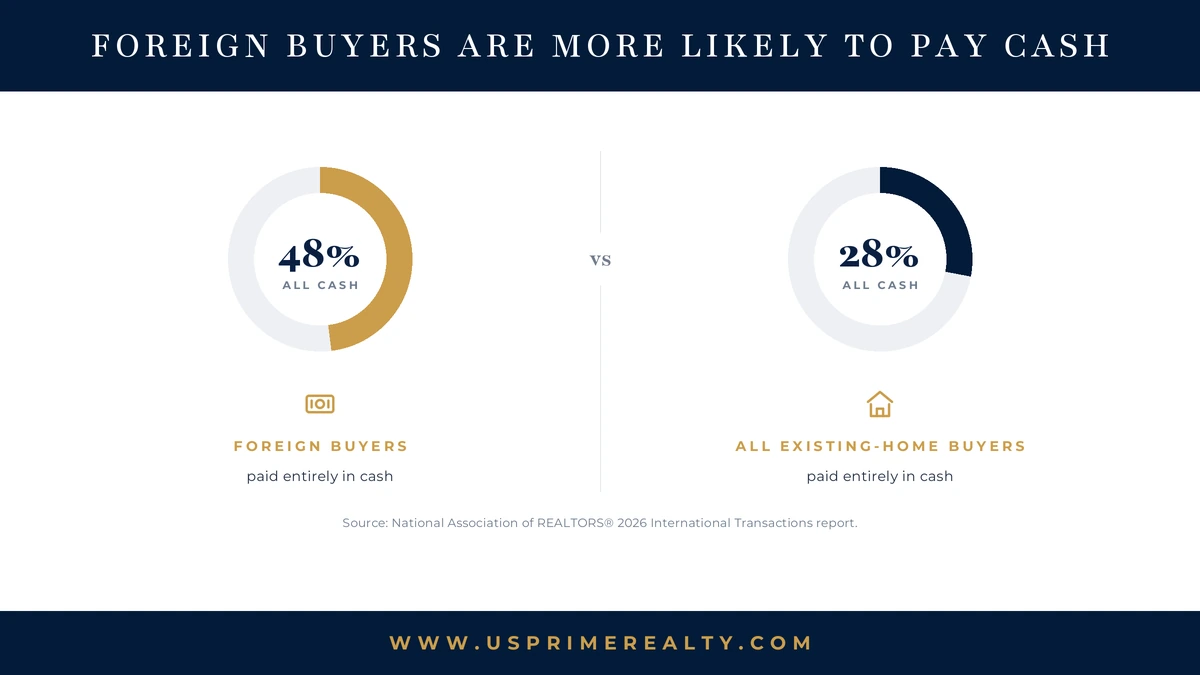
Foreign buyers are more likely to make all-cash purchases than the overall U.S. existing-home buyer population.
Foreign buyers may use cash because they do not have an established U.S. credit history or because their income, assets and financial records are held outside the United States.
A cash purchase may also:
- Remove the financing contingency
- Reduce the possibility of mortgage delays
- Simplify documentation
- Shorten the closing process
- Make an offer more attractive to some sellers
However, foreign buyers are not automatically required to pay cash.
Foreign-national financing may be available depending on:
- Income
- Available assets
- Down payment
- Residency or visa status
- Financial documentation
- Property type
- Lender requirements
Buyers should compare the benefits and costs of paying cash with the financing options available to them.
What Should International Buyers Prepare Before Purchasing in Florida?
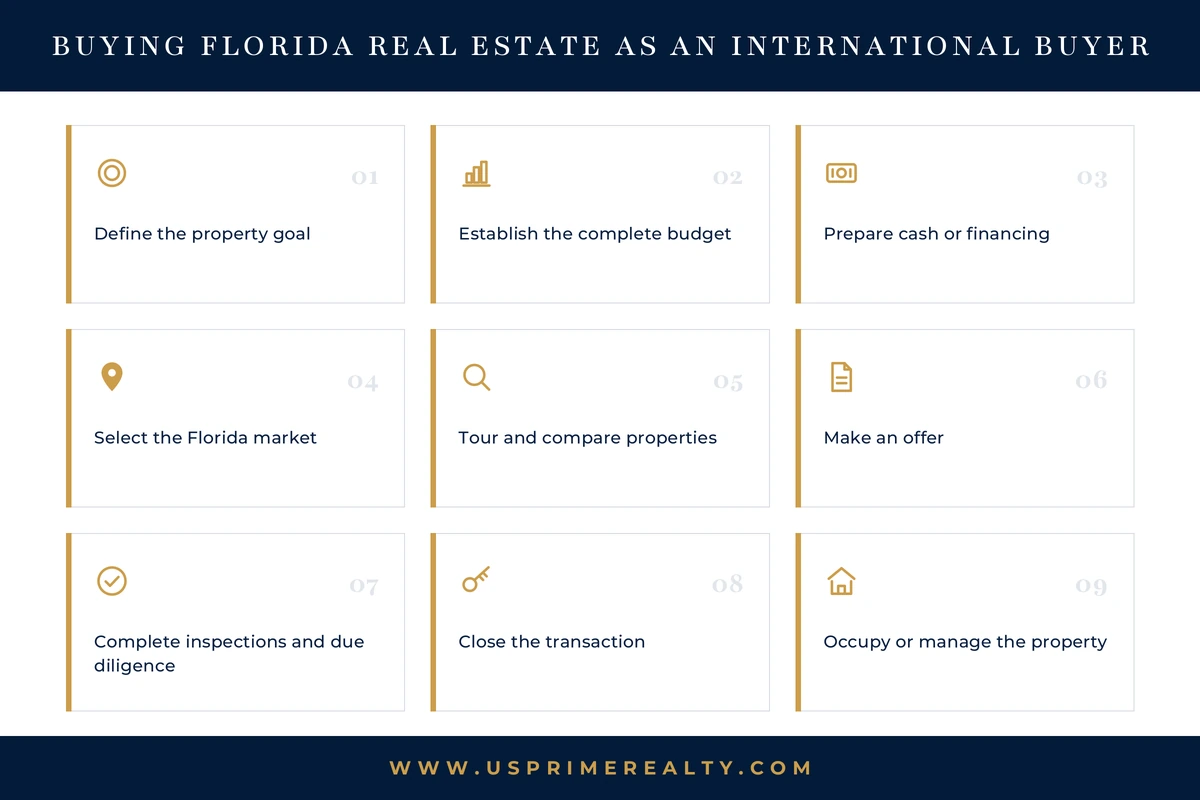
Purchasing Florida real estate from another country requires more preparation than simply selecting a home.
1. Decide How the Property Will Be Used
Determine whether the property will be:
- A primary residence
- A second home
- A vacation property
- A seasonal residence
- A long-term rental
- A short-term rental
- An investment
- A future retirement home
The intended use affects the preferred market, property type, ownership budget and rental requirements.
2. Establish the Complete Budget
The purchase price is only one part of the cost.
Buyers may also need to budget for:
- Closing expenses
- Property taxes
- Homeowners insurance
- Flood insurance when applicable
- Condominium or HOA fees
- Inspections
- Repairs and maintenance
- Property management
- Financing costs
- Tax and legal consultation
- Currency-transfer expenses
A property with a lower listing price does not necessarily have lower ownership expenses.
3. Prepare Cash or Financing Documents
Cash buyers may need to provide proof that funds are available.
Financed buyers should speak with a lender experienced with foreign-national transactions before beginning their property search.
Early preparation helps clarify:
- Required down payment
- Necessary financial documents
- Reserve requirements
- Estimated monthly payments
- Eligible property types
- Expected closing timeline
4. Compare Communities Before Comparing Homes
A property may look attractive but still be located in a community that does not support the buyer’s goals.
Compare:
- Distance from airports
- Neighborhood amenities
- Waterfront or boating access
- Insurance costs
- Condominium or HOA rules
- Rental restrictions
- Flood zones
- Property-management availability
- Long-term resale considerations
5. Complete Property Due Diligence
Depending on the property, due diligence may include:
- General home inspection
- Roof and HVAC evaluation
- Flood-zone review
- Insurance estimates
- Condominium-document review
- Reserve and assessment information
- Dock or seawall inspection
- Permit review
- Rental-rule review
- Title examination
6. Obtain Tax and Legal Guidance
Foreign real estate ownership may create U.S. tax, withholding, reporting or estate-planning considerations.
Buyers and sellers should review the IRS guidance on FIRPTA withholding and consult a qualified tax professional.
An Individual Taxpayer Identification Number may also be relevant in certain tax situations. Buyers can review IRS ITIN guidance when applicable.
A real estate agent does not replace an attorney, accountant, tax adviser or immigration professional.
7. Work With a Florida Real Estate Professional
International transactions may involve:
- Virtual property tours
- Electronic signatures
- Proof-of-funds documentation
- Financing coordination
- Inspection scheduling
- Title and closing arrangements
- Time-zone differences
- Property-management referrals
- Language differences
A local agent with international-buyer experience can help coordinate the real estate process and connect buyers with qualified professionals when needed.
Common Mistakes International Homebuyers Make
International buyers should avoid:
- Selecting a property before defining its purpose
- Looking only at the listing price
- Underestimating insurance and maintenance costs
- Assuming every condominium permits rentals
- Failing to review HOA or condominium documents
- Skipping inspections
- Assuming every canal provides direct open-water access
- Waiting too long to prepare financing documents
- Failing to confirm how funds will be transferred
- Purchasing without tax or legal guidance
- Assuming property ownership provides immigration status
- Failing to plan for property management
- Relying only on photographs or virtual tours
- Working with professionals unfamiliar with international transactions
Understanding these issues before making an offer can help buyers avoid expensive surprises.
International Buyer’s Florida Property Checklist
Before making an offer, ask:
- ✔ What is the purpose of the property?
- ✔ Does the location support my goals?
- ✔ Have I calculated the complete ownership budget?
- ✔ Have I prepared proof of funds or financing?
- ✔ Have I reviewed the flood zone?
- ✔ Have I obtained insurance estimates?
- ✔ Have I reviewed condominium or HOA rules?
- ✔ Are rentals permitted?
- ✔ Have I completed the appropriate inspections?
- ✔ Will I need property management?
- ✔ Have I planned how funds and documents will be transferred?
- ✔ Have I consulted qualified legal and tax professionals?
- ✔ Am I working with a Florida real estate professional experienced with international buyers?
Ready to Explore Florida Real Estate?
Buying Florida property from another country is about more than choosing a home. The right property should match your lifestyle, financial plan, intended use and long-term ownership goals.
Whether you are searching for a luxury condominium in Miami, a waterfront residence in Aventura, a beachfront property in Naples, a Gulf-access home in Cape Coral or an investment opportunity near Orlando, U.S. Prime Realty can help you understand your options.
Explore Our Florida Real Estate Resources
Waterfront Homes in Florida Guide
Florida Waterfront Homes for Sale
Miami Real Estate
Aventura Real Estate
Naples Real Estate
Cape Coral Real Estate
Orlando Real Estate
Or contact U.S. Prime Realty to begin your Florida property search with a local real estate professional.
Call: +1 (239) 513-0011
Email: cc@usprimerealty.com
Buy. Sell. Invest.
U.S. Prime Realty serves buyers, sellers and investors across Miami, Aventura, Cape Coral, Fort Myers, Fort Lauderdale, Naples, Orlando and Tampa.
Frequently Asked Questions About Foreign Homebuyers and Florida Real Estate
1. When buying a home in the United States, why do foreign buyers often pay cash?
1. When buying a home in the United States, why do foreign buyers often pay cash?
Foreign buyers may pay cash because they do not have an established U.S. credit history or because their income, employment records and assets are located outside the United States.
Cash may also remove the financing contingency, simplify documentation, reduce the possibility of mortgage delays and shorten the closing process.
According to NAR, 48% of foreign buyers paid entirely in cash, compared with 28% of all existing-home buyers. Financing may still be available to qualified international buyers.
2. How many homes are bought and sold in the United States each year?
2. How many homes are bought and sold in the United States each year?
The number changes each year, and existing-home sales and newly built home sales are reported separately.
In June 2026, existing-home sales were occurring at a seasonally adjusted annual rate of approximately 4.09 million. New single-family home sales were occurring at an annual rate of approximately 628,000 during the same month. These figures represent annualized monthly rates rather than completed calendar-year totals.
For comparison, foreign buyers purchased 67,100 existing homes during the 12-month period from April 2025 through March 2026.
3. Is it true that foreigners are buying U.S. homes again?
3. Is it true that foreigners are buying U.S. homes again?
Yes. Foreign buyers purchased 67,100 U.S. existing homes worth $45.3 billion from April 2025 through March 2026.
However, the latest report does not show an overall increase. The number of properties purchased declined by 14%, and total dollar volume declined by 19.1% compared with the previous reporting period.
Foreign buyers remain active, but the market should not be described as a new nationwide foreign-buyer boom.
4. Why are people moving out of Florida in 2026?
4. Why are people moving out of Florida in 2026?
The question can give the impression that Florida is experiencing a widespread population exodus, but the latest Census estimates show a more balanced picture.
Florida still recorded positive net domestic migration of 22,517 people from July 2024 through June 2025. However, that was substantially lower than its domestic migration gains in 2022 and 2023.
Florida also recorded the highest net international migration of any state during the same period, gaining 178,674 more international residents than it lost.
The Census data does not establish one single reason why individual residents leave. The more accurate conclusion is that Florida’s domestic migration growth has slowed, while the state continues to attract international residents and foreign homebuyers.
5. Is 2026 a good year to buy a house in Florida?
5. Is 2026 a good year to buy a house in Florida?
2026 may be a good year to buy a Florida property for buyers who are financially prepared, plan to hold the property long enough and find a home that fits their complete ownership budget.
Florida’s market conditions vary significantly by city, neighborhood and property type. In April 2026, statewide single-family closed sales increased by nearly 2.5% compared with the previous year, while new pending sales increased by 8%. However, Florida Realtors noted that the market had not yet established one clear statewide direction for the rest of 2026.
International buyers should evaluate local inventory, purchase price, cash or financing costs, currency exchange rates, insurance expenses, flood exposure, condominium or HOA fees, rental restrictions and intended length of ownership.
Whether it is a good year to buy depends more on the individual property and buyer’s financial plan than on a single statewide prediction.
6. Is it wise to buy a house in Florida now?
6. Is it wise to buy a house in Florida now?
Buying a Florida home may be a wise decision when the property matches the buyer’s goals, budget and expected length of ownership.
Before making an offer, buyers should review the asking price compared with similar properties, available inventory, time on market, price reductions, insurance estimates, flood-zone information, property taxes, condominium or HOA finances, special assessments, rental restrictions, inspection results and expected property-management expenses.
Florida Realtors advises buyers and real estate professionals to examine neighborhood-level inventory, days on market, pending sales and price reductions rather than relying only on broad statewide trends.
Florida’s ranking as the number one destination for foreign homebuyers does not automatically make every Florida property a good purchase. Each home must be evaluated individually.
7. What are the best U.S. cities for property investment in 2026?
7. What are the best U.S. cities for property investment in 2026?
There is no single best city for every investor. The right market depends on the investor’s budget, strategy, expected rental demand, operating expenses and risk tolerance.
NAR’s 2026 Housing Hot Spots report identified these markets as offering meaningful opportunities: Charleston, Charlotte, Columbus, Indianapolis, Jacksonville, Minneapolis–St. Paul, Raleigh, Richmond, Salt Lake City and Spokane.
The report evaluated indicators including job and income growth, migration, inventory, affordability, mortgage activity and the relationship between mortgage payments and rent. Jacksonville was the only Florida market included in NAR’s national top ten for 2026.
International investors focused on Florida may also compare Miami, Naples, Cape Coral, Orlando and Aventura based on their specific goals. However, those markets should not be described as part of NAR’s 2026 top-ten list unless they appear in the official report.
Florida’s popularity among foreign buyers does not mean that every Florida property is automatically a strong investment. Buyers should compare the property’s purchase price, rental restrictions, expected income, vacancy risk, insurance expenses, taxes, maintenance and resale potential.
Start Your International Florida Home Search With Local Guidance
U.S. Prime Realty can help international buyers compare Florida communities, understand property options and connect with the right local professionals before making an offer.
About The Author

Isbely Glazer - Founder and Broker of U.S. Prime Realty
Isbely brings over 20 years of experience across Florida’s key markets. She leads with a client-first approach, combining deep market insight with a commitment to trust, results, and long-term relationships.
Business Info


Recent Posts

Florida Real Estate Investment Guide 2026: Top Cities for Property Investors
Florida real estate investment guide 2026: compare Miami, Orlando, Tampa, Cape Coral, Fort Myers, Naples and Jacksonville, plus rental costs and risks.
Moving to Florida in 2026: Why Homebuyers Continue to Choose the Sunshine State
Moving to Florida in 2026? Explore housing prices, taxes, lifestyle, top cities and hidden ownership costs before buying a Florida home.
What’s it really like to live in Orlando, Florida? The 2026 Guide
Moving to Orlando in 2026? Compare home prices, daily costs, neighborhoods, commutes, summer weather and the tradeoffs of living beyond the theme parks.