What Is Florida Amendment 3, and How Could It Affect Property Taxes and Homeowners?
Pre-election explainer · November 3, 2026 ballot
Florida Amendment 3 is one of the most consequential property-tax questions on Florida’s November 3, 2026 ballot. For people who already own a home—or are thinking about buying one—it raises a practical question: could the cost of owning property change over the next few years? The answer depends on the kind of property, when its owner became a Florida resident, and what local taxing authorities do next.
The proposal would expand the homestead exemption used for non-school property taxes, lower the limit on annual assessment increases for many non-homestead properties, and change constitutional rules for county and municipal tax revenue. None of those changes is in effect today. Voters must first approve the amendment, and the size of any tax-bill difference would depend on local millage rates, assessed value and other charges. The discussion also reaches beyond individual tax savings: counties and cities rely on property taxes to pay for services people use every day. Here is what the official proposal says, what it does not say, and what Florida residents should check before making a housing decision.
Quick answer: If approved, Amendment 3 would expand qualifying non-school homestead exemptions to $150,000 in 2027 and $250,000 in 2028, lower a non-homestead assessment cap to 5%, and change local spending rules. It would not eliminate all Florida property taxes.
What is in this guide
- What Is Florida Amendment 3?
- How Does Florida’s Property Tax System Work?
- What Changes Would Florida Amendment 3 Introduce?
- How Could Florida Amendment 3 Affect Homeowners?
- How Could Amendment 3 Affect Renters and First-Time Homebuyers?
- What Could Amendment 3 Mean for Local Government Budgets?
- What Are the Potential Benefits and Concerns of Amendment 3?
- When Would Florida Amendment 3 Take Effect?
- Frequently Asked Questions About Florida Amendment 3
- Conclusion: What Should Florida Property Owners Know About Amendment 3?
What Is Florida Amendment 3?
Amendment 3 is a proposed change to the Florida Constitution titled “Increased Homestead Exemption; Lower Cap on Increases in Non-Homestead Property Assessments.” The Florida Legislature placed it on the 2026 general-election ballot. Its central purpose is to change how certain properties are valued and exempted for taxation while setting new rules around county and municipal use of property-tax money.
The key distinction is between a proposal and current law. Florida homeowners can already qualify for homestead exemptions and Save Our Homes assessment protection. Most qualifying non-homestead real estate has a separate 10% assessment-growth limit. Amendment 3 would change parts of that framework only after voter approval. Read the official Florida Department of State ballot record for the full summary and constitutional references.
What Are the Main Provisions of Amendment 3?
The proposal has three major property-tax pieces: a larger exemption for qualifying primary residences on non-school levies, a cut from 10% to 5% in the annual assessment-growth cap for qualifying non-homestead property, and restrictions on designated uses of county and municipal property-tax revenue. It also creates a significant residency distinction: people who were not Florida residents on December 31, 2026 would generally wait until their fifth year of homestead eligibility for the expanded exemption, to the extent the U.S. Constitution permits.
When Would Florida Amendment 3 Take Effect?
The vote is scheduled for November 3, 2026. Constitutional amendments need at least 60% approval from those voting on the measure. If approved, the measure states an effective date of January 1, 2027; changes for the 2027 tax year would generally first appear on bills sent in November 2027.
How Does Florida’s Property Tax System Work?
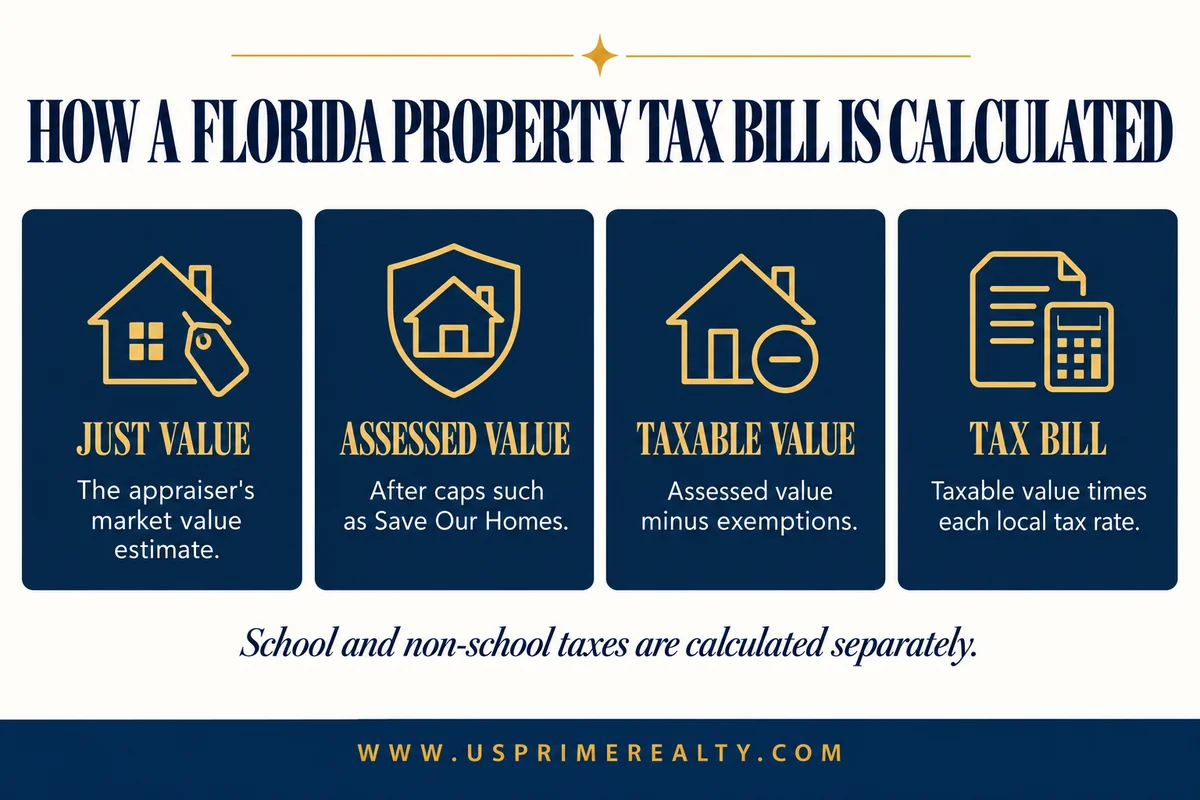
Florida property taxes begin with a property appraiser’s estimate of just value, often called market value for tax purposes. Assessment limitations can reduce the value used to calculate taxes, and exemptions can reduce it further. Individual taxing authorities—counties, cities, school districts and some special districts—then apply their own millage rates. This is why two similarly priced houses can generate different tax bills.
What Is the Difference Between Market Value and Assessed Value?
Market or just value reflects an appraisal of the property’s value. Assessed value is the number after applicable assessment caps or adjustments. A long-time owner may have an assessed value substantially below today’s market value because of Save Our Homes protections.
What Is Taxable Value?
Taxable value is assessed value minus exemptions that apply to a particular levy. A home can have different taxable values for school and non-school taxes because the exemptions are not always identical.
What Is a Homestead Exemption?
A homestead exemption generally benefits an eligible owner who makes a Florida property their permanent residence (or the permanent residence of a dependent). Under current rules, qualifying homes can receive up to roughly $50,000 in the familiar two-part general exemption structure, with the additional portion applying to non-school levies. Other specialized exemptions may also apply.
How Are Property Tax Bills Calculated?
One mill equals $1 in tax per $1,000 of taxable value. The basic calculation is taxable value multiplied by the applicable millage rate divided by 1,000, repeated for each taxing authority. Non-ad valorem assessments and fees can add to the bill. The Florida Department of Revenue’s calculation example illustrates the separate school and non-school calculations.
| Term | Definition |
|---|---|
| Market value | Estimated value in the real estate market (just value) |
| Assessed value | Value after applicable assessment limitations |
| Taxable value | Assessed value less applicable exemptions |
| Millage rate | Tax dollars per $1,000 of taxable value |
| Homestead exemption | Taxable-value reduction for qualifying primary residences |
What Changes Would Florida Amendment 3 Introduce?
The proposal would not simply lower every property-tax bill by the same amount. It changes the taxable-value calculations for certain properties and imposes additional constitutional rules for government finance. The effective benefit varies because an exemption cannot push a qualifying levy’s taxable value below zero, and because local rates and assessments differ.
How Would the Homestead Exemption Change?
For qualifying owners covered by the expanded benefit, Amendment 3 would raise the homestead exemption for non-school property taxes to $150,000 in 2027 and $250,000 in 2028. Positive inflation adjustments would follow beginning in 2029. The measure also directs the Legislature to establish a uniform route for counties and municipalities to increase their exemption up to full assessed value for their own levies; special districts could do so with referendum approval. This does not mean every authority would automatically adopt a full exemption.
How Would the Non-Homestead Assessment Cap Change?
For real property qualifying under the non-homestead assessment limit, the annual ceiling on assessment increases would drop from 10% to 5% for non-school levies. That limits growth in assessed value, not necessarily growth in the final bill. Millage changes, reassessment events and other legal exceptions still matter. Rental properties and some second homes may fall into this category; eligibility is property-specific.
Would Amendment 3 Affect School Property Taxes?
The new larger homestead exemption expressly excludes school taxes. School district levies would continue under their applicable existing treatment, and owners could still owe school property taxes even when a non-school exemption removes much of their non-school taxable value.
How Could Local Government Spending Rules Change?
Counties and municipalities would face constitutional categories for property-tax use, including public safety, education and schools, infrastructure, natural resources, debt service on bonds, employee retirement benefits, and operations and administration. The proposal also permits other spending when approved by specified local officials or governing bodies unless general law prohibits it. That approval provision is important: the language is not an absolute ban on all other expenditures.
| Feature | Current framework | Proposed change |
|---|---|---|
| Homestead exemption | Existing school/non-school exemption rules | Up to $150K in 2027; $250K in 2028 for qualifying non-school levies |
| Non-homestead cap | Generally 10% per year for eligible property | 5% annual cap for qualifying property (non-school levies) |
| School property taxes | Current school-tax rules | Expanded exemption does not apply to school taxes |
| Local spending | Existing constitutional/statutory authority | Specified permitted categories, with a conditional approval path for other uses |
How Could Florida Amendment 3 Affect Homeowners?
For many households, a tax bill is a significant part of the annual housing budget. Amendment 3 could bring relief to some eligible owners, but it would be a mistake to calculate an expected saving by multiplying $250,000 by a single statewide tax rate. Florida does not have one uniform local property-tax rate, and not every owner gets the expanded exemption at the same time.
Could Homeowners Pay Less in Property Taxes?
Yes, an eligible homestead owner could see a lower non-school taxable value. As a simple illustration—not a forecast—removing an additional $100,000 of taxable value under a combined five-mill non-school rate would equal $500 before considering other limits, rates and charges. A home with less eligible taxable value may realize a smaller reduction. Meanwhile school taxes, special assessments and rate changes can still affect the bottom line.
Who Could Qualify for the Proposed Tax Benefits?
Qualifying homestead owners must meet Florida’s ownership and permanent-residence criteria. The amendment’s additional rule matters for movers: someone who was not a Florida resident as of December 31, 2026 would receive existing homestead benefits upon qualification but generally wait until the fifth year of exemption for the larger amount, subject to constitutional limits. Local appraisers administer applications and eligibility; review the state homestead and exemptions guide rather than assuming an automatic first-year benefit.
What Should Existing Homeowners Consider?
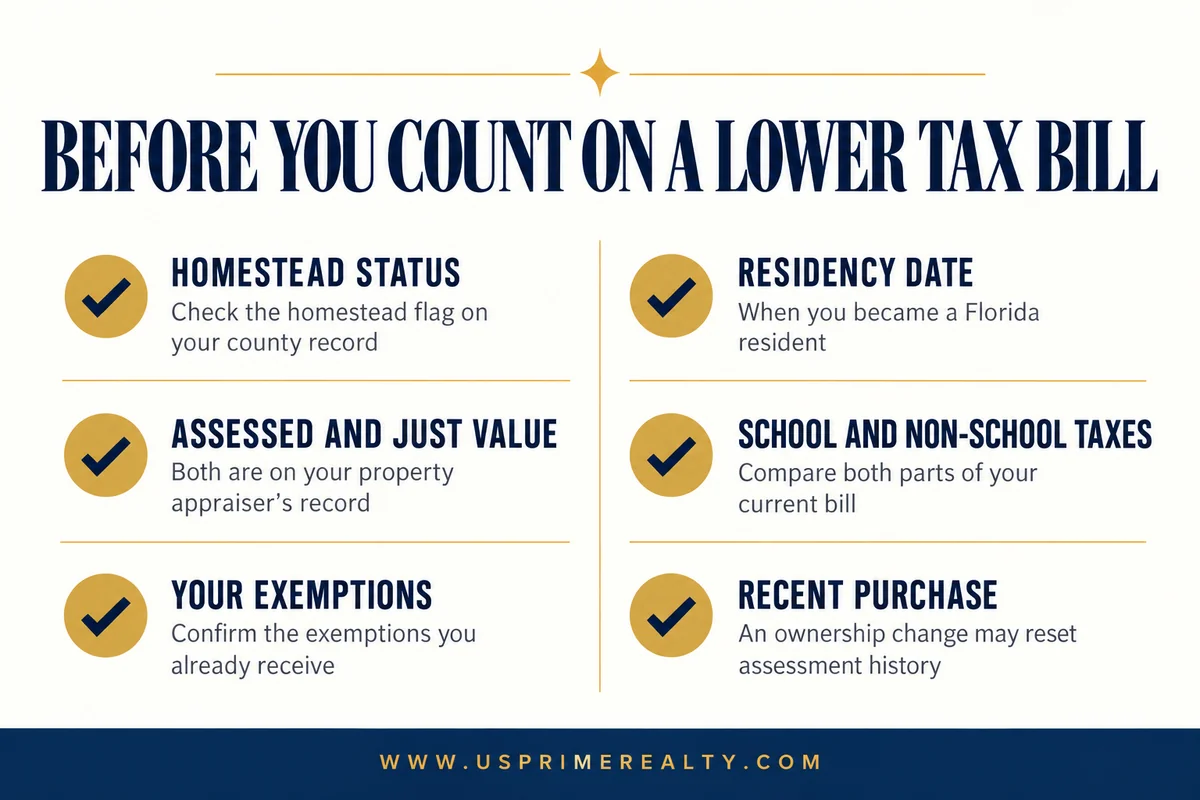
Check your county property-appraiser record for the homestead flag, assessed value, just value and existing exemptions. Compare the school and non-school portions on your current bill, and remember that a purchase or ownership change may reset assessment history. If you are preparing to sell, property-tax estimates should be weighed alongside a real market analysis; U.S. Prime Realty’s seller resource explains how to assess a home’s competitive position.
| Homeowner situation | Potential consideration |
|---|---|
| Existing homestead owner | May receive a larger eligible non-school exemption |
| Recent homebuyer | New assessed value and residency timing can change outcomes |
| New Florida resident | Proposed fifth-year rule may delay expanded benefit |
| Owner with other exemptions | Interaction with existing exemptions affects actual savings |
How Could Amendment 3 Affect Renters and First-Time Homebuyers?
Renters, first-time buyers and owners of investment properties do not experience property-tax policy in the same way. The homestead exemption rewards an eligible primary-residence ownership arrangement. Renters do not apply for that exemption on a landlord’s property, but taxes can still influence the economics of their housing.
Would Renters Benefit From Amendment 3?
A tenant would not receive the expanded homestead exemption directly. Owners of qualifying rental property, however, might benefit from the proposed lower non-homestead assessment-growth cap. Whether any cost difference is reflected in rent depends on leases, supply and demand, repairs, insurance, financing and the landlord’s pricing decisions. Lower assessment growth is not a promise of lower rent.
Could Amendment 3 Affect Housing Affordability?
Lenders generally consider expected property taxes as part of monthly housing expenses. A possible lower bill for an eligible owner could affect budgeting and affordability, but mortgage approval depends on a fuller picture: income, credit, debt, insurance and the property itself. Buyers can use U.S. Prime Realty’s mortgage and affordability resources to begin building that budget.
What Could First-Time Homebuyers Expect?
A first-time buyer purchasing a primary residence should focus on homestead eligibility and the potential new-resident waiting period, rather than the non-homestead cap alone. The 5% proposal principally concerns qualifying properties that do not receive homestead treatment. Buyers considering a second home or rental should ask the county appraiser about applicable caps and changes in ownership. A seller’s old tax bill often does not predict the new owner’s bill.
What Could Amendment 3 Mean for Local Government Budgets?
Property taxes help support services whose costs do not automatically shrink when taxable values do. That is why local officials are studying Amendment 3 as both a homeowner issue and a budget issue. The practical effect would depend on how much of each community’s tax base is homesteaded, how rapidly property values are changing, and what other revenues are available.
How Do Local Governments Use Property Tax Revenue?
Counties and municipalities fund a mix of public safety, roads, parks, facilities, administration and other responsibilities. Some services draw on multiple sources, including sales taxes, state transfers, fees and dedicated assessments. The amendment identifies a set of permitted uses for property-tax revenue but includes a route for locally approved expenditures outside those categories where law allows.
Could Amendment 3 Affect Police and Fire Services?
Police, fire and emergency response are explicitly within the proposal’s public-safety category, so the measure would not prohibit spending property-tax dollars on them. A reduction in available revenue could still force budget trade-offs. The extent of any pressure would be determined locally; it would be inaccurate to say that emergency services must be cut.
Could Local Governments Introduce New Fees?
Local governments could examine spending reductions, reserve use, other revenue sources or legally available fees and assessments. None is an automatic requirement of Amendment 3. Non-ad valorem assessments, for example, are distinct from millage-based taxes and may still appear on the same bill. Residents should review public budget hearings and proposed rates before assuming how a county will respond.
Why Could the Effects Differ by County?
A coastal city with high home values and substantial homestead participation faces a different tax base from a fast-growing inland community or one with more commercial property. Budget commitments, service costs, tourism revenue and available reserves all shape the choices. Miami-Dade County’s public Amendment 3 explainer offers one local perspective; figures for other counties should come from their own officials.
| Area | Potential consideration |
|---|---|
| Public safety | Budget pressure may arise even though eligible spending remains allowed |
| Infrastructure | Local project timing and funding priorities may shift |
| Government budgets | Expenditures or lawful revenue sources may need review |
| Residents | Fees or service levels could change, but neither is guaranteed |
What Are the Potential Benefits and Concerns of Amendment 3?
Supporters of property-tax relief point to the burden of recurring ownership costs, especially for households on fixed incomes or those facing rising expenses. A larger exemption could lower non-school taxable value for eligible homesteads, while a 5% non-homestead cap could make assessment growth more predictable for qualifying properties. Greater predictability can help households and small property owners plan.
What Are the Potential Benefits?
Potential benefits include less non-school taxable value for established qualifying homesteads, reduced assessed-value growth on eligible non-homestead real estate, and additional flexibility for local voters or officials to adopt deeper relief on certain levies. Those are features of the proposal, not guarantees of a specific dollar saving.
What Are the Main Concerns?
Critics and budget officials emphasize that shrinking a tax base can complicate planning for roads, public safety and daily operations. The new residency timing rule could also mean that two otherwise similar homeowners qualify for different benefits. Some savings could be offset by rate decisions or other charges, subject to law. Evaluating the measure requires considering both the household bill and how the community funds services.
| Potential benefits | Potential concerns |
|---|---|
| Potential relief for eligible homestead owners | Less local property-tax revenue |
| Larger non-school homestead exemption | Benefits vary by residency and parcel |
| 5% cap on eligible non-homestead growth | Budget adjustments may be needed |
| More predictable assessed-value increases | Other taxes or fees may offset part of the benefit |
When Would Florida Amendment 3 Take Effect?
Amendment 3 is scheduled for Florida’s November 3, 2026 general election, and passage requires at least 60% of votes cast on the amendment. If approved, the constitutional effective date is January 1, 2027. The proposed $150,000 non-school homestead exemption begins with tax year 2027, while the $250,000 amount starts in tax year 2028; later positive inflation adjustments are contemplated. The first affected annual tax bills would generally arrive in November 2027, not November 2026. Implementation can involve additional legislation and county-appraiser guidance, and some new residents would face a fifth-year eligibility rule. Check the state’s official ballot listing after Election Day for the result and any updated legal status.
Frequently Asked Questions About Florida Amendment 3
What Is Florida Amendment 3 in Simple Terms?+
What Is Florida Amendment 3 in Simple Terms?
It is a proposed constitutional amendment that would increase eligible homestead exemptions for non-school property taxes, lower the annual assessment-growth cap for qualifying non-homestead property from 10% to 5%, and revise county and municipal property-tax spending rules. Voters will decide whether it becomes law.
Would Amendment 3 Eliminate Property Taxes in Florida?+
Would Amendment 3 Eliminate Property Taxes in Florida?
No. Even if approved, the proposal would not abolish Florida property taxes. School levies would remain outside the new expanded homestead exemption, and owners could still owe non-school taxes, other assessments or fees depending on their circumstances.
Who Would Qualify for the Expanded Homestead Exemption?+
Who Would Qualify for the Expanded Homestead Exemption?
Eligible owners generally must meet Florida homestead rules for a primary residence. The proposal distinguishes people who were Florida residents on December 31, 2026 from those who were not; later-arriving residents would generally wait until their fifth year of homestead exemption for the expanded amount, subject to constitutional requirements.
Would Amendment 3 Affect School Property Taxes?+
Would Amendment 3 Affect School Property Taxes?
The expanded $150,000 and $250,000 homestead exemptions are expressly limited to non-school taxes. School district property-tax rules would continue to apply, and the school-tax portion of a bill should be reviewed separately.
How Could Amendment 3 Affect Rental Properties?+
How Could Amendment 3 Affect Rental Properties?
Qualifying non-homestead rental property could benefit from the lower 5% assessment-growth cap. That is not a direct homestead benefit for tenants, nor a guarantee of lower rent. Property-specific assessment rules and market conditions determine the outcome.
Would Amendment 3 Guarantee Lower Property Tax Bills?+
Would Amendment 3 Guarantee Lower Property Tax Bills?
No. Taxable value, local millage rates, the parcel’s exemption status, school taxes and non-ad valorem assessments all matter. An owner who already owes little in eligible non-school property tax may benefit differently from an owner with a larger taxable base.
When Would the Proposed Changes Take Effect?+
When Would the Proposed Changes Take Effect?
If at least 60% of voters approve the measure on November 3, 2026, it is scheduled to take effect January 1, 2027. Initial effects would generally be seen in 2027 tax calculations and bills issued in November 2027, with a further homestead increase in 2028.
Conclusion: What Should Florida Property Owners Know About Amendment 3?
Florida Amendment 3 offers a potentially substantial change in how qualifying homes and other properties are assessed for taxes. The proposed 2027 and 2028 homestead exemptions could ease certain homeowners’ non-school taxes; the 5% non-homestead cap could affect some rental, second-home and investment properties. At the same time, counties and cities would have to manage any changes in revenue and follow revised spending rules.
Before counting on a lower bill, find your parcel’s assessed and taxable values, confirm your exemptions, check your residency situation and review your local taxing authorities. For buying or selling decisions, speak with your county property appraiser and appropriate tax advisers. For help interpreting local housing-market conditions, contact U.S. Prime Realty. For the ballot’s precise terms, always consult the official state record.
Important information: This article is educational, not tax, legal, appraisal or lending advice. Amendment 3 had not been approved as of October 27, 2026. Consult official state and county materials and qualified professionals for parcel-specific decisions.
Share This
About The Author

Isbely Glazer - Founder and Broker of U.S. Prime Realty
Isbely brings over 20 years of experience across Florida’s key markets. She leads with a client-first approach, combining deep market insight with a commitment to trust, results, and long-term relationships.
Business Info


Recent Posts

What Does a Real Estate Agent Actually Do for Homebuyers?
What does a real estate agent do for homebuyers in Florida? Learn how agents help with home searches, offers, inspections and closing.
Would You Buy a Haunted House? How a Home’s History Can Affect Its Value
Would you buy a haunted house? Discover how a home’s history affects property value, buyer demand, disclosures, negotiations and resale.
Renting vs. Buying a Home in Florida in 2026: Costs, Benefits, and What to Know
Renting vs. buying a home in Florida in 2026? Compare rent, mortgage costs, insurance, taxes, down payments and which choice may fit your plans.