Would You Buy a Haunted House? How a Home’s History Can Affect Its Value
Does a haunted house affect property value?
When a House Has More Than Just History
Imagine finding the house you have been searching for: a beautiful porch, generous rooms, a great neighborhood and a price that actually fits your budget. Then a neighbor mentions that the place is supposedly haunted. Would you still make an offer?
Most homes come with stories. Some are charming; others make buyers look twice. A reported haunting, a highly publicized crime or a tragic event does not change the square footage, but it can change how someone feels about living there. And feelings influence real estate decisions. Here is what buyers and sellers should know about stigmatized properties, from market value and disclosure rules to inspections and resale. The goal is not to decide whether ghosts exist. It is to decide what a house is worth to you—and what it may be worth to the next buyer.
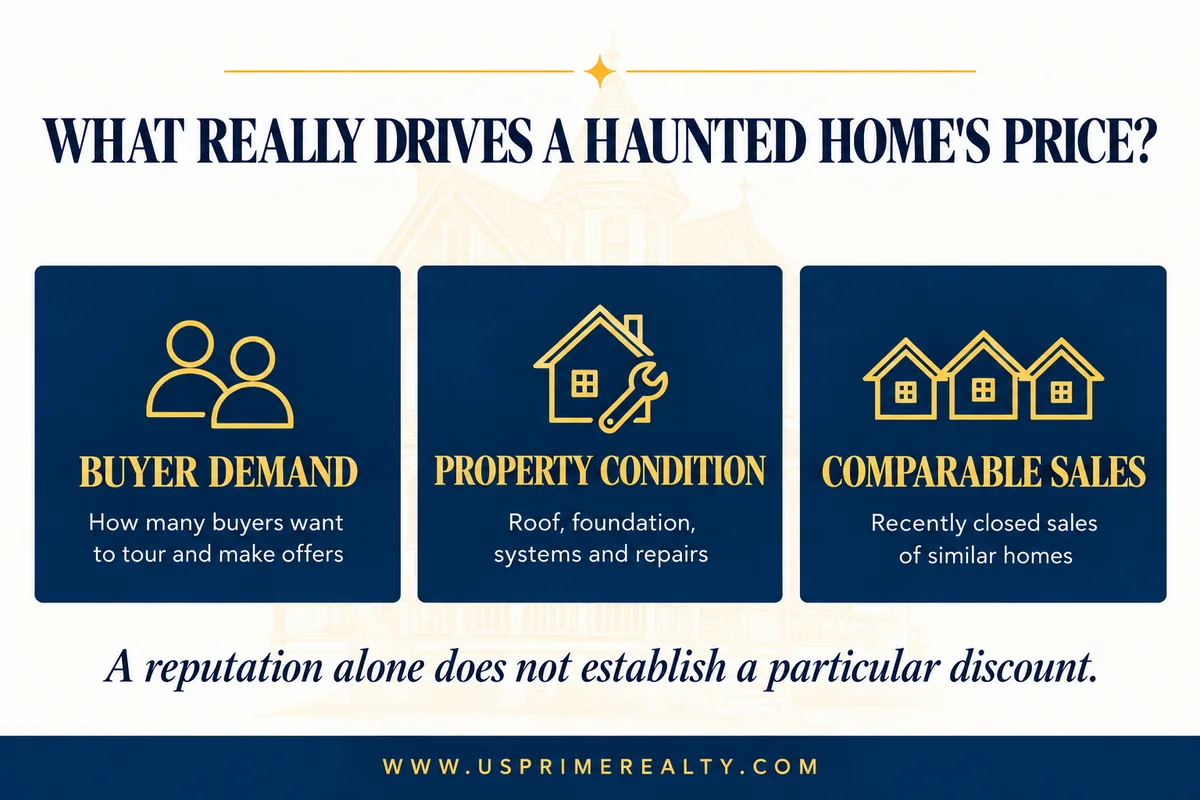
Quick answer: A home’s troubling reputation can reduce demand, affect negotiations or lengthen marketing time, but there is no standard “haunted-house discount.” Location, condition, comparable sales and state disclosure rules still matter most.
What is in this guide
- What Makes a House a “Haunted” Property?
- Can a Haunted House Affect Property Value?
- The Psychology of Buying a House With a Dark History
- Do Sellers Have to Disclose a Haunted House?
- What to Check Before Buying a House With a Troubled Past
- Could a Haunted House Be a Smart Real Estate Investment?
- Would You Buy a Haunted House? The Final Verdict
- Frequently Asked Questions About Haunted Houses and Real Estate
What Makes a House a “Haunted” Property?
The word haunted gets used loosely in real estate. It might describe a house with creaky stairs and flickering lights, or one with stories that have circulated for generations. Sometimes the legend begins with an unsettling experience. Sometimes it begins with an old newspaper headline. Neither a rumor nor a dramatic nickname is proof of paranormal activity.
The Stories and Events Behind a Haunted Home
A property’s reputation can grow from local folklore, previous owners’ accounts, online videos or a documented event, such as a crime. Those are not interchangeable. Public records may confirm a date, ownership change or reported incident; they cannot establish that a home is haunted. Separating what can be verified from what people believe is an important first step.
What Is a Stigmatized Property in Real Estate?
Real estate professionals use the term stigmatized property for a home affected by a psychological association rather than an obvious physical defect. The National Association of REALTORS® includes alleged hauntings and certain troubling events among examples. A home can be structurally sound and still face a smaller pool of willing buyers.
Can a Haunted House Affect Property Value?
Yes, a haunted reputation can influence a property’s marketability—and sometimes its sale price. But the effect is not automatic. Real estate value reflects what informed buyers are willing to pay in a particular market. If fewer people want to tour a home because of its history, the seller may need more time, a different marketing strategy or stronger price positioning. In a competitive neighborhood with limited inventory, the same property may attract plenty of interest.
Why Some Buyers May Offer Less for a Home With a Troubled Past
A buyer may factor in personal discomfort, unwanted attention from curious visitors or concern about a difficult resale later. That perceived risk can become a bargaining point. A low offer, however, should be supported by the property’s condition and relevant sales—not by an arbitrary percentage pulled from a ghost story.
Can a Haunted Reputation Make a Property Harder to Sell?
It can. Buyers who might otherwise love the layout could decline a showing, and a listing with a widely known history may receive more questions. Longer time on market can create pressure to negotiate, although pricing, interest rates and neighborhood demand also affect how quickly any home sells.
When a Unique History Becomes a Selling Point
Not every buyer sees unusual history as a drawback. Some appreciate historic architecture, preservation opportunities or a memorable backstory. The right audience may be drawn to a distinctive house—provided the marketing remains accurate and does not present unverified claims as facts.
The Psychology of Buying a House With a Dark History
House hunting is rarely just a spreadsheet exercise. People picture birthdays in the dining room, quiet evenings on the couch and feeling safe at night. A disturbing story can interrupt that picture, even when the house has no known physical problem. Friends’ reactions, neighborhood talk and social media can magnify the feeling.
Why Some Buyers Walk Away
For some, peace of mind is nonnegotiable. Religious or personal beliefs may make a home uncomfortable, and a buyer who feels uneasy during every visit probably will not enjoy living there. Walking away can be a reasonable lifestyle choice even if an inspection finds nothing wrong.
Why Others See an Opportunity
Other buyers separate a building from its reputation. They may see original woodwork, a walkable street, a larger lot or a chance to restore a historic property. If the house fits their goals and the price is justified, they may be comfortable with a story that puts someone else off. Neither response is irrational; the question is whether the choice still makes sense financially and personally.
Do Sellers Have to Disclose a Haunted House?
There is no single United States rule requiring a seller to tell every buyer about an alleged haunting. Disclosure law varies by state, and legal duties for physical defects are not the same as rules for a property’s psychological stigma. Buyers should not assume that silence means a house has no unusual history.
Understanding Real Estate Disclosure Laws
In Florida, 2026 Florida Statutes § 689.25 says a property’s suspected or actual history as the site of a homicide, suicide or death is not, by itself, a material fact that must be disclosed in a real estate transaction. That statute does not excuse concealment of independently disclosable physical defects.
California uses a different framework: Civil Code § 1710.2 generally removes a requirement to disclose an occupant’s death that occurred more than three years before a buyer’s offer, while expressly not protecting intentional misrepresentation in response to a direct question about deaths on the property.
What Buyers Should Ask About a Property’s History
Ask the seller or agent, preferably in writing, whether they know of notable events, previous damage, major repairs, unresolved safety concerns or publicity connected to the address. Ask how long the seller has owned the property and which facts are verified. A real estate attorney can explain what answers the law requires in your location.
Why State and Local Laws Matter
Rules and court interpretations can change, and state statutes may distinguish death, crime, paranormal claims and material property conditions. The correct approach is to verify the law for the exact address before making a disclosure decision—not to rely on a national checklist or an internet rumor.
What to Check Before Buying a House With a Troubled Past
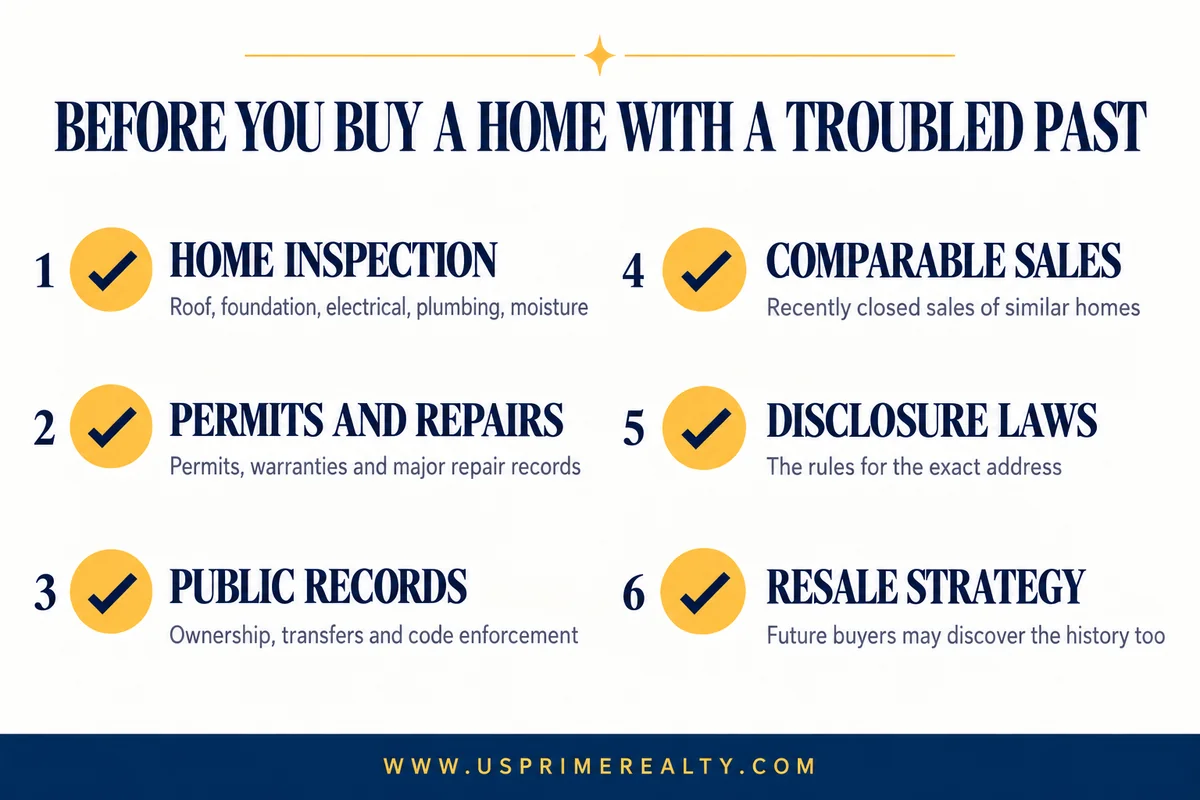
Before deciding whether a spooky reputation is a dealbreaker, investigate the same fundamentals you would for any other home. An unfamiliar noise may be an aging HVAC system. A damp smell may indicate moisture. Those deserve professional attention whether or not the house has a legend attached.
Review the Home Inspection and Repair History
Hire a qualified inspector and review the roof, foundation, electrical system, plumbing, moisture intrusion and signs of deferred maintenance. Request permits, warranties and records of major repairs where available. For older homes, ask whether specialized assessments are warranted. A story should never distract you from an actual safety or repair issue.
Research Public Records and Property History
Look up ownership and transfer records, municipal permits, local code enforcement records and reputable historical archives. Verify any significant claim through primary records when possible. Keep in mind that public information may be incomplete, and third-party websites can repeat errors.
Compare the Asking Price With Similar Homes
Review recently closed sales of comparable homes with similar size, condition, location and features. Account for renovation needs, days on market and current competition. If you want to negotiate over a property’s reputation, explain how it affects demand rather than assuming a fixed markdown.
Work With a Knowledgeable Real Estate Agent
A local agent can help put the asking price in context, coordinate due diligence and negotiate sensible contingencies. If you are considering a Florida property, connect with a U.S. Prime Realty agent who knows the surrounding market.
Could a Haunted House Be a Smart Real Estate Investment?
Possibly. A house that attracts fewer bidders can offer negotiating room, but a lower purchase price is not the same as a good investment. Repairs, insurance, carrying costs and future buyer demand still determine the outcome. A property may be an appealing long-term home for one owner and a difficult short-term flip for another.
Potential Savings Versus Long-Term Resale Risks
A motivated seller may accept favorable terms when a listing has lingered. Yet a buyer who benefits from a discount today might encounter the same objections at resale. If the history is widely publicized and easy to find online, assume future buyers may discover it too.
What Investors Should Consider Before Making an Offer
Estimate renovation costs with contingencies, analyze realistic comparable sales and test conservative exit scenarios. For financing questions, review U.S. Prime Realty’s financing resources and seek lender guidance. Investors can also explore the real estate investor FAQ before evaluating risk and potential returns.
Would You Buy a Haunted House? The Final Verdict
A house with a haunting story may be worth less to one buyer and just as much to another. Reputation can affect interest, offers and time on the market, but it should never replace the basics: location, structural condition, price, financing and the strength of nearby sales.
If you love the home, investigate the facts, understand your legal rights and think about how easy—or difficult—it could be to sell later. A good purchase is one you can live with both emotionally and financially.
Thinking about buying, selling or investing in Florida? Talk to U.S. Prime Realty at 239-513-0011 or cc@usprimerealty.com.
Now your turn: if everything else about the house were perfect, would its spooky reputation stop you from buying it?
Frequently Asked Questions About Haunted Houses and Real Estate
Does a haunted house have a lower resale value?+
Does a haunted house have a lower resale value?
Not necessarily. A reputation can reduce the buyer pool or increase marketing time, but there is no universal discount. Local comparable sales and actual demand matter more than a fixed percentage.
Is a seller required to disclose a death in a house?+
Is a seller required to disclose a death in a house?
It depends on state law and the circumstances. Florida generally does not require disclosure of a death under § 689.25. California has a different time-based provision. Get current advice for the state where the home is located.
Can you legally sell a house that is believed to be haunted?+
Can you legally sell a house that is believed to be haunted?
Yes. A home’s alleged haunted reputation does not, by itself, prevent a sale. Sellers still must comply with applicable disclosure, contract and property-condition requirements.
Should you buy a house with a bad reputation?+
Should you buy a house with a bad reputation?
Consider whether you feel comfortable there, what the inspection reveals, how its price compares with similar homes and whether the history may complicate resale.
Does a home’s history affect its market value?+
Does a home’s history affect its market value?
It can. Publicized events and neighborhood perceptions may influence buyer demand and negotiation behavior even when the building itself has not changed.
How do I find out what happened in a house before buying?+
How do I find out what happened in a house before buying?
Start with seller questions, local property and permit records, reliable news archives and a title professional where appropriate. Confirm claims rather than relying solely on neighborhood rumors.
Can I negotiate the price of a stigmatized property?+
Can I negotiate the price of a stigmatized property?
Yes. Use comparable sales, condition reports and evidence of buyer demand to support an offer. A reputation alone does not establish a particular discount.
Does a home inspection reveal if a house is haunted?+
Does a home inspection reveal if a house is haunted?
No. Inspectors evaluate observable physical conditions within the scope of their inspections; they do not test supernatural claims.
Are haunted houses harder to finance or insure?+
Are haunted houses harder to finance or insure?
An alleged haunting alone is not a standard underwriting category. Lenders and insurers focus on the property and borrower, but documented physical damage, vacancy, unusual uses or valuation issues may affect approval or cost.
Important information: This article is educational, not legal, appraisal, lending or investment advice. Disclosure laws, market conditions and property facts vary. Consult appropriately licensed local professionals before making a decision.
Share This
About The Author

Isbely Glazer - Founder and Broker of U.S. Prime Realty
Isbely brings over 20 years of experience across Florida’s key markets. She leads with a client-first approach, combining deep market insight with a commitment to trust, results, and long-term relationships.
Business Info


Recent Posts

What Does a Real Estate Agent Actually Do for Homebuyers?
What does a real estate agent do for homebuyers in Florida? Learn how agents help with home searches, offers, inspections and closing.
What Is Florida Amendment 3, and How Could It Affect Property Taxes and Homeowners?
What is Florida Amendment 3? Explore proposed 2027–2028 homestead exemptions, property tax caps, homeowner impacts and the November 2026 vote.
Renting vs. Buying a Home in Florida in 2026: Costs, Benefits, and What to Know
Renting vs. buying a home in Florida in 2026? Compare rent, mortgage costs, insurance, taxes, down payments and which choice may fit your plans.