Florida Homeowners: Do You Need a Building Permit for Projects Under $7,500?
Permits & renovations · Florida homeowners
A Florida building permit under $7,500 is no longer automatically required for every small home project. Effective July 1, 2026, Florida law created a limited permit exemption for qualifying work on certain single-family properties. But the rule is narrower than the headline may sound.
Under Florida Statute 553.79(1)(g), a local government that issues building permits must exempt an owner of a single-family dwelling, or the owner’s contractor, from obtaining a building permit for work valued at less than $7,500 when every statutory condition is met. The law was enacted through CS/CS/HB 803, Chapter 2026-63, with an effective date of July 1, 2026.
The key point for Florida homeowners is that this is a permit exemption, not a blanket “under $7,500 means no permit” rule. Flood-hazard properties are excluded, electrical and several other trade categories are excluded, and the owner or contractor still has to submit a written exemption request with documentation showing the nature and value of the work.
For buyers and sellers, permit history can also become part of property due diligence. U.S. Prime Realty’s Florida homebuying guide explains how inspections, insurance and other ownership considerations fit into the purchase process.
Quick answer: You may not need a Florida building permit for a project valued at less than $7,500 if it is on property containing a single-family dwelling, the property is not partially or entirely in a flood hazard area, the project includes no electrical, plumbing, structural, mechanical or gas work, and you submit the required written exemption request with supporting documentation. You cannot divide a larger project into smaller pieces to qualify.
What is in this guide
- What changed in Florida’s building permit law in 2026
- When can a homeowner skip a permit under $7,500?
- What projects under $7,500 still require a permit
- What types of small projects may qualify
- The written request for exemption: what to prepare
- A permit exemption is not a code exemption
- Buying or selling? Permit history still matters
- The $7,500 permit exemption checklist
- Frequently asked questions
What Changed in Florida’s Building Permit Law in 2026?
Florida’s general rule still says that construction, alteration, modification, repair or demolition of a building requires a permit unless another law provides an exception. The 2026 change added a specific exemption in Section 553.79(1)(g) for certain low-value work on single-family residential property.
The Florida Senate bill page for HB 803 lists July 1, 2026 as the effective date, and the final 2026 statute now contains the exemption. The Florida Senate’s 2026 bill summary describes the change as requiring local governments, except in flood hazard areas, to exempt work on single-family residential property valued below the threshold while excluding electrical, plumbing, structural, mechanical and gas work.
That means the question is not simply, “Is my project cheap enough?” The better question is, “Does my property and the full scope of my project satisfy every condition in the exemption?”
When Can a Florida Homeowner Skip a Building Permit Under $7,500?
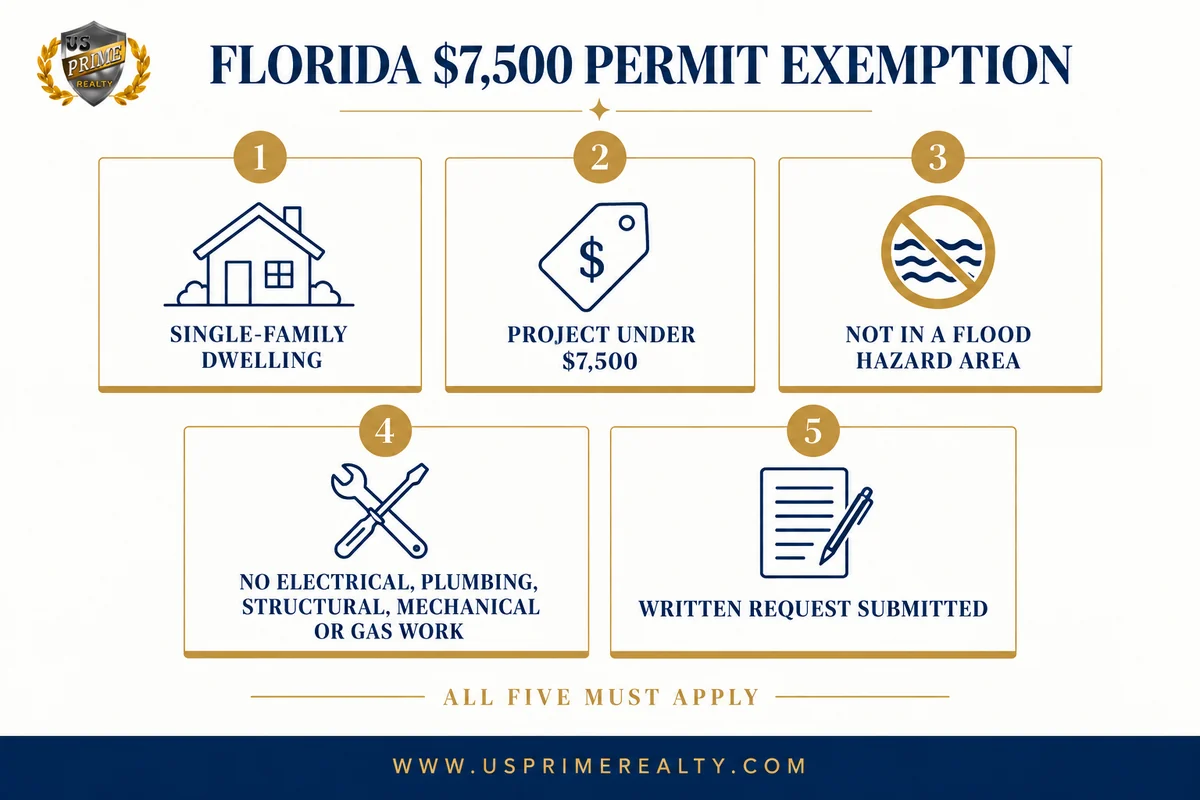
1. The Property Must Contain a Single-Family Dwelling
The exemption is written for an owner of a single-family dwelling or the owner’s contractor. It should not be assumed to cover every residential property type. Condominium work, multifamily property work, commercial projects and other property classifications are not included in this specific single-family exemption.
If you are buying a Florida home and comparing property types, U.S. Prime Realty’s Florida communities guide can help you explore major markets, but the local building department should confirm how a specific property is classified for permitting.
2. The Full Project Value Must Be Less Than $7,500
The statutory wording is “less than $7,500.” In practical terms, a project valued at exactly $7,500 does not meet the literal threshold. More importantly, the law prohibits dividing one construction project into multiple smaller projects just to avoid permit requirements.
Treat the entire scope of work as one project when determining value. Keep the estimate, contract, invoice or other documentation that shows what work is being performed and the project value, because that documentation is part of the exemption request.
3. The Property Cannot Be in a Flood Hazard Area
The exemption does not apply if the property is partially or entirely located in a flood hazard area as defined by the Florida Building Code. This matters across Florida, especially in coastal, waterfront and low-lying communities.
Homeowners can start by reviewing the FEMA Flood Map Service Center, the official public source for FEMA flood hazard information, then confirm the regulatory flood-hazard status with the local building or floodplain office. For storm-readiness context, U.S. Prime Realty’s Florida hurricane season guide also explains why flood exposure and property condition should be part of homeownership planning.
4. The Project Cannot Include Electrical, Plumbing, Structural, Mechanical or Gas Work
Even when the project costs only a few hundred or a few thousand dollars, the $7,500 exemption does not apply to electrical, plumbing, structural, mechanical or gas work. These categories remain outside the exemption.
- Electrical work, including changes to wiring, circuits, panels or similar systems.
- Plumbing work that changes piping, drains, supply lines or other plumbing systems.
- Structural work that affects load-bearing or other structural components.
- Mechanical work, including work that falls within regulated HVAC or mechanical systems.
- Gas work involving gas piping, appliances or regulated gas systems.
If a mostly cosmetic renovation also includes one of these excluded scopes, do not assume the cosmetic portion makes the overall job exempt. Ask the local enforcing agency how it will treat the full project.
5. You Must Submit a Written Exemption Request
This is the requirement homeowners are most likely to miss. To qualify, the owner or the owner’s contractor must submit a written request for exemption to the local enforcement agency. The request must include a copy of the contract or other documentation demonstrating the nature and value of the work.
In other words, “permit-exempt” does not mean “do nothing and start work.” Your city or county may have an exemption form, online record type or submission procedure. Check the building department’s current instructions before the project begins.
What Projects Under $7,500 Still Require a Permit?
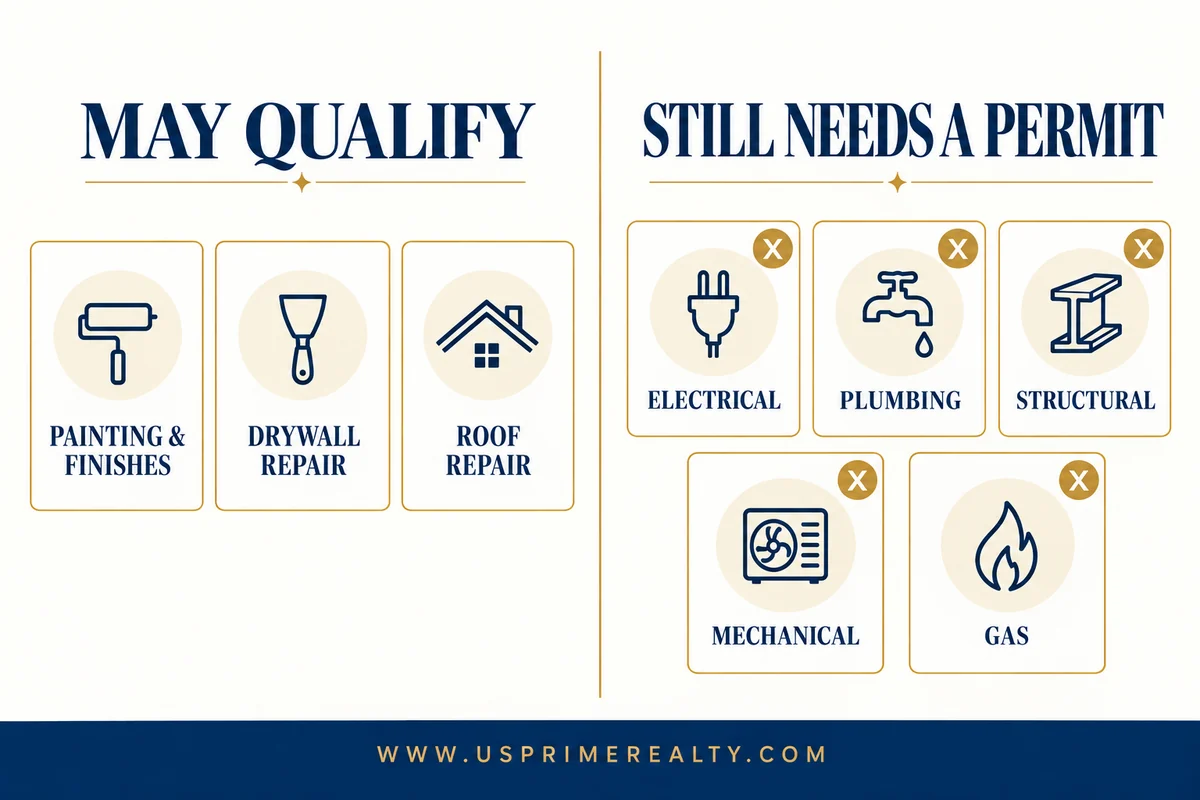
A low project price does not override the statutory exclusions. A Florida home improvement permit may still be required for work under $7,500 when any of the following is true:
- The property is partially or entirely in a flood hazard area.
- The work is electrical.
- The work is plumbing.
- The work is structural.
- The work is mechanical.
- The work is gas-related.
- The full project is actually $7,500 or more.
- The project has been split into smaller phases to try to fall below the threshold.
- The property or project does not otherwise fit the single-family dwelling exemption.
Also remember that a building-permit exemption does not automatically erase separate requirements such as zoning rules, setbacks, community-association approvals, contractor licensing, product-approval requirements or other laws that may apply to the work.
What Types of Small Projects May Qualify for the Exemption?
The statute creates the statewide framework, but local building departments still receive and review exemption requests. That makes local guidance important when a project’s classification is not obvious.
For example, Bay County’s Building Safety Division published an implementation memo explaining the new law. Its examples say drywall replacement and roof repairs are two types of work that could potentially qualify if all statutory conditions are met. The same memo says exterior window and door replacements do not qualify there because the county considers those components structural.
That local example is useful because it shows why homeowners should not build a project list from price alone. Painting, flooring, trim, cabinetry or other finish work may look non-structural, but the complete scope should still be presented to the local building department if you plan to rely on the exemption.
If you hire a contractor, verify the professional’s license through the Florida Department of Business and Professional Regulation before work begins.
Written Request for Exemption: What Should You Prepare?
Florida Statute 553.79 requires a written request plus a contract or other documentation showing the nature and value of the work. Your local agency may have its own form and submission method. A practical exemption packet may include:
- The property address and owner information.
- A clear written description of the full project scope.
- The contractor’s estimate or signed contract, or other documentation showing project value.
- Enough detail to show whether electrical, plumbing, structural, mechanical or gas work is involved.
- Any local exemption form or online application required by the city or county.
- Flood-hazard information or other supporting documents if requested by the local agency.
- A copy of the approved or acknowledged exemption record for your own property files.
Local procedures can vary. Florida law requires local enforcement agencies to post permit-processing procedures on their websites, so start with the building department for the jurisdiction where the property is located.
Important note: The law states that a local government has no legal duty to the owner, contractor, or successors or assigns for work performed under this exemption. Permit-exempt work should still be approached carefully, with qualified professionals and documentation appropriate to the project.
A Florida Building Permit Exemption Is Not the Same as a Code Exemption
Homeowners should separate two ideas: whether a permit is required, and whether the work is safe, lawful and appropriate for the property. The $7,500 provision addresses the building-permit requirement when the statutory conditions are satisfied. It should not be read as permission to ignore other applicable rules.
- Use qualified, properly licensed professionals when licensing is required.
- Follow applicable zoning, drainage, easement and setback rules.
- Do not make structural, electrical, plumbing, mechanical or gas changes under the small-project exemption.
- Keep contracts, receipts, photos and exemption records with the home’s permanent documents.
- If the scope changes after work begins, stop and confirm whether the exemption still applies.
For current Florida Building Code resources, homeowners and contractors can review the Florida Building Commission’s 2026 code resources and consult the local enforcing agency for project-specific requirements.
Buying or Selling a Florida Home? Permit History Still Matters
Even when work was legally permit-exempt, keeping a clear record can help later. Buyers, inspectors, insurers, appraisers and closing professionals may ask questions about renovations, roof work, additions, repairs or altered systems. Documentation can make it easier to explain what was done and why a permit was or was not required.
If you are shopping for a home, start with U.S. Prime Realty’s Florida property search and use the Florida homebuying guide to organize inspections, insurance questions and other due-diligence steps. Homeowners preparing to sell can also review U.S. Prime Realty’s real estate resources for additional planning tools.
Florida $7,500 Building Permit Exemption Checklist
| Question area | What to confirm | Why it matters |
|---|---|---|
| Project value | Less than $7,500 for the full project | If no, the exemption does not apply |
| Property type | Property contains a single-family dwelling | If no, do not rely on this exemption |
| Flood hazard | Property is not partially or entirely in a flood hazard area | If in a flood hazard area, exemption does not apply |
| Work type | No electrical, plumbing, structural, mechanical or gas work | Any excluded trade scope defeats this exemption |
| Project scope | One complete project, not divided into smaller jobs | Splitting a project to evade permitting is prohibited |
| Paperwork | Written exemption request plus contract or value/scope documentation | Submit to local enforcement agency before relying on exemption |
| Records | Keep exemption response, contract, invoices and photos | Useful for future property due diligence |
What U.S. Prime Realty and Isbely Glazer Can Help With
U.S. Prime Realty is a licensed Florida real estate brokerage, not a building department, contractor, engineer or law firm. Founder and Broker Carmen Isbely Glazer leads the brokerage with more than 20 years of experience across Florida markets. You can learn more about Isbely Glazer and U.S. Prime Realty on the company’s website.
The real estate team can help buyers and sellers evaluate property information, compare communities, coordinate showings and transactions, and identify questions that may need to be directed to the appropriate building official, contractor, inspector, insurer or attorney.
Your Next Step Before Starting a Project
Before starting work under the Florida building permit exemption, contact the city or county building department that has jurisdiction over the property. Ask whether the project qualifies under Section 553.79(1)(g), what exemption form or written request is required, and what documentation should be submitted.
Do this before demolition, ordering custom materials or scheduling work. A short confirmation from the appropriate local agency can prevent a much larger problem later. Thinking about buying, selling or relocating in Florida? Call or text +1 (239) 513-0011 or email cc@usprimerealty.com.
Frequently Asked Questions
Does every Florida home project under $7,500 qualify for the permit exemption?+
Does every Florida home project under $7,500 qualify for the permit exemption?
No. The exemption is limited to qualifying work on property containing a single-family dwelling. It does not apply in flood hazard areas or to electrical, plumbing, structural, mechanical or gas work, and a written exemption request with supporting documentation is required.
Is a $7,500 project exempt?+
Is a $7,500 project exempt?
The statute says work must be valued at less than $7,500. A project valued at exactly $7,500 does not meet the literal threshold.
Can I split a $12,000 renovation into two $6,000 projects?+
Can I split a $12,000 renovation into two $6,000 projects?
No. Florida Statute 553.79 states that a construction project may not be divided into more than one project for the purpose of evading the permit requirements.
Do I need a permit for electrical or plumbing work under $7,500 in Florida?+
Do I need a permit for electrical or plumbing work under $7,500 in Florida?
The small-project exemption does not apply to electrical or plumbing work. It also excludes structural, mechanical and gas work, regardless of the project’s low value.
Does the exemption apply if my home is in a flood zone?+
Does the exemption apply if my home is in a flood zone?
No. The exemption does not apply when the property is partially or entirely located in a flood hazard area as defined by the Florida Building Code. Confirm the property’s regulatory status with the local building or floodplain office.
Are exterior window and door replacements exempt under $7,500?+
Are exterior window and door replacements exempt under $7,500?
Do not assume they are exempt. Bay County’s 2026 implementation memo states that exterior windows and doors are considered structural there and do not qualify. Ask the local building department how it classifies your project.
Can a small roof repair qualify for the exemption?+
Can a small roof repair qualify for the exemption?
Possibly. Bay County lists roof repairs as one possible example of work that may qualify, but every statutory condition still has to be met, including the value, flood-hazard, work-type and written-request requirements.
What paperwork is required for the Florida building permit exemption?+
What paperwork is required for the Florida building permit exemption?
The owner or the owner’s contractor must submit a written request for exemption to the local enforcement agency with a copy of the contract or other documentation demonstrating the nature and value of the work.
Does this $7,500 exemption apply to condos?+
Does this $7,500 exemption apply to condos?
The specific exemption in Section 553.79(1)(g) is written for owners of single-family dwellings or their contractors. Condo owners should not rely on this provision and should check with the applicable building department and condominium association.
Does U.S. Prime Realty decide whether my project needs a building permit?+
Does U.S. Prime Realty decide whether my project needs a building permit?
No. U.S. Prime Realty is a Florida real estate brokerage. Permit eligibility should be confirmed with the local enforcing agency, and construction questions should be handled by the appropriate licensed professionals.
Important information note: Building-permit requirements, flood-hazard classifications, project scope, contractor licensing, zoning rules and local procedures can change or depend on the specific property. This article is general educational information and is not legal, engineering or construction advice. Confirm requirements with the local enforcing agency and qualified professionals before work begins.
Share This
About The Author

Isbely Glazer - Founder and Broker of U.S. Prime Realty
Isbely brings over 20 years of experience across Florida’s key markets. She leads with a client-first approach, combining deep market insight with a commitment to trust, results, and long-term relationships.
Business Info


Recent Posts

Pre-Construction Properties in Florida: Discover New Homes for Sale Across the State
Discover pre-construction properties in Florida, from Miami and Sunny Isles condos to Naples, Cape Coral and Orlando new homes. Explore options with U.S. Prime Realty.
New Construction vs. Pre-Construction Homes in Florida: Which Is Right for You?
New construction vs. pre-construction homes in Florida: compare costs, timelines, deposits, builder incentives and risks before you buy.
Florida Flood Zones: What Homebuyers Need to Know Before Buying a Home
Buying a home in Florida? Learn how FEMA Florida flood zones, flood insurance, elevation, seller disclosures and Citizens requirements can affect your costs and risk.