Renting vs. Buying a Home in Florida in 2026: Costs, Benefits, and What to Know
Renting vs buying a home in Florida in 2026
The rent is due. Again. And if you have spent the past few months browsing Florida homes for sale, you may have asked yourself a familiar question: would buying actually cost less? The answer is not as simple as comparing your rent with a mortgage payment.
In 2026, location, interest rates, insurance, taxes and how long you plan to stay all change the math. A home that works as a long-term purchase in Cape Coral might be a stretch in Miami. A condo with a manageable asking price can still carry substantial association fees. And for someone who expects to relocate next year, renting may be the better financial choice—even if they could qualify for a loan.
If you are weighing your next move, start with U.S. Prime Realty’s Florida homebuying guide and compare homes and rental options only after setting a realistic total monthly budget.
Quick answer: Renting usually offers more flexibility and lower upfront costs. Buying can provide stability and an opportunity to build equity, but ownership adds taxes, insurance, maintenance and transaction costs. In Florida in 2026, the better choice depends on the specific property, loan terms, available savings and how long you expect to live there.
What is in this guide
- Renting vs. Buying a Home in Florida in 2026: The Market Snapshot
- What Does Renting a Home in Florida Really Cost?
- What Does Buying a Home in Florida Really Cost?
- Renting vs. Buying in Florida: Side-by-Side Comparison
- Florida Example: A $400,000 Home vs. a $2,500 Monthly Rental
- Five Florida-Specific Costs Buyers Should Check Before Making an Offer
- When Renting Makes More Sense in Florida
- When Buying Makes More Sense in Florida
- Buying in Miami, Naples, Cape Coral or Orlando: Why Location Changes the Math
- First-Time Florida Buyers: Do You Really Need 20% Down?
- A Simple Checklist Before You Decide to Rent or Buy
- So, Should You Rent or Buy a Home in Florida in 2026?
- Frequently Asked Questions About Renting vs. Buying in Florida
Renting vs. Buying a Home in Florida in 2026: The Market Snapshot
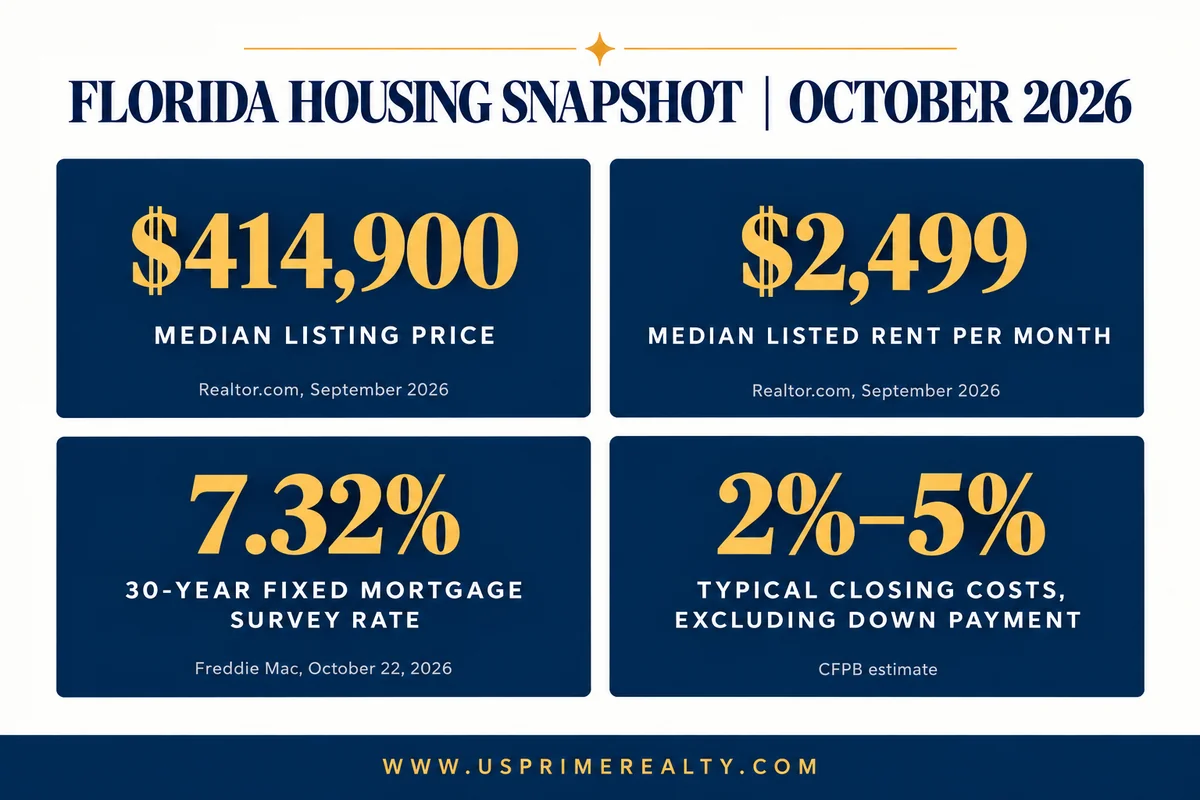
Florida is not one housing market. For a useful statewide starting point, Realtor.com’s September 2026 market view reported a $414,900 median home listing price and a $2,499 median advertised rent. Zillow’s Florida rental tracker, updated October 19, reported an average asking rent of about $2,300 across property types. These measures use different methods and rental listings, so they should not be treated as interchangeable.
Financing has also become a bigger part of the decision. Freddie Mac reported a national average 30-year fixed mortgage rate of 7.32% on October 22, 2026 for its standard surveyed loan profile. Your actual rate depends on your credit, loan type, down payment, points and lender.
| 2026 indicator | Reported figure | Why it matters |
|---|---|---|
| Florida median listing price | $414,900 | A statewide asking-price benchmark, not a typical closing price. |
| Florida median listed rent | $2,499 / month | Realtor.com statewide September 2026 measure. |
| Florida average asking rent | $2,300 / month | Zillow, updated October 19; different sample/method. |
| 30-year fixed-rate average | 7.32% | Freddie Mac national survey, October 22, 2026. |
| Buyer closing costs | Often 2%–5% | CFPB rough estimate, excluding down payment. |
Sources: Realtor.com Florida housing trends; Zillow Florida rental market; Freddie Mac mortgage-rate archive; Consumer Financial Protection Bureau closing-cost guidance.
What Does Renting a Home in Florida Really Cost?
When you rent, the headline amount is usually easier to understand: a monthly payment for the right to live in the home. But that number is not the whole story. Many Florida renters also budget for a security deposit, application fees, utilities, parking, pet fees, potential rent increases and renters insurance. The lease determines who handles landscaping, pest control, air-conditioning repairs and other upkeep.
The benefits of renting in Florida
- Flexibility. If your job, family or preferred neighborhood changes, a lease can be easier to leave than a house you need to sell.
- Less responsibility for major repairs. Your landlord is generally responsible for many property maintenance obligations, subject to the lease and applicable law.
- Lower initial cash commitment in many cases. You may avoid a home down payment, lender fees and title-related closing costs.
- Time to learn a city. Renting in Miami, Naples, Orlando or Cape Coral first can help you see whether the location fits your daily life.
The tradeoffs renters should consider
Your rent can change at renewal, the owner may decide to sell or not renew, and you typically cannot make major changes to the property. Rent payments do not create home equity for the tenant. Still, renters can build wealth in other ways by saving and investing the money they are not tying up in a property.
For options that start with a rental rather than a purchase, explore U.S. Prime Realty’s South Florida rental and homeownership resource.
What Does Buying a Home in Florida Really Cost?
Buying gives you greater control over a property, but it is rarely a matter of exchanging rent for an equal mortgage payment. The real monthly cost begins with principal and interest and expands to property taxes, homeowners insurance, flood coverage when needed, HOA or condo fees, mortgage insurance when required, and a reserve for repairs.
The upfront costs of buying
- Down payment. The amount depends on loan eligibility and product; 20% is not universally required.
- Closing costs. The CFPB suggests planning roughly 2%–5% of the purchase price, separate from the down payment.
- Inspections and appraisal. Costs vary with location, property size and lender requirements.
- Cash reserves. Keep money available for moving, repairs, an insurance deductible and emergencies after closing.
Why a fixed mortgage does not mean fixed housing expenses
With a fixed-rate mortgage, principal and interest are generally predictable for the loan term. Property taxes, insurance premiums, association dues and upkeep are not. Florida owners should pay particular attention to roof condition, storm coverage, flood exposure and the deductible they could owe after a covered claim.
The Florida Department of Financial Services recommends comparing insurance policies on the same coverage terms. Review its homeowners insurance shopping guide before deciding that a lower quote is the better deal.
Renting vs. Buying in Florida: Side-by-Side Comparison
| Factor | Renting | Buying |
|---|---|---|
| Upfront cash | Deposit, rent and possible fees | Down payment, closing costs and reserves |
| Monthly cost | Rent, utilities and applicable fees | Mortgage, taxes, insurance, HOA and maintenance |
| Mobility | Usually easier after lease ends | Sale and closing process may be costly |
| Maintenance | Landlord typically handles major repairs | Owner responsible, except covered association items |
| Payment stability | May change at lease renewal | Fixed loan P&I stable; other costs can rise |
| Equity | No direct property ownership equity | Potential equity through loan repayment/value changes |
| Customization | Subject to lease and owner permission | More freedom subject to permits and HOA rules |
| Risk | Renewal and displacement risk | Market, repair, insurance and selling-cost risk |
Florida Example: A $400,000 Home vs. a $2,500 Monthly Rental
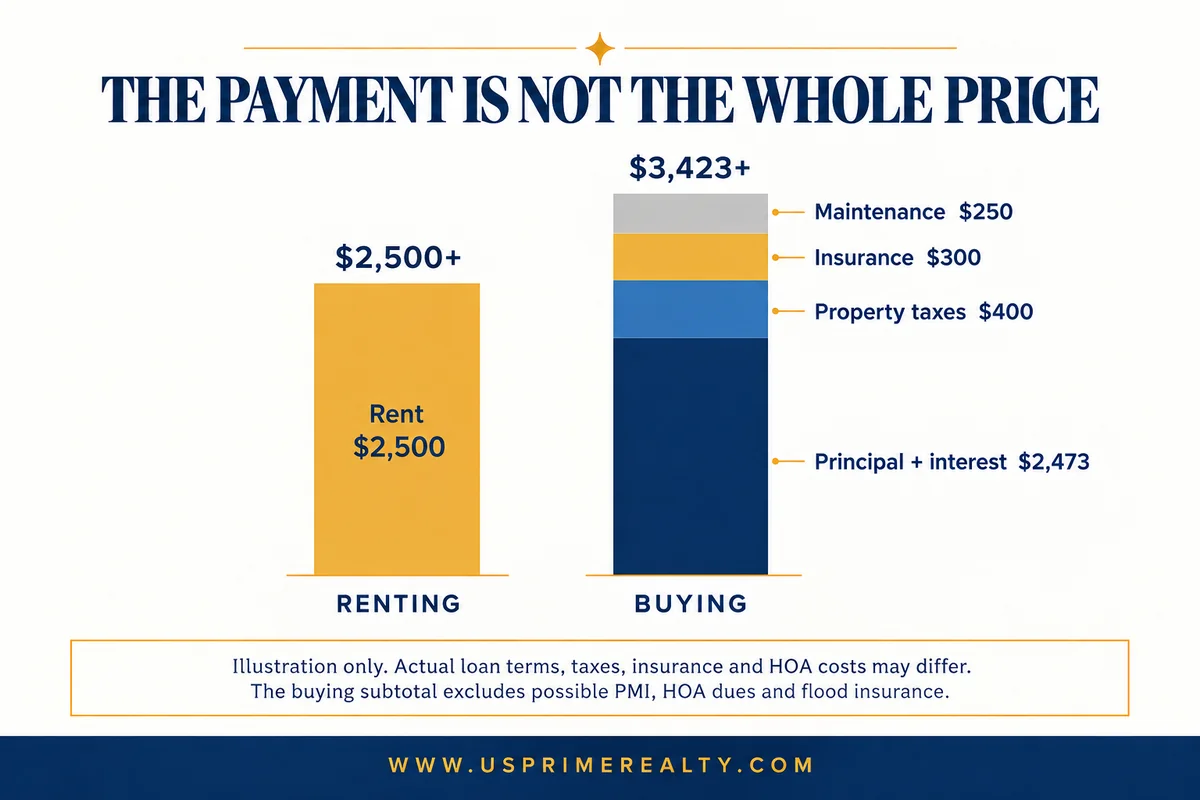
Here is a hypothetical calculation to show why mortgage-only comparisons are misleading. Assume a $400,000 purchase, 10% down, and a 30-year fixed loan at 7.32%. The loan balance would be $360,000. Principal and interest alone would be about $2,473 per month. This is an illustration using the October 22 national survey average—not a live loan quote.
| Illustrative monthly item | Buying | Renting |
|---|---|---|
| Principal + interest | $2,473 | — |
| Property tax assumption | $400 | — |
| Homeowners insurance assumption | $300 | — |
| Maintenance reserve assumption | $250 | — |
| Mortgage insurance / HOA | Not included; may apply | — |
| Rent | — | $2,500 |
| Illustrative subtotal | $3,423+ | $2,500+ |
| Upfront purchase funds | $40,000 down + $8,000–$20,000 illustrative closing cost range | Lease-specific move-in costs |
All tax, insurance and maintenance amounts above are made-up planning assumptions, not Florida averages or property quotes. The buying subtotal excludes utilities, flood insurance, HOA dues and mortgage insurance; the renter figure excludes utilities, deposits and applicable fees. Taxes must be estimated after purchase rather than copied from the current owner’s bill. A larger down payment or a different rate changes the result. Part of the mortgage payment also reduces principal over time, while buying and selling create transaction costs.
The point is not that renting always costs less. It is that a $2,500 rent payment and a roughly $2,500 mortgage payment do not represent equal housing budgets.
Five Florida-Specific Costs Buyers Should Check Before Making an Offer
1. Property taxes and homestead exemptions
A seller’s tax bill can be a poor estimate for a new owner. Purchase prices and reassessment rules matter. Florida’s homestead exemption and Save Our Homes assessment limitation may provide benefits for eligible primary residences; requirements apply, and future savings should not be assumed before the county property appraiser confirms them.
Review the Florida Department of Revenue’s property tax exemption guide and ask for a property-specific post-purchase tax estimate.
2. Windstorm and homeowners insurance
Insurance costs can make two homes with similar asking prices very different to own. Roof age, construction materials, hurricane protections, claims history, deductible and location affect coverage options and premiums. Get a written quote early and compare coverage rather than shopping only for the cheapest premium.
3. Flood zones and separate flood coverage
Many standard homeowners and renters policies do not cover flood damage. A property can face flood risk outside the highest-risk mapped areas. Review flood exposure, consider separate coverage and confirm lender requirements before closing.
Start with the National Flood Insurance Program’s coverage explanation.
4. HOA and condominium fees
Association fees can fund amenities, insurance and common-area maintenance, but they can also rise. Condos may have special assessments, reserve requirements and building-specific lending considerations. Review the association budget, insurance, reserves, recent meeting minutes and planned projects with appropriate professionals.
5. Repairs, renovations and storm preparation
A home may need roof work, an HVAC replacement, drainage improvements or storm shutters long before you expect it. Build a repair reserve that reflects the actual home’s age and condition—not a generic internet rule.
When Renting Makes More Sense in Florida
Renting may be the smarter option when you expect to move within a couple of years, are trying out a new community, need time to improve your credit, or would have to empty your emergency savings to buy. It can also make sense if the available homes carry insurance or association costs that are hard to predict.
There is no prize for buying before you are ready. A year of renting can give you time to check different neighborhoods, compare lenders, save cash and avoid a purchase that feels uncomfortable from day one.
When Buying Makes More Sense in Florida
Buying becomes more compelling when your income is dependable, your emergency fund can survive closing, you plan to remain in the area for several years, and the full ownership cost fits without squeezing out retirement savings or other priorities. Over time, paying down principal can help build equity, although home values can fall and equity is not guaranteed.
Ownership also offers practical benefits that do not show up in a spreadsheet: choosing your improvements, avoiding lease-renewal uncertainty and putting down roots. Those benefits are real—but they should be weighed against the cost of staying, repairing and eventually selling the home.
Buying in Miami, Naples, Cape Coral or Orlando: Why Location Changes the Math
The statewide median is useful context, not a shopping budget. South Florida coastal properties can require greater attention to flood, wind and condo costs. Inland neighborhoods may have different prices and commutes. A modest home with lower monthly costs but a lengthy drive may not be a bargain once you factor in time and transportation.
In September 2026, Realtor.com’s local market snapshot reported very different median rents: approximately $2,939 in Miami, $1,900 in Cape Coral, $2,000 in Fort Myers and $1,999 in Orlando. These are broad listing indicators, not rent quotes for equivalent homes. A useful comparison matches bedroom count, square footage, condition and location as closely as possible.
Browse Florida homes for sale and buyer tools or start with U.S. Prime Realty’s local expert team to compare actual properties instead of statewide averages.
First-Time Florida Buyers: Do You Really Need 20% Down?
Not necessarily. The appropriate down payment depends on the loan and your qualifications. Low-down-payment financing and assistance programs may help eligible households, but those programs have rules and may involve extra monthly costs or repayable assistance. Compare the entire loan estimate—including mortgage insurance, fees and payment—not just the required down payment.
Florida Housing’s Homebuyer Program works through participating lenders and sets rules for credit, income, purchase price, and homebuyer education. Program funding and offerings can change, so confirm current eligibility before planning around a particular benefit.
See the official Florida Housing homebuyer programs overview and the U.S. Prime Realty buying guide for a practical starting checklist.
A Simple Checklist Before You Decide to Rent or Buy
- Compare a rental and a for-sale home in the same neighborhood and with similar living space.
- Request lender loan estimates from more than one lender; compare rate, points, cash to close and monthly payment.
- Ask for actual insurance and flood quotes and a post-purchase property-tax projection.
- Review HOA or condo costs, reserves, and assessments if applicable.
- Keep savings after your move for emergencies, maintenance, and possible insurance deductibles.
- Estimate how long you will stay and what selling costs could mean if plans change.
- Choose based on your budget and plans—not pressure to buy or fear of missing out.
So, Should You Rent or Buy a Home in Florida in 2026?
If renting gives you breathing room, a shorter commute, and the ability to save, it can be a wise choice. If you have a stable financial cushion, expect to stay for the long run and find a home whose complete costs fit your life, buying may be worth the commitment. Either way, start with real numbers for the exact home—not an online promise that owning always beats renting.
U.S. Prime Realty has served Florida homebuyers and sellers since 2008. Our team can help you compare communities, explore available homes and discuss the practical steps of moving from renting to owning. We are a real estate brokerage, not a lender; mortgage eligibility and terms come from the lender.
Ready to weigh your options? Contact U.S. Prime Realty at 239-513-0011 or cc@usprimerealty.com.
Important information: This article is educational, not mortgage, financial, tax, legal or insurance advice. Rates, inventory, taxes, home values, rents, assistance programs and coverage terms change. Hypothetical scenarios are illustrative only. Obtain actual lender estimates, insurance quotes, county tax information and qualified professional advice for a specific property.
Frequently Asked Questions About Renting vs. Buying in Florida
Is it cheaper to rent or buy in Florida in 2026?+
Is it cheaper to rent or buy in Florida in 2026?
It depends on the location, property, loan, insurance and length of ownership. Renting can have a lower monthly and upfront cost, while buying can build equity over time. Compare full costs rather than rent and mortgage principal-and-interest alone.
What is the average rent in Florida in 2026?+
What is the average rent in Florida in 2026?
Zillow reported an average advertised Florida rent of approximately $2,300 on October 19, 2026. Realtor.com reported a different statewide median listed rent of about $2,499 in September. The methods and property samples differ.
How much down payment do I need to buy a house in Florida?+
How much down payment do I need to buy a house in Florida?
The required amount varies by loan program and borrower. Twenty percent is not always required, but lower down payments may involve mortgage insurance or other tradeoffs. Verify options with a participating lender.
What hidden costs come with buying a home in Florida?+
What hidden costs come with buying a home in Florida?
Property taxes, homeowners and flood insurance, association dues, maintenance, inspections, closing costs and major storm-related repairs can materially change affordability.
Does a fixed-rate mortgage mean my Florida housing payment cannot rise?+
Does a fixed-rate mortgage mean my Florida housing payment cannot rise?
No. The loan’s principal and interest are generally fixed, but property taxes, insurance, HOA dues and other ownership costs can rise.
Does renting in Florida mean I am wasting money?+
Does renting in Florida mean I am wasting money?
No. Rent pays for housing and flexibility without requiring you to bear all ownership risks. Renting can be appropriate when buying would strain your finances or you expect to move soon.
Is it smart to buy a Florida home if I might move in two years?+
Is it smart to buy a Florida home if I might move in two years?
Possibly, but short ownership periods can make closing and resale costs difficult to recover. Consider your likely holding period and get a property-specific analysis.
Can a first-time buyer get down payment assistance in Florida?+
Can a first-time buyer get down payment assistance in Florida?
Some eligible buyers can access assistance through Florida Housing or local programs, subject to income, credit, lender, education and funding rules. Check current requirements and whether assistance must be repaid.
Is flood insurance included in Florida homeowners insurance?+
Is flood insurance included in Florida homeowners insurance?
Usually not. Standard homeowners policies typically exclude flood damage; separate coverage may be necessary or required by a lender.
Where can I compare Florida homes and speak to an agent?+
Where can I compare Florida homes and speak to an agent?
U.S. Prime Realty offers Florida home search tools and a buyer guide. Visit usprimerealty.com/buy/ or contact the brokerage for a property-specific discussion.
Share This
About The Author

Isbely Glazer - Founder and Broker of U.S. Prime Realty
Isbely brings over 20 years of experience across Florida’s key markets. She leads with a client-first approach, combining deep market insight with a commitment to trust, results, and long-term relationships.
Business Info


Recent Posts

Florida Real Estate Investment Guide 2026: Top Cities for Property Investors
Florida real estate investment guide 2026: compare Miami, Orlando, Tampa, Cape Coral, Fort Myers, Naples and Jacksonville, plus rental costs and risks.
Moving to Florida in 2026: Why Homebuyers Continue to Choose the Sunshine State
Moving to Florida in 2026? Explore housing prices, taxes, lifestyle, top cities and hidden ownership costs before buying a Florida home.
What’s it really like to live in Orlando, Florida? The 2026 Guide
Moving to Orlando in 2026? Compare home prices, daily costs, neighborhoods, commutes, summer weather and the tradeoffs of living beyond the theme parks.