New Construction vs. Pre-Construction Homes in Florida: Which Is Right for You?
Florida buyer’s guide · New vs. pre-construction
A brand-new house sounds simple until you realize there are two very different ways to buy one. You can walk into a finished home, inspect it and prepare to move in. Or you can reserve a property that may still be a floor plan, a construction site or a rendering.
When you weigh new construction vs. pre-construction homes in Florida, both can be smart choices. The difference comes down to how soon you need the keys, how much uncertainty you can comfortably carry and what the builder is actually promising in writing. Here is how to compare the choices without getting distracted by the model home or the glossy brochure.
If you want to explore developments while reading, browse U.S. Prime Realty’s Florida pre-construction opportunities and its 2026 pre-construction buyer guide.
Quick answer: Choose completed new construction if you value a faster, more predictable move, the ability to inspect the actual property and clearer near-term financing. Consider pre-construction if you can wait, want earlier access to floor plans or finishes and are prepared to review deposit terms, project risk and schedule changes. Neither is automatically cheaper or a better investment.
What is in this guide
- The Difference Is Not Just the Construction Date
- New Construction vs. Pre-Construction Homes in Florida: At a Glance
- 1. Your Move-In Timeline Changes Everything
- 2. Compare the Total Price, Not the Starting Price
- 3. Builder Incentives Can Be Helpful—If You Read the Fine Print
- 4. Deposits and Contracts: Where the Biggest Differences Hide
- 5. Mortgage Planning: Today’s Approval May Not Cover a Future Closing
- 6. What You Can Inspect—and What You Cannot
- 7. Florida-Specific Costs Can Surprise Both Buyers
- Which Choice Works for Your Life?
- Before You Reserve or Sign: Your Florida Buyer Checklist
- How U.S. Prime Realty Can Help You Compare the Right Properties
- Final Takeaway
- Frequently Asked Questions
The Difference Is Not Just the Construction Date
In everyday Florida real estate language, “new construction” can mean anything from a finished, never-occupied home to a house that is still being built. For this comparison, new construction means a completed or nearly completed home with a reasonably clear closing timeline. Pre-construction means contracting to buy before the unit or house is finished, sometimes before construction starts at all.
That distinction matters most for condos, where the developer may sell from plans long before the building is ready. Among single-family new construction homes, Florida buyers may also see quick-move-in inventory, production homes bought during the build and custom construction. Each comes with different contract and financing details.
New Construction vs. Pre-Construction Homes in Florida: At a Glance
| Buyer question | Completed new construction | Pre-construction |
|---|---|---|
| When can I move? | Often sooner, subject to completion and closing | Usually later; delivery may shift |
| What am I buying? | An actual home you can typically tour | Plans, specifications and a future home |
| Choices and upgrades | Limited if construction is finished | Potentially more, subject to selection deadlines |
| Cash commitment | Earnest money plus closing funds | Possible staged deposits before closing |
| Biggest uncertainty | Punch-list items, final costs, neighborhood work | Completion, contract changes and financing at delivery |
| Negotiation opportunities | May include inventory discounts or closing credits | May include release-stage pricing or packages; no guarantee |
1. Your Move-In Timeline Changes Everything
If a lease ends in three months, a home that may be delivered next year probably is not your best first option. With move-in ready new homes, Florida buyers get a more defined target for movers, school schedules and the sale of an existing home. Still ask whether the certificate of occupancy has been issued and whether any final work remains.
Pre-construction is often a better fit for buyers with flexible housing arrangements. Estimated dates are not firm promises unless the contract says so. Ask what triggers a permissible extension, when the developer must provide notice and what remedies you have if completion is significantly delayed.
2. Compare the Total Price, Not the Starting Price
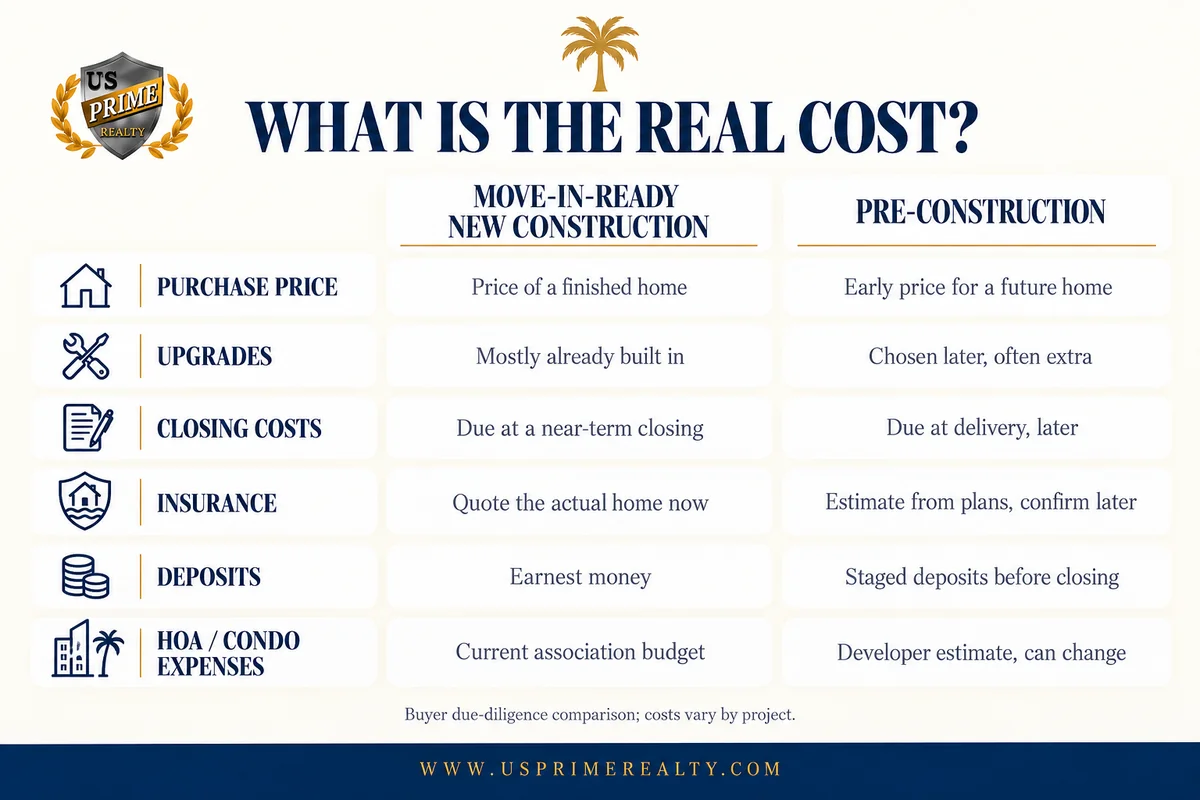
The price on a builder’s website is rarely the whole budget. On a completed home, compare the list price with included appliances, window treatments, landscaping, lot premiums, closing costs and any special assessment or HOA expenses. Inventory homes sometimes attract incentives, but those vary by community and month. For a local example, see the hidden costs of new construction homes in Cape Coral.
In pre-construction, an appealing initial price can change the conversation once you add floor-plan premiums, finish packages, parking or storage, closing charges and the cost of keeping a deposit committed for an extended period. And an early reservation does not guarantee appreciation by delivery.
3. Builder Incentives Can Be Helpful—If You Read the Fine Print
Florida new home builder incentives may include rate buydowns, design-center credits or help with closing costs. Ask whether the offer requires a preferred lender or title company, whether you give up another concession and whether it survives a delayed closing.
Compare written Loan Estimates rather than comparing only a promised monthly payment. The Consumer Financial Protection Bureau’s Loan Estimate guidance shows why rates, cash to close and lender fees deserve separate attention.
4. Deposits and Contracts: Where the Biggest Differences Hide
A completed new-build transaction may look closer to an ordinary purchase, although builders often use their own agreements. When buying pre-construction in Florida, the contract can involve more milestones, more money paid before you take possession and wider latitude for changes. Have a Florida real estate attorney explain the document before you sign.
Special Rules for Florida Pre-Construction Condos
For pre-construction condo deposits, Florida law contains specific protections and conditions that apply to developers. Section 718.202 addresses escrow of certain payments and circumstances in which amounts above the initial 10% may be used for construction if the statutory and contractual conditions are met. Do not assume every dollar will remain untouched in escrow.
Review the current Florida Statutes section 718.202 and the condo disclosures required under section 718.503. Rights and notice periods depend on the contract, document delivery and the applicable law. The rules for a detached house are not identical to condo rules.
Five Contract Questions to Ask
- Exactly who holds each deposit, and when can it be released?
- Can the developer change unit size, layout, materials or amenities?
- What happens if construction stops or the closing date moves?
- When do you lose the right to cancel, and what does default cost?
- Are promised parking, storage, finishes and incentives written into the agreement?
5. Mortgage Planning: Today’s Approval May Not Cover a Future Closing
For an already finished home, your lender can generally work toward a near-term closing. For a pre-construction purchase, a mortgage approval or quote obtained at reservation may not remain valid until delivery. Your income, credit, rates, appraisal and lender project requirements may be reviewed again.
Ask the lender how long a rate can be locked and what an extension costs. The CFPB’s rate-lock explanation is a useful starting point. If you are building a custom home rather than buying a developer-delivered property, a construction loan may work differently.
For more background on borrowing and buying, see U.S. Prime Realty’s financing resources and Florida homebuying guide.
6. What You Can Inspect—and What You Cannot
A finished home lets you check the actual light, room dimensions, finishes, drainage, parking and surroundings. Schedule an independent inspection even if the property is new. Review warranty documents and get unfinished punch-list items in writing.
For pre-construction homes, Florida buyers should treat renderings as a sales tool, not a substitute for signed plans and specifications. Visit the site, investigate the builder’s previous projects and ask how changes will be documented. Budget for an inspection when construction reaches an appropriate stage and again before closing, where the contract allows.
7. Florida-Specific Costs Can Surprise Both Buyers
New does not mean maintenance-free, storm-proof or cheap to insure. Get quotes for homeowners, wind and flood coverage using the actual address and available building details. Review roof and window specifications, storm-protection features, drainage and whether the lot is in a flood hazard area.
Start with the official FEMA Flood Map Service Center. For condominium purchases, review association budgets, estimated fees and what the master insurance policy covers. Early developer estimates can change as a community becomes fully operational.
Which Choice Works for Your Life?
Use this quick guide to match new construction vs. pre-construction homes in Florida to your situation.
| If this sounds like you… | Start with… | Why |
|---|---|---|
| You must relocate within months | Completed new construction | A clearer possession and closing schedule |
| You want to see the exact view and floor plan | Completed new construction | Less reliance on renderings |
| You can wait and value design selections | Pre-construction | Potential choices before selections close |
| You cannot tolerate tied-up cash or delays | Completed new construction | Often fewer long-range unknowns |
| You want a specific future condo development | Pre-construction | May offer earlier access to available units |
Before You Reserve or Sign: Your Florida Buyer Checklist
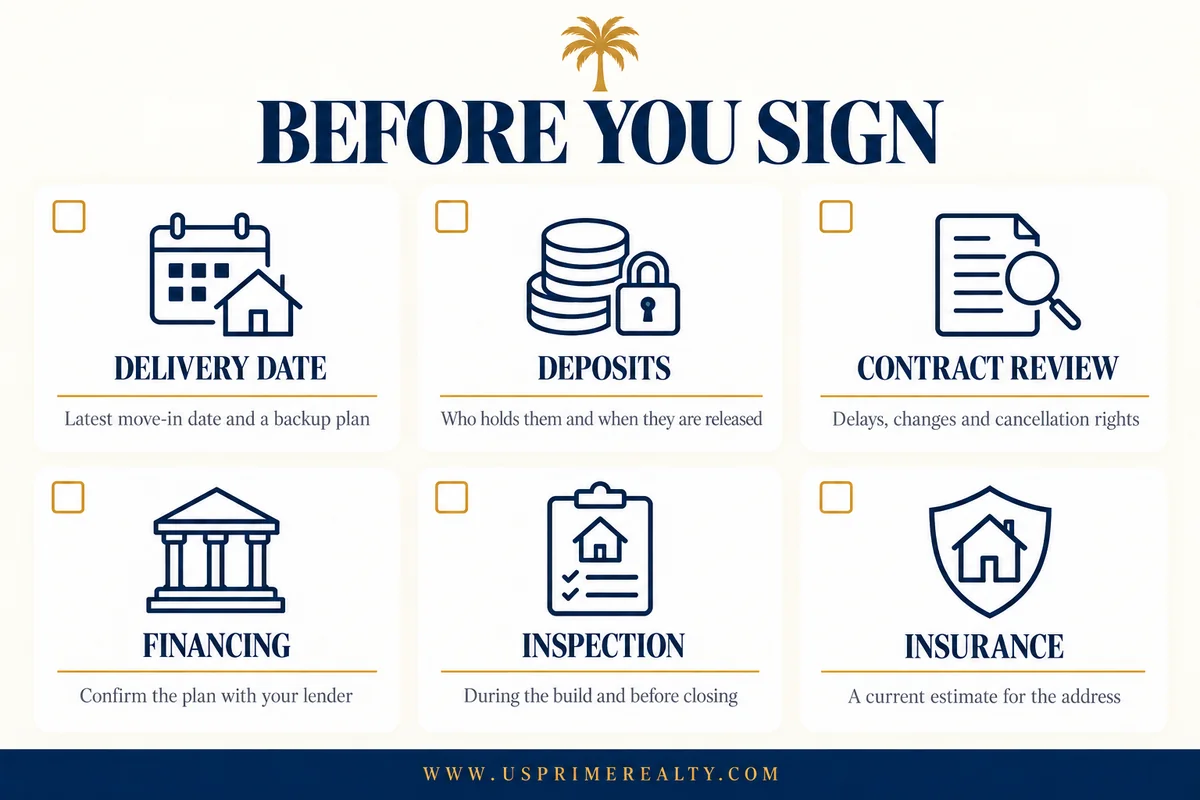
- Write down your latest acceptable move-in date and your backup housing plan.
- Compare the total cash needed now, during construction and at closing.
- Ask for a current insurance estimate and HOA/condo budget.
- Check the builder’s completed projects, permits and delivery record.
- Obtain every plan, finish schedule and incentive in writing.
- Review deposit custody, cancellation rights and delay provisions with a Florida attorney.
- Ask your lender to confirm the financing plan and future qualification risks.
- Budget for inspections, walk-throughs, warranty follow-up and move-in costs.
How U.S. Prime Realty Can Help You Compare the Right Properties
A finished new home in Cape Coral and a proposed condo in Miami can both be attractive, but they solve different problems. When you compare new construction vs. pre-construction homes in Florida, the better decision begins with your actual budget, the neighborhood you want, your timeline and what you need the home to do for you.
Use U.S. Prime Realty’s pre-construction listings and development resources to explore projects, and keep its Florida buyer guide handy when comparing homes that are ready now. A conversation about the contract and full cost is more useful than choosing based on a rendering alone.
Final Takeaway
Choose completed new construction if you want to make a decision about a home you can see and expect to occupy sooner. Choose pre-construction if the opportunity fits your plans and you are comfortable with the wait, deposits and contract uncertainties. The right answer is the one you can still feel good about if the timeline or cost changes.
Ready to compare Florida new homes and upcoming developments? Call U.S. Prime Realty at 239-513-0011 or email cc@usprimerealty.com. Buy. Sell. Invest.
Important information note: This article is educational, not legal, lending, insurance or investment advice. Builder offerings, project status, timelines, prices, mortgage terms, warranties and Florida requirements can change. Verify property-specific details with licensed professionals before signing.
Frequently Asked Questions
Is pre-construction cheaper than new construction in Florida?+
Is pre-construction cheaper than new construction in Florida?
Not necessarily. Early-stage pricing may be attractive, but upgrades, closing charges, waiting costs and market changes can alter the overall value. Compare written total-cost estimates.
Can I move into a new construction home right away?+
Can I move into a new construction home right away?
Sometimes. A completed inventory home may close sooner than one still awaiting final inspections or occupancy approvals. Confirm the actual delivery status.
Can a Florida builder delay a pre-construction closing?+
Can a Florida builder delay a pre-construction closing?
Construction contracts often address schedule extensions and delay events. Your rights depend on the agreement and applicable law, so have a Florida attorney review those clauses.
Are Florida pre-construction condo deposits protected?+
Are Florida pre-construction condo deposits protected?
Florida Statute 718.202 contains escrow rules for developer condominium deposits, including specified circumstances for use of certain funds. The exact treatment depends on the agreement and legal conditions.
Can I negotiate with a new construction builder?+
Can I negotiate with a new construction builder?
Often there is room to ask about inventory pricing, upgrades or closing-cost assistance, although no incentive is guaranteed. Compare concessions against the full purchase and loan costs.
Do I need a real estate agent to buy from a builder?+
Do I need a real estate agent to buy from a builder?
You can generally approach a builder directly, but independent representation may help you compare options, ask useful questions and coordinate due diligence. Clarify representation and compensation before visiting a sales office.
Is pre-construction a good investment in Florida?+
Is pre-construction a good investment in Florida?
It can suit some buyers, but appreciation is not guaranteed. Weigh developer risk, deposit liquidity, carrying costs, rental restrictions and the possibility of different market conditions at completion.
What is the biggest mistake buyers make?+
What is the biggest mistake buyers make?
Comparing the advertised purchase prices without comparing time to delivery, contract risk, upgrades, financing and monthly ownership expenses.
Share This
About The Author

Isbely Glazer - Founder and Broker of U.S. Prime Realty
Isbely brings over 20 years of experience across Florida’s key markets. She leads with a client-first approach, combining deep market insight with a commitment to trust, results, and long-term relationships.
Business Info


Recent Posts

Pre-Construction Properties in Florida: Discover New Homes for Sale Across the State
Discover pre-construction properties in Florida, from Miami and Sunny Isles condos to Naples, Cape Coral and Orlando new homes. Explore options with U.S. Prime Realty.
Florida Flood Zones: What Homebuyers Need to Know Before Buying a Home
Buying a home in Florida? Learn how FEMA Florida flood zones, flood insurance, elevation, seller disclosures and Citizens requirements can affect your costs and risk.
Pre-Construction Homes in Florida: The 2026 Buyer’s Guide
Buying pre-construction homes in Florida in 2026? Compare markets, deposits, contracts, financing, warranties, costs and red flags before you sign.