Pre-Construction Homes in Florida: The 2026 Buyer’s Guide
2026 buyer’s guide · Florida pre-construction
Buying pre-construction in Florida can give you something resale rarely offers: time. You may be able to choose a floor plan earlier, select finishes, spread deposits across milestones and buy into a community before it is complete. But the tradeoff is just as important: you are committing to a contract, a developer and a future delivery date before you can walk through the finished property. That is why the smartest question is not simply “Is pre-construction a good deal?” It is “Does this project, contract and timeline make sense for the way I plan to use the home?”
This 2026 guide updates U.S. Prime Realty’s existing pre-construction buyer content with current Florida construction data, current Florida condominium law and practical due-diligence steps. For live opportunities, start with U.S. Prime Realty’s Pre-Construction page and new-construction project portal, then compare the individual project documents before you reserve or sign.
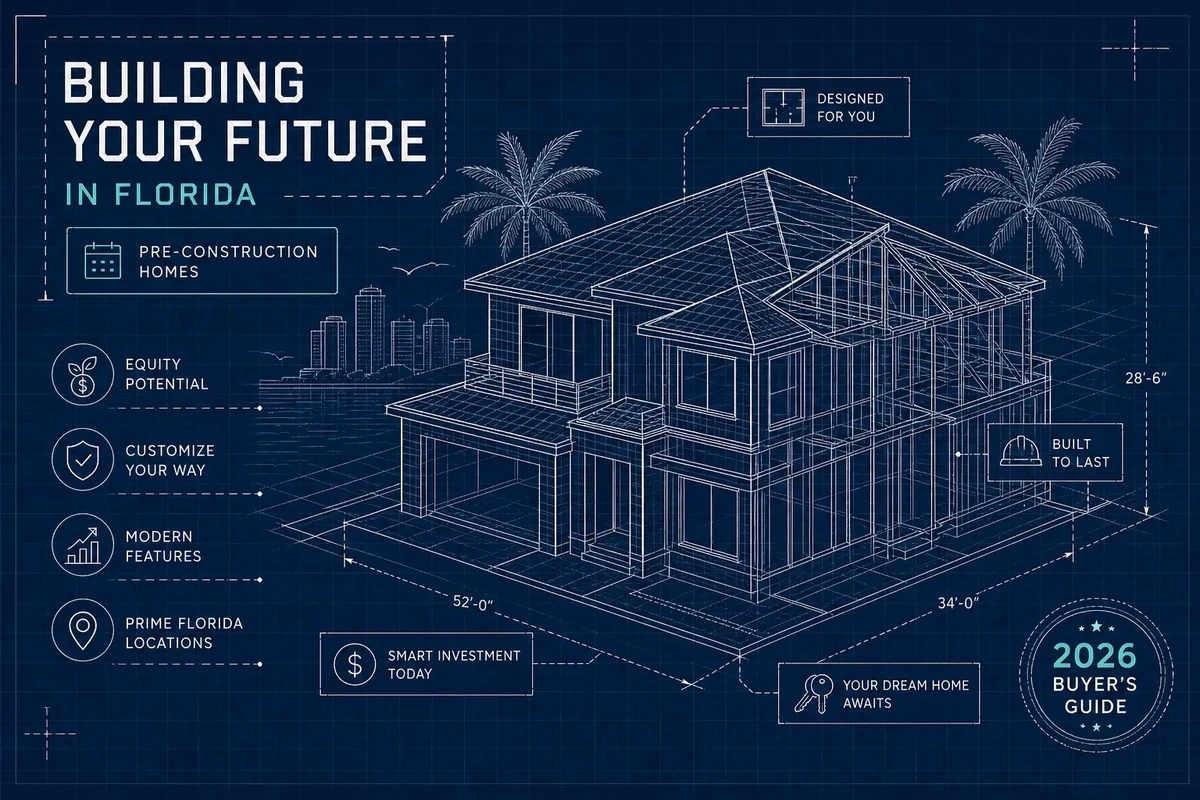
Quick answer: Florida is still building at scale in 2026, but buyers have more reason to be selective. Florida recorded 51,444 new-home permits through the second quarter, down 7% from a year earlier, while Census permit data showed 13,980 housing units authorized statewide in August 2026, including 9,697 one-unit homes. The market is active, not uniform: project quality, developer strength, insurance, financing and contract language matter more than a broad “Florida is growing” story.
What is in this guide
- Florida pre-construction market highlights for 2026
- Where pre-construction homes are most active
- What pre-construction actually costs
- Builder contracts, deposits and warranties
- Red flags in sales brochures
- The upgrade trap
- Financing pre-construction homes
- Your 2026 due-diligence checklist
- How to find the right agent
- Your next step
- Frequently asked questions
Florida Pre-Construction Market Highlights: What Changed in 2026
Florida’s construction pipeline is still large, but it is no longer a one-direction boom. Statewide permit activity cooled in the first half of 2026, even as some months and local markets remained resilient. For buyers, that is useful. A slower pipeline can create more room to compare incentives, deposit schedules and finished inventory instead of feeling pressured by every launch.
| 2026 signal | Latest figure | Change | What it means for a buyer |
|---|---|---|---|
| New residential permits through Q2 2026 | 51,444 | -7% vs. first half 2025 | Statewide construction cooled, but remains substantial. |
| All Florida housing units permitted – Aug. 2026 | 13,980 | +2.8% vs. Aug. 2025 | Monthly activity rebounded from a softer first half. |
| Florida 1-unit permits – Aug. 2026 | 9,697 | +7.8% vs. Aug. 2025 | Single-family permitting remained a major share of activity. |
| U.S. new-home supply – Aug. 2026 | 8.5 months | Flat vs. Aug. 2025 | National context suggests buyers have meaningful new-home choice. |
| U.S. median new-home sale price – Aug. 2026 | $393,700 | -5.8% YoY | National price pressure eased; Florida project pricing still varies widely. |
Sources: Florida Realtors / HBW mid-year construction update; U.S. Census Bureau Florida permit series via FRED; Florida single-family permit series; and U.S. Census Bureau August 2026 New Residential Sales.
Where Pre-Construction Homes in Florida Are Most Active
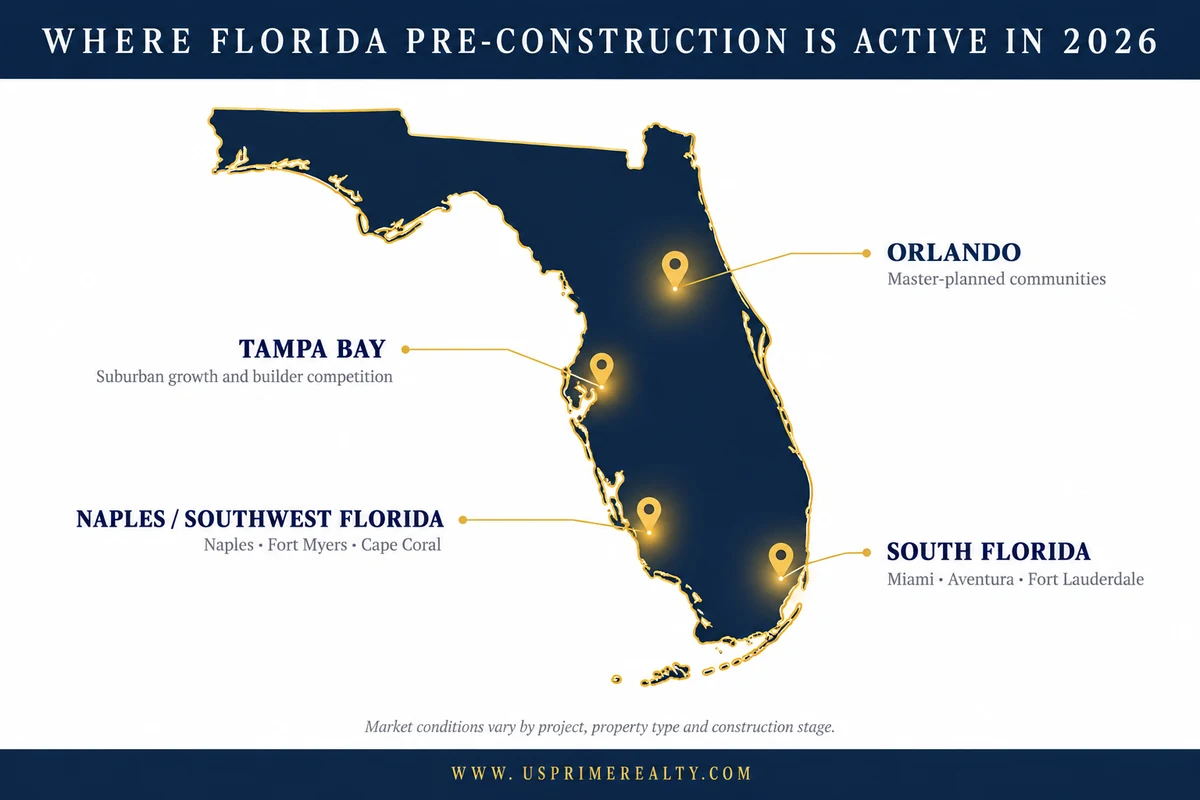
The original buyer guide focused on South Florida, Southwest Florida and Central Florida. That is still the right framework, but the buyer experience is different in each region. A Miami pre-construction condo is usually a different financial and contractual decision from a single-family home in a master-planned Orlando community or a new Gulf Coast residence in Naples.
South Florida: Miami, Aventura, Fort Lauderdale and the Coastal Corridor
South Florida remains the state’s most visible pre-construction condo market, especially for waterfront, branded and luxury product. Buyers should separate the marketing story from the ownership math: compare deposit timing, projected association costs, parking and storage, rental rules, flood and wind exposure, delivery timing, and the developer’s completed track record. U.S. Prime Realty’s Miami community page and Florida waterfront buyer guide are useful companion resources when water access or coastal exposure is part of the decision.
Southwest Florida: Naples, Fort Myers and Cape Coral
Southwest Florida’s new-build market is more single-family and lifestyle-driven. Buyers often compare gated communities, golf, marina access, waterfront lots and builder inventory rather than towers alone. In Naples, the base price is only the start: lot premiums, pools, outdoor kitchens, design-center upgrades, club fees, CDD or community charges where applicable, landscaping and insurance can materially change the all-in cost. Start with U.S. Prime Realty’s Naples community guide and compare completed homes with to-be-built options before deciding whether the wait is worth it.
Central Florida: Orlando and Master-Planned Communities
Orlando-area construction is often driven by master-planned communities, suburban growth and builder inventory. For buyers, the comparison is usually not “new versus old” in the abstract. It is one specific builder package versus another: base specification, lot position, incentives, school/commute fit, HOA or CDD costs, closing-cost credits and the price of upgrades. U.S. Prime Realty’s Orlando community page provides a local starting point.
Tampa Bay: Suburban Growth and Builder Competition
Tampa and its surrounding suburbs continue to attract new communities across a wide range of price points. Builder competition can create incentives, but buyers should compare the incentive to the price and financing package as a whole. A large closing-cost credit is not automatically the best offer if it is tied to a higher purchase price, a preferred lender or fewer upgrade choices. Review the Tampa community page alongside current project-specific pricing.
What Pre-Construction Actually Costs: From Reservation to Closing
Pre-construction buyers often focus on the advertised price and miss the timing of the cash. The right budget is a calendar, not just a number. Ask for a written deposit schedule, upgrade-payment schedule and estimated closing statement before you sign. Then stress-test the plan if delivery moves by six to twelve months.
| Cost stage | What may be due | What to verify before signing |
|---|---|---|
| Reservation / initial contract | Reservation fee or first deposit | Refundability, escrow holder, deadline to convert reservation to contract. |
| Contract / early milestones | Staged deposits; condo projects can require substantial total deposits | Exact dates or construction milestones, default terms, whether deposits may be used for construction. |
| Design / upgrades | Deposits or full payment for options and finishes | Refundability, change-order deadlines, substitution rights, whether upgrades appraise at closing. |
| Pre-closing | Lender approval, appraisal, insurance, final funds | Rate-lock timing, project approval, flood/wind coverage, final HOA budget and tax estimate. |
| Closing / move-in | Remaining purchase price plus closing costs and startup charges | Developer fees, title/recording, HOA or condo startup, parking/storage, utility or club charges. |
Buyer budgeting rule: keep a separate reserve for upgrades, insurance, taxes, association costs and rate changes. A project can stay on budget at the contract price and still become unaffordable at closing if those moving pieces are ignored.
How Florida Deposit Protection Works for Pre-Construction Condos
Florida condominium law treats buyer deposits differently depending on the amount and the contract. Under Florida Statutes 718.202, payments up to 10% of the sale price generally must be placed in escrow. Amounts above 10% are held in a special escrow account, but the contract may allow the developer to use excess deposits for actual construction and development costs after construction begins. If that use is permitted, the contract must carry a conspicuous warning. This is one reason buyers should not assume every deposited dollar is sitting untouched until closing.
The 15-Day Review Window for Developer Condo Contracts
For a residential condominium sold by a developer, Florida Statutes 718.503 requires specific disclosures and provides a 15-day voidability period tied to contract execution and receipt of required documents. The statute also addresses materially adverse amendments. This is a legal deadline, so buyers should use the period to have the full package reviewed by a Florida real estate attorney rather than treating it as a casual “cooling off” period.
Builder Contracts: What They Protect and What Buyers Should Read Closely
A builder or developer contract is not the same document as a standard resale purchase contract. It is written for a property that may not exist yet, so the agreement has to address design changes, timing, substitutions, deposits, financing, closing conditions and default before those events happen.
Contract Clauses That Deserve a Line-by-Line Review
- Completion and delay language: Is there an estimated date, an outside date, or only broad extension rights?
- Material-change rights: What can the developer alter in the unit, building, amenities, finishes or site plan?
- Substitution clauses: Can specified finishes or appliances be replaced with “comparable” alternatives, and who decides what is comparable?
- Assignment and resale restrictions: Can you transfer the contract before closing, and is there a fee or developer approval requirement?
- Financing contingency: Is your purchase contingent on obtaining a loan, or are you obligated to close even if financing changes?
- Default and liquidated damages: How much of your deposit can be retained if you cannot close?
- Closing costs and developer fees: Which costs that are commonly seller-paid in resale are shifted to the buyer?
- Post-closing warranty and punch-list process: Who receives notices, and what deadlines apply?
Florida Warranty Rules Buyers Should Know in 2026
Florida added a statutory warranty for certain newly constructed low-rise homes. Under Florida Statutes 553.837, a builder must generally warrant a newly constructed single-family home, duplex, triplex or quadruplex for one year against covered construction defects that result in a material Florida Building Code violation, subject to the statute’s terms and exclusions. Condominiums have a separate warranty framework under Florida Statutes 718.203. The practical point: ask exactly what warranty applies to your property type and obtain the written warranty before closing.
Red Flags in Sales Brochures and Project Presentations
Renderings are useful for understanding a concept, but they are not a substitute for the contract, disclosure package and recorded documents. The most expensive surprises usually come from assuming a sales image or verbal statement has the same legal weight as the signed agreement.
- A view, amenity or finish is shown prominently in marketing but is not described with similar specificity in the contract or disclosure documents.
- The phrase “comparable,” “similar,” “developer’s selection” or “subject to change” appears repeatedly without objective standards.
- A floor plan shows furniture layouts that make rooms appear larger than the actual dimensioned plan.
- Projected HOA or condo budgets look unusually low compared with staffing, insurance, reserve, amenity and service levels.
- The delivery date is emphasized in marketing, but the contract gives the developer broad extension rights.
- The sales pitch centers on appreciation or resale profit rather than the home’s actual use, cost and exit restrictions.
A brochure can help you imagine the finished property. The contract tells you what you are actually buying. When the two do not match, rely on the signed legal documents and qualified professional advice – not the rendering.
The Upgrade Trap: How Options Change the Real Cost of a New Home
The base price is often the cleanest number in the sales center and the least useful number for the final budget. Structural options, lot premiums, flooring, cabinetry, countertops, appliances, lighting, window treatments, pools and outdoor living can add quickly. Some upgrades must be paid before closing and some may not add dollar-for-dollar appraised value.
A Better Way to Compare Builder Packages
- Build a “move-in equivalent” price: base home + lot + structural options + design selections + closing costs + immediate post-closing work.
- Ask what is standard in the model home and what is an upgrade. Model merchandising can make optional items feel included.
- Compare the builder’s upgrade price with the cost and practicality of doing the work after closing.
- Prioritize structural or hard-to-change items first. Cosmetic changes are often easier to phase later.
- If financing, ask the lender how upgrades are treated for appraisal and loan-to-value purposes.
Financing Pre-Construction Homes in Florida
Financing a property that closes months or years in the future is different from financing a resale that closes next month. A pre-approval today does not guarantee a mortgage at delivery. Rates, underwriting rules, the buyer’s income, the project’s approval status and the appraised value can all change before closing.
The Questions to Ask Your Lender Early
- When will the lender underwrite me again before closing?
- Can the rate be locked far enough in advance, and what does an extended lock cost?
- If this is a condo, is the project eligible for the loan type I plan to use?
- How will builder credits or preferred-lender incentives affect the rate, APR and total cash to close?
- What happens if the appraisal is below the contract price plus upgrades?
- What cash reserves should I keep available if taxes, insurance or association costs rise before delivery?
U.S. Prime Realty’s Florida financing resource can help buyers organize lender questions, but loan approval, program eligibility and final terms are determined by the lender.
U.S. Prime Realty is a licensed Florida real estate brokerage (BK3153881), not a mortgage lender or an insurer. Any financing discussed in this guide is arranged through lender partners and is subject to lender approval; loan eligibility, rates and terms are determined by the lender. Insurance coverage and premiums should be confirmed with a licensed insurance professional.
International and Out-of-State Buyers: Add Time for Documents, Banking and Tax Planning
Pre-construction can work well for buyers who are not in Florida full time because the purchase unfolds over months or years. The challenge is coordination. International buyers should plan early for source-of-funds documentation, wire procedures, U.S. banking, entity or title structure, tax advice, currency movement and remote-signing logistics. Out-of-state buyers should also budget for insurance and property-tax differences rather than importing assumptions from their current state.
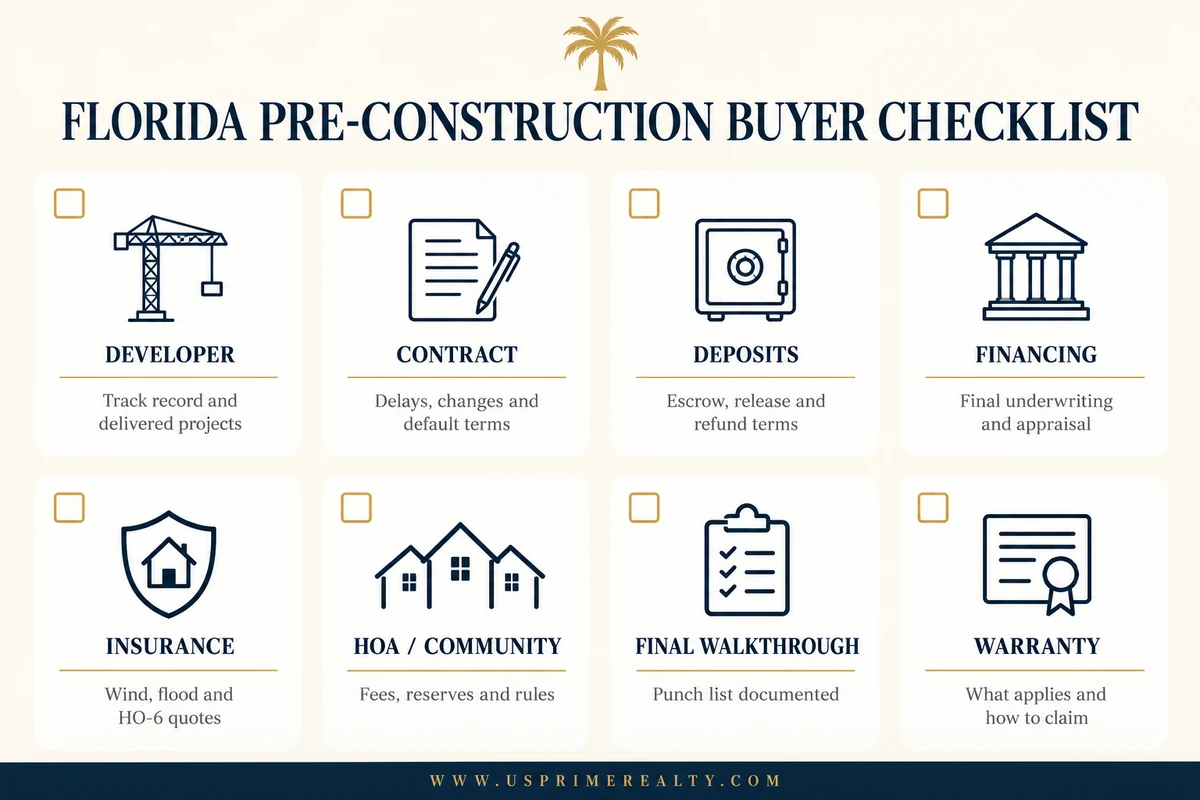
Your 2026 Pre-Construction Due-Diligence Checklist
| Before you commit | Questions to answer |
|---|---|
| Developer and project | What has this developer completed? Are prior projects delivered substantially as promised? Who owns the land? Is construction financing in place? |
| Contract | What are the cancellation, delay, change, assignment, default and closing-cost provisions? |
| Deposits | Where are funds held? When can funds be released? What portion is refundable and under what circumstances? |
| Property details | What is the exact unit, lot, exposure, parking, storage, appliance package, finish schedule and square-footage definition? |
| Association / community | What are projected fees, reserves, insurance, rental rules, pet rules, club or CDD charges, and future turnover provisions? |
| Insurance and flood | What wind, homeowners, HO-6 and flood coverage may be needed? What are current quotes for comparable completed properties? |
| Financing | When is final underwriting? Is the project lender-approved? What happens if rates or appraisal change? |
| Closing and warranty | What is the walkthrough process? How are punch-list items documented? What warranty applies and how are claims submitted? |
How to Find the Right Agent for a Pre-Construction Purchase
The best pre-construction representation is not about repeating the developer’s brochure. It is about helping you compare the project with competing developments, resale alternatives and your actual financial plan. A useful buyer’s agent should know when a question belongs with the developer, attorney, lender, inspector, insurance professional or tax advisor – and make sure the answer arrives before the deadline.
Questions to Ask an Agent Before You Register With a Builder
- Have you represented buyers in developer or builder contracts before?
- Can you compare this project with resale and other new-construction options in the same market?
- Will you review the deposit and milestone schedule with me before I sign?
- How will you track construction updates, document deadlines and the final walkthrough?
- Do you represent me rather than the builder, and how is your brokerage relationship disclosed?
- Can you coordinate with my attorney, lender, inspector and insurer without stepping outside your licensed role?
Why U.S. Prime Realty Is a Practical Starting Point
U.S. Prime Realty maintains dedicated resources for Florida pre-construction opportunities, new-construction projects, Florida property search, financing and major Florida communities including Miami, Naples, Orlando and Tampa. Buyers can use those pages to narrow the location and property type first, then request project-specific pricing, availability and documents.
Your Next Step Before Buying Pre-Construction in Florida
Start with the property you would still want to own if appreciation were slower than expected and delivery took longer than the sales presentation suggests. Then compare three numbers: the contract price, the realistic move-in cost and the monthly ownership cost after closing. If all three fit, move to the contract and due-diligence stage. If only the advertised price fits, keep looking.
Review current options through U.S. Prime Realty’s pre-construction page or new-construction project portal, then request a property-specific review before signing.
Contact U.S. Prime Realty: 239-513-0011 | cc@usprimerealty.com | Contact page.
Important information note: Pre-construction pricing, incentives, availability, deposit schedules, completion estimates, insurance, association fees, taxes, financing and developer terms can change without notice and vary by project. This article is general educational information and is not legal, tax, lending, insurance, engineering or investment advice. Have the actual contract and project documents reviewed by the appropriate licensed professionals before making a purchase decision.
Frequently Asked Questions
Is 2026 a good time to buy pre-construction in Florida?+
Is 2026 a good time to buy pre-construction in Florida?
There is no single statewide answer. Construction activity remains substantial, but the market is more selective than the post-pandemic boom. Buyers should compare the exact project, incentives, deposit schedule, financing, delivery timeline and resale alternatives rather than trying to time Florida as one market.
How much deposit do I need for a pre-construction condo in Florida?+
How much deposit do I need for a pre-construction condo in Florida?
The project controls the deposit schedule, and totals can be substantial. For Florida condominium developer sales, state law also governs how deposits are escrowed and when amounts above 10% may be used for construction. Read the project contract and Florida Statutes 718.202 before assuming all deposits remain untouched until closing.
Can I cancel a pre-construction condo contract in Florida?+
Can I cancel a pre-construction condo contract in Florida?
For a residential condominium sold by a developer, Florida Statutes 718.503 provides a 15-day voidability period tied to execution and receipt of required documents, plus protections for certain materially adverse amendments. Contract-specific rights can differ, so buyers should get legal advice immediately after receiving the package.
Are pre-construction homes always cheaper than resale homes?+
Are pre-construction homes always cheaper than resale homes?
No. Early pricing and incentives can be attractive, but upgrades, lot premiums, developer fees, HOA or community charges, insurance and financing can erase the apparent discount. Compare the move-in equivalent cost, not only the base price.
Can I finance a pre-construction home before it is finished?+
Can I finance a pre-construction home before it is finished?
You can prepare and sometimes obtain lender or builder-program approvals earlier, but the final mortgage usually depends on underwriting closer to completion. Rates, appraisal, borrower finances and project eligibility can change before closing.
Do new homes in Florida come with a warranty?+
Do new homes in Florida come with a warranty?
Warranty rules depend on property type and the written contract. Florida Statutes 553.837 generally provides a one-year statutory builder warranty for certain newly constructed single-family through four-family homes, while condominiums have a separate warranty framework under section 718.203.
What should I inspect on a brand-new home?+
What should I inspect on a brand-new home?
Treat “new” as untested, not automatically perfect. Use a qualified inspector when permitted, document punch-list items, test systems and finishes, confirm permits and certificates, and understand the warranty claim process before the closing deadline.
Where can I find current Florida pre-construction properties?+
Where can I find current Florida pre-construction properties?
U.S. Prime Realty maintains a dedicated pre-construction page and a separate new-construction project portal. Pricing and availability can change quickly, so confirm the current unit, floor plan, incentives and delivery estimate directly before relying on any marketing page.
Share This
About The Author

Isbely Glazer - Founder and Broker of U.S. Prime Realty
Isbely brings over 20 years of experience across Florida’s key markets. She leads with a client-first approach, combining deep market insight with a commitment to trust, results, and long-term relationships.
Business Info


Recent Posts

Pre-Construction Properties in Florida: Discover New Homes for Sale Across the State
Discover pre-construction properties in Florida, from Miami and Sunny Isles condos to Naples, Cape Coral and Orlando new homes. Explore options with U.S. Prime Realty.
New Construction vs. Pre-Construction Homes in Florida: Which Is Right for You?
New construction vs. pre-construction homes in Florida: compare costs, timelines, deposits, builder incentives and risks before you buy.
Florida Flood Zones: What Homebuyers Need to Know Before Buying a Home
Buying a home in Florida? Learn how FEMA Florida flood zones, flood insurance, elevation, seller disclosures and Citizens requirements can affect your costs and risk.