Florida Flood Zones: What Homebuyers Need to Know Before Buying a Home
2026 buyer’s guide · Florida flood zones
Florida sunshine, water views and year-round outdoor living are a big part of the appeal of buying a home here. But in Florida, flood risk deserves the same attention as the kitchen, roof, neighborhood and monthly payment. A property’s flood zone can affect insurance requirements, financing, renovation decisions and long-term ownership costs — and a low-risk map designation does not mean zero risk.
Before making an offer, check the official FEMA Flood Map Service Center, ask for property-specific insurance quotes, review elevation information and read the seller’s flood disclosure. If you are comparing waterfront property, U.S. Prime Realty’s Florida Waterfront Homes Buyer Guide is a useful companion resource.
Quick answer: A and V flood zones are FEMA’s high-risk Special Flood Hazard Areas. Zone X is lower or moderate risk, but flooding can still happen there. Flood insurance is generally separate from homeowners insurance, and federally backed mortgages in high-risk zones typically require it. In Florida, sellers must provide a flood disclosure at or before the sales contract is executed, and in 2026 many Citizens policyholders also face flood-insurance requirements even outside high-risk FEMA zones.
What is in this guide
- Florida Flood Risk: 2026 Buyer Highlights
- What Do FEMA Flood Zones Mean?
- Flood Insurance: What Florida Buyers Need to Know
- Florida’s Flood Disclosure Law for Home Sales
- Citizens Flood Insurance Requirements in 2026
- The Elevation Certificate and Base Flood Elevation
- A Florida Flood-Zone Due Diligence Checklist
- Waterfront Homes Need an Extra Layer of Review
- How Flood Risk Can Affect Your Offer
- Buying a Home in Florida: Put Flood Risk in the Budget Early
- Final Takeaway
- Frequently Asked Questions
Florida Flood Risk: 2026 Buyer Highlights
The most important flood numbers are not meant to scare buyers. They are meant to prevent expensive surprises during underwriting or after closing.
| Fact | What it means for a buyer |
|---|---|
| 1% annual chance | FEMA’s Special Flood Hazard Area (SFHA) is based on the flood with a 1% chance of occurring or being exceeded in any given year. |
| About 1 in 4 over 30 years | FEMA describes the long-term chance of flooding in high-risk areas as roughly one in four over a 30-year mortgage. |
| 1 in 3 claims outside high risk | FloodSmart says about one-third of flood insurance claims come from low- and moderate-risk zones. |
| Up to $25,000 from 1 inch | Florida’s Insurance Consumer Advocate notes that just one inch of water can cause up to $25,000 in damage. |
| Citizens: $400K threshold in 2026 | For many Citizens personal-lines policies with wind coverage outside the SFHA, flood coverage is required in 2026 when dwelling replacement cost is $400,000 or more. |
What Do FEMA Flood Zones Mean?
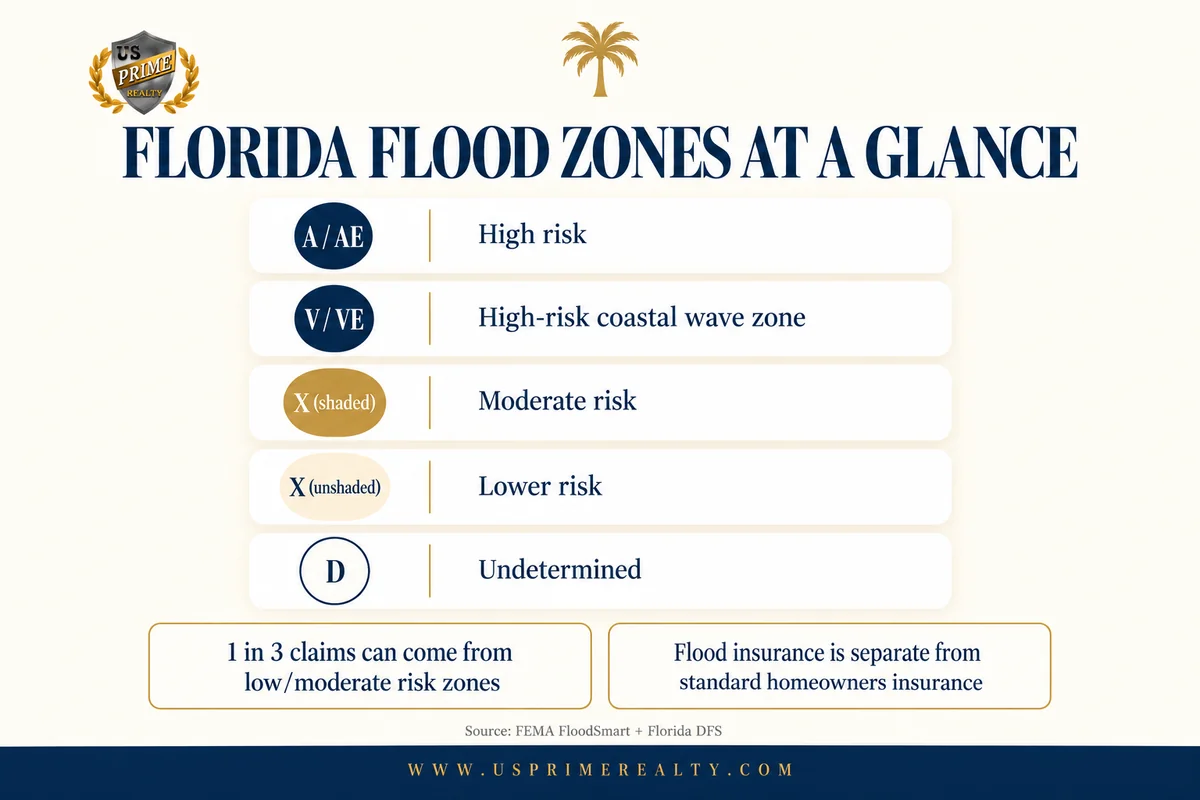
FEMA maps communities using Flood Insurance Rate Maps, usually called FIRMs. You can search an address through the FEMA Flood Map Service Center. The letter on the map is important, but it should be treated as a starting point rather than a complete property-risk report.
| Zone | General FEMA meaning | Buyer takeaway |
|---|---|---|
| A / AE | High-risk riverine or inland flood areas; AE includes a mapped Base Flood Elevation (BFE). | Expect closer lender and insurance review. Verify the structure’s elevation relative to the BFE. |
| AH / AO | High-risk shallow flooding or ponding areas, commonly around 1–3 feet. | Ask how water drains across the lot and where finished-floor elevation sits. |
| V / VE | High-risk coastal areas with added storm-wave or velocity hazards. | Pay special attention to elevation, foundation type, storm surge, breakaway enclosures and coastal construction. |
| X (shaded) | Moderate-risk area, often between the 1% and 0.2% annual-chance flood limits or protected by levees. | Flood insurance may not be federally required, but risk is still meaningful. |
| X (unshaded) / C | Lower-risk areas outside the mapped 0.2% annual-chance floodplain. | Lower risk is not no risk. Intense rainfall, drainage failures and changing conditions can still cause flooding. |
| D | Flood risk is possible but has not been fully determined. | Do not treat “undetermined” as “safe.” Get an insurance quote and inspect local drainage history. |
Why Zone X Does Not Mean “Flood-Proof”
One of the most common buyer mistakes is seeing “Zone X” and assuming flood insurance is unnecessary. FEMA’s own consumer guidance says every zone carries some flood risk and that roughly one-third of flood insurance claims come from low- and moderate-risk zones. In Florida, heavy rainfall, storm surge, overwhelmed drainage systems and water flowing from nearby streets or canals can create losses even outside a mapped high-risk area.
That is why the best question is not only “What is the flood zone?” but also “What is the property’s actual flood exposure?” Review the map, elevation, drainage, nearby water, prior flooding, insurance pricing and any available local records together. FEMA’s Flood Zones and Maps guide explains the major zone categories.
Flood Insurance: What Florida Buyers Need to Know
Flood damage is generally not covered by a standard homeowners policy. Florida’s Department of Financial Services states that flood insurance is typically a separate policy, although private carriers may also offer flood coverage by endorsement or through stand-alone private flood products.
Buyers can compare National Flood Insurance Program (NFIP) coverage with private-market options. The Florida Department of Financial Services flood insurance overview explains how standard, preferred, customized, flexible and supplemental private flood policies can differ.
The Flood Zone Is Not the Same as the Premium
Under FEMA’s Risk Rating 2.0 methodology, pricing is more property-specific than the old system that relied heavily on map zones. Rate factors can include distance to water, elevation, foundation type, first-floor height, replacement cost, coverage amount and other building characteristics. Two homes in the same mapped zone can therefore receive very different flood premiums.
For a serious purchase, ask your insurance agent to quote the exact address rather than estimating from the neighborhood. If the seller has an existing NFIP policy, ask whether assumption is possible and whether it benefits the transaction.
Do Not Wait Until the Final Week Before Closing
Florida DFS notes that flood policies generally have a 30-day waiting period, although there are important exceptions — including when the initial purchase is connected with making, increasing, extending or renewing a loan, and when a policy is assumed by a new owner. Even when an exception applies, getting quotes early gives you time to compare coverage and avoid a last-minute financing issue.
U.S. Prime Realty is a licensed Florida real estate brokerage (BK3153881), not an insurer or a mortgage lender. Flood coverage, premiums, waiting periods and eligibility should be confirmed with a licensed insurance professional, and any lender flood-insurance requirement, loan eligibility, rates and terms are determined by the lender and subject to lender approval.
Florida’s Flood Disclosure Law for Home Sales
Florida Statute 689.302 requires a seller to provide a flood disclosure to a purchaser of residential real property at or before the time the sales contract is executed. The current 2026 statute asks whether the seller knows of flooding that damaged the property during ownership, whether a flood-related insurance claim was filed, and whether flood assistance was received. Read the official 2026 Florida flood-disclosure statute.
The disclosure is valuable, but it should not replace independent due diligence. A seller may have limited ownership history, and a property can still carry future flood risk even if no previous claim was filed.
Citizens Flood Insurance Requirements in 2026
Florida buyers using or considering Citizens Property Insurance Corporation should check flood requirements early. Citizens states that properties with wind coverage inside a FEMA Special Flood Hazard Area must maintain flood insurance. Outside the SFHA, the 2026 phase-in applies to many properties with a dwelling replacement cost of $400,000 or more. Citizens’ published guidance lists condominium unit-owner policies, tenant content policies and policies excluding windstorm or hail coverage as exceptions to that requirement.
Because eligibility rules can affect the total cost of ownership, ask your insurance agent to verify the current requirement for the exact property and policy type. See the official Citizens flood-insurance requirements.
The Elevation Certificate and Base Flood Elevation
For homes in or near high-risk areas, elevation can matter as much as the zone label. In Zone AE and certain other mapped areas, FEMA publishes a Base Flood Elevation — the expected water-surface elevation of the 1% annual-chance flood. An Elevation Certificate can show the elevation of key parts of the structure and may help an insurer, lender, surveyor or floodplain official understand the building’s relationship to mapped flood levels.
Ask whether an existing Elevation Certificate is available. If not, a licensed surveyor may be able to prepare one when it is useful for underwriting, renovations or floodplain compliance. Also verify whether the lowest enclosed area is living space, storage, parking or a compliant enclosure, especially in coastal or elevated homes.
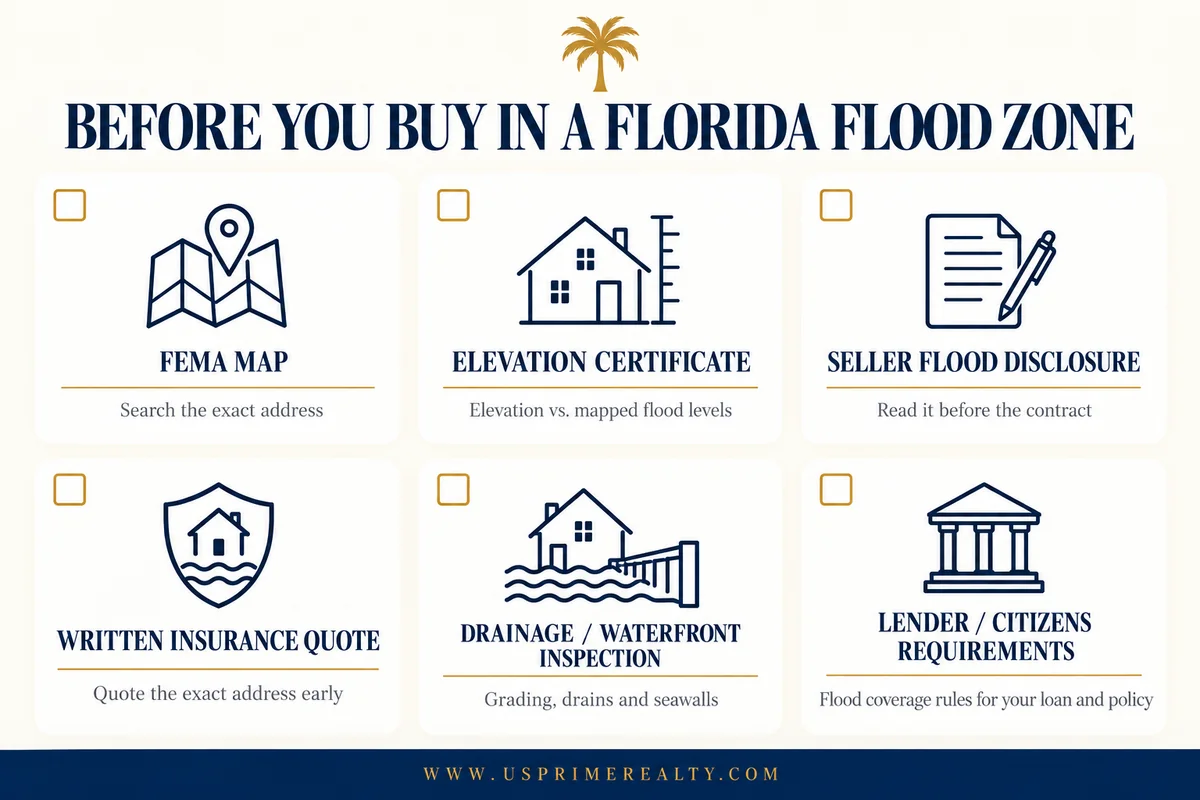
A Florida Flood-Zone Due Diligence Checklist
- Search the exact address on FEMA’s map. Do not rely only on a listing description or neighborhood assumption.
- Confirm the lender’s flood determination. The lender may use an official flood determination service for mortgage requirements.
- Get written flood quotes before the inspection/insurance deadline. Compare NFIP and private options when appropriate.
- Ask for the seller’s flood disclosure and prior claim information. Read it before committing to the contract.
- Review elevation and drainage. Look for an Elevation Certificate, finished-floor elevation, grading, swales, drains, pumps and nearby canals or low points.
- Inspect for signs of prior water intrusion. Staining, replaced drywall, new baseboards, corrosion, odors and repaired lower-wall areas deserve questions.
- Check permits and substantial-improvement rules before remodeling. Major renovations in flood hazard areas can trigger floodplain-compliance requirements.
- For waterfront homes, inspect more than the house. Review seawalls, docks, storm-surge exposure, tidal conditions and water access.
- For condos, review the building’s flood coverage. Ask how the association master policy and your HO-6/flood coverage interact, especially for first-floor improvements and contents.
- Budget for the full ownership cost. Use mortgage, taxes, homeowners/wind insurance, flood insurance, deductibles, HOA/condo costs and maintenance — not just the purchase price.
Waterfront Homes Need an Extra Layer of Review
A waterfront property can be an excellent fit, but a beautiful view does not tell you how the site behaves during a storm. Coastal buyers should evaluate storm-surge and wave exposure; canal and river buyers should evaluate water level, drainage and seawall condition; and low-lying inland properties may still face rain-driven flooding.
U.S. Prime Realty’s Waterfront Homes in Florida: 2026 Buyer Guide covers flood zones, insurance, maintenance and other waterfront-specific questions. Buyers focusing on South Florida can also review Miami waterfront homes for sale.
How Flood Risk Can Affect Your Offer
Flood exposure does not automatically make a home a bad purchase. It changes what needs to be verified. A well-elevated home in a high-risk zone may be easier to insure than a lower structure with a different construction profile. Likewise, a Zone X home may still have drainage problems that deserve attention.
Before removing contingencies, compare the property against alternatives on four practical questions: What will flood coverage cost? What deductible and exclusions apply? What physical mitigation already exists? What future renovation or resale constraints could matter? That gives you a clearer basis for deciding whether the price and risk fit your plans.
Buying a Home in Florida: Put Flood Risk in the Budget Early
Flood due diligence works best when it happens before the final days of the transaction. Start with U.S. Prime Realty’s Buying a Home in Florida guide, browse current homes through the Florida property search, and request insurance information as soon as a property becomes a serious candidate.
The goal is not to eliminate every risk — no home can offer that. The goal is to understand the risk well enough to price it, insure it and decide whether the property still makes sense for you.
Final Takeaway
Florida flood zones are a useful first filter, not a final answer. FEMA maps tell you how an area is classified, while elevation, construction, drainage, insurance pricing, prior flooding and local conditions tell you more about the individual property. A careful buyer checks both.
If you are planning a Florida purchase and want help comparing homes, flood-zone considerations and total ownership costs, contact U.S. Prime Realty at 239-513-0011 or cc@usprimerealty.com.
Important information note: Flood maps, insurance premiums, Citizens requirements, lender standards, local floodplain rules and property conditions can change. This article is general educational information and is not legal, insurance, engineering, lending or tax advice. Verify property-specific requirements with the appropriate licensed professionals and public agencies before purchasing.
Frequently Asked Questions
What flood zone requires flood insurance in Florida?+
What flood zone requires flood insurance in Florida?
For homes with federally backed mortgages, FEMA high-risk Special Flood Hazard Areas — generally A and V zones — typically trigger mandatory flood insurance. Other lenders or insurers may have additional requirements.
Is Zone X safe in Florida?+
Is Zone X safe in Florida?
Zone X is lower or moderate risk, depending on whether it is shaded or unshaded, but it is not flood-free. FEMA says roughly one-third of claims come from low- and moderate-risk zones.
What is the difference between Zone AE and Zone VE?+
What is the difference between Zone AE and Zone VE?
Both are high-risk Special Flood Hazard Areas. Zone AE is generally inland/riverine high risk with mapped Base Flood Elevations. Zone VE is coastal high risk with an additional storm-wave or velocity hazard.
Does homeowners insurance cover flooding in Florida?+
Does homeowners insurance cover flooding in Florida?
Generally no. Florida DFS states that flood damage is not covered by standard homeowners insurance, so buyers usually need a separate flood policy or qualifying flood endorsement.
What is an Elevation Certificate?+
What is an Elevation Certificate?
It is a standardized document used to report a building’s elevation information. It can help with flood-risk review, insurance rating, floodplain compliance and renovation planning, depending on the property.
Do Florida sellers have to disclose flooding?+
Do Florida sellers have to disclose flooding?
Yes. Florida Statute 689.302 requires a residential seller to provide a flood disclosure at or before the sales contract is executed, including specified information about known flooding, claims and assistance.
What is the Citizens flood-insurance rule in 2026?+
What is the Citizens flood-insurance rule in 2026?
Citizens requires flood coverage for many policies with wind coverage. Inside a FEMA Special Flood Hazard Area, the requirement applies regardless of replacement cost. Outside the SFHA, the 2026 phase-in includes many structures with a dwelling replacement cost of $400,000 or more, subject to listed exceptions.
How early should I get a flood insurance quote?+
How early should I get a flood insurance quote?
As early as possible once you are serious about a property. Flood policies commonly have a waiting period, and early quotes help buyers identify lender or affordability issues before contingency deadlines.
Share This
About The Author

Isbely Glazer - Founder and Broker of U.S. Prime Realty
Isbely brings over 20 years of experience across Florida’s key markets. She leads with a client-first approach, combining deep market insight with a commitment to trust, results, and long-term relationships.
Business Info


Recent Posts

Pre-Construction Properties in Florida: Discover New Homes for Sale Across the State
Discover pre-construction properties in Florida, from Miami and Sunny Isles condos to Naples, Cape Coral and Orlando new homes. Explore options with U.S. Prime Realty.
New Construction vs. Pre-Construction Homes in Florida: Which Is Right for You?
New construction vs. pre-construction homes in Florida: compare costs, timelines, deposits, builder incentives and risks before you buy.
Pre-Construction Homes in Florida: The 2026 Buyer’s Guide
Buying pre-construction homes in Florida in 2026? Compare markets, deposits, contracts, financing, warranties, costs and red flags before you sign.