What’s It Really Like to Live in Naples, Florida? (2026 Guide)
Living guide · Naples, Florida
To live in Naples, Florida, is to trade year-round big-city energy for something more polished and seasonal. The beaches are real, the restaurant scene is strong, and a winter afternoon can feel almost unfairly pleasant. But the version of Naples you meet during a February weekend is only part of the story. Full-time life also means summer heat, hurricane planning, insurance quotes, association fees and a housing market where the difference between two ZIP codes can be enormous.
That is why this guide does not sell Naples as a postcard. It combines the lifestyle questions people actually ask with current 2026 housing, rent, climate and local-cost data. If you are comparing homes now, keep the U.S. Prime Realty Naples community page and Florida property search open while you read so you can compare the numbers with real listings.
Quick answer: Living in Naples works best when you budget for the whole lifestyle, not just the mortgage or rent. The city proper is small, older and affluent; the broader Naples market is much more varied. Winter is lively and crowded, summer is quieter and much hotter, and coastal ownership can add insurance, flood and association costs that are easy to underestimate.
What is in this guide
- 2026 Naples Living Snapshot
- The Community Vibe Is Unlike Most of Florida
- What Naples Beach Access Actually Delivers
- Living in Naples, Florida: Season vs. Summer
- The Honest Cost of Living in Naples, FL
- Naples Neighborhoods: Match the Lifestyle, Then Check the Costs
- Jobs, Income and the Day-to-Day Practical Side
- The Risks Newcomers Consistently Underestimate
- Is Living in Naples, FL Actually the Right Move for You?
- Frequently Asked Questions: Living in Naples, Florida in 2026
- The Bottom Line on Living in Naples, Florida
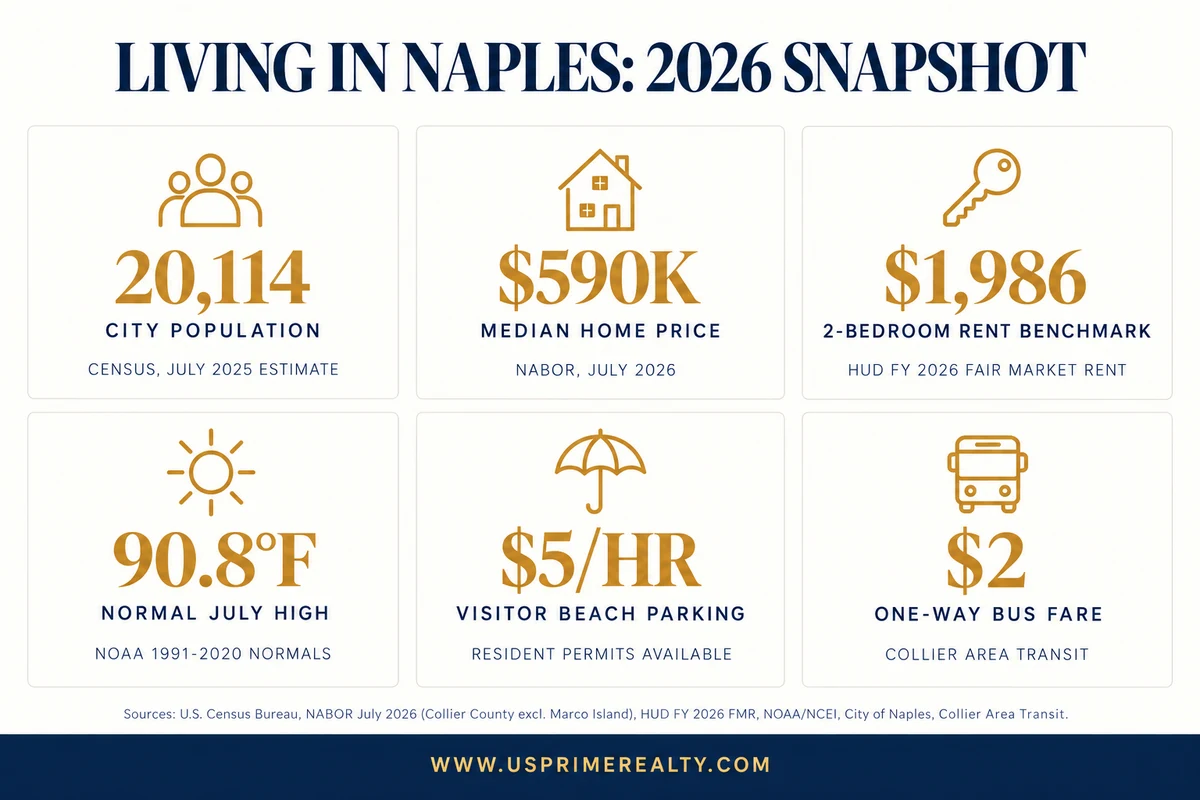
2026 Naples Living Snapshot
| Living factor | 2026 / latest verified benchmark | Source / how to read it |
|---|---|---|
| City-proper population | 20,114 (July 1, 2025 estimate) | U.S. Census QuickFacts |
| Residents age 65+ | 55.8% in Naples city | City-proper demographic; broader Naples is more mixed. |
| Home resale market | $590,000 overall median; $745,000 single-family; $400,000 condo | NABOR July 2026 market report |
| Rent benchmark | $1,797 1BR; $1,986 2BR; $2,581 3BR | HUD FY 2026 Fair Market Rents |
| July climate normal | 90.8°F high / 75.5°F low; 7.77 in. rain | NOAA/NCEI Naples climate normals |
| Beach parking | Free annual permit for eligible residents/property taxpayers; visitor meters $5/hour | City of Naples beach parking |
| Public transit | $2 one-way; $40 30-day fixed-route pass | Collier Area Transit fares |
Sources: U.S. Census Bureau QuickFacts, Naples city; Naples Area Board of REALTORS® (NABOR®) July 2026 Market Report, Collier County excluding Marco Island; HUD FY 2026 Fair Market Rent schedule, Naples-Marco Island MSA; NOAA/NCEI 1991-2020 climate normals, Naples Municipal Airport; City of Naples beach parking; Collier Area Transit fares.
The Community Vibe Is Unlike Most of Florida
Who actually lives here
Naples city itself is tiny compared with the region people casually call “Naples.” The Census estimated 20,114 city residents in 2025, and 55.8% of city residents were 65 or older in the 2020-2024 estimates. Median household income in the city was $153,182. Those figures help explain why the city proper feels older, quieter and wealthier than many Florida metros, but they should not be used to describe every community with a Naples mailing address.
The broader lifestyle is more mixed. You will find year-round families, hospitality workers, healthcare professionals, construction and service workers, remote professionals, seasonal residents and second-home owners spread across North Naples, East Naples, Golden Gate Estates and the coastal neighborhoods. The biggest mistake is assuming the social rhythm of Fifth Avenue South describes the entire local area.
Refined, low-rise and very neighborhood-driven
Naples does not feel like Miami, Tampa or Orlando. There is no major downtown skyline, and nightlife is not the organizing principle. The city core is defined more by dining, galleries, beaches, landscaped streets and low-rise neighborhoods. Outside the core, daily life becomes more car-oriented and community-specific: gated neighborhoods, golf communities, condo buildings, acreage properties and newer planned developments can each feel like a different version of Naples.
That is why relocation decisions here work better when they start with lifestyle questions: Do you want to walk to dinner? Keep a boat? Live near the beach but outside the city? Avoid mandatory club fees? Have room for a larger lot? Those answers narrow the map faster than a citywide price average ever will.
What Naples Beach Access Actually Delivers
The Gulf is not just scenery in Naples; beach access is woven into daily life. City rules currently list 24 beach ends reserved for City of Naples and Collier County permit holders, plus visitor-access locations with metered parking. Eligible City and Collier County residents and property taxpayers can obtain annual beach parking permits, while visitors currently pay $5 per hour at city meters. That difference matters if you expect to use the beach several times a week rather than only when family visits.
The practical tradeoff is seasonality. In winter and early spring, parking fills faster and popular access points feel busy. In summer, the same shoreline can feel dramatically quieter, but the heat, humidity and afternoon storms change how you use it. The historic Naples Pier is currently closed for the rebuild project, so anyone moving near the Old Naples beach corridor should check the latest City updates rather than relying on older travel guides.
Local-living detail: A resident beach parking permit can turn the Gulf from a special outing into an everyday habit. If beach access is one of the reasons you are moving, compare the exact parking rules, walking distance and access points for each property before you buy.
Living in Naples, Florida: Season vs. Summer
What snowbird season actually feels like
From roughly late fall through spring, Naples feels fuller and more social. Restaurants are busier, traffic thickens on the major corridors, events stack up and the city center feels polished and active. That is the version many visitors fall in love with, and it is a fair part of the Naples experience – just not the whole one.
What summer feels like when the crowds thin out
Summer is the reality check. NOAA’s 1991-2020 climate normals for Naples Municipal Airport put the normal July high at 90.8°F and the normal low at 75.5°F. July averages 7.77 inches of rain, and August is even wetter at 8.89 inches. Air conditioning is not a luxury detail here; it is part of the household budget, and afternoon outdoor plans often work better when they are flexible.
The upside is a calmer city. Restaurants may be easier to book, roads can feel less crowded and the beach is less pressured. Some full-time residents prefer this version of Naples. Others find the heat and humidity limiting. If you are seriously considering a move, visit once in January or February and again in July or August. Those two trips will tell you more than a dozen online rankings.
The Honest Cost of Living in Naples, FL
For the full line-by-line breakdown, see our Naples, Florida cost of living 2026 guide.
Housing is the biggest swing factor
As of the latest fully accessible NABOR report verified for this update, July 2026 closed sales across Collier County excluding Marco Island had an overall median closed price of $590,000. The split was wide: $745,000 for single-family homes and $400,000 for condominiums. Inventory was 4,415 properties, with 5.8 months of supply and 108 days on market for July sales.
Those numbers are useful for context, not for pricing one house. In the same July report, the single-family median for Naples Beach ZIP codes 34102, 34103 and 34108 was $2.5 million, while North Naples ZIP codes 34109, 34110 and 34119 posted a $1,132,500 single-family median. Monthly neighborhood medians can swing when sales volume is small, but the gap makes one point clear: where you live in Naples matters more than the citywide headline.
For buyers considering the upper end of the market, the Naples luxury real estate 2026 market guide gives more context on luxury and waterfront segments.
Renting: the annual lease and the seasonal market are different worlds
HUD’s FY 2026 Fair Market Rent schedule lists $1,396 for a studio, $1,797 for a one-bedroom, $1,986 for a two-bedroom, $2,581 for a three-bedroom and $2,805 for a four-bedroom in the Naples-Marco Island MSA. Fair Market Rents are administrative benchmarks, not live asking rents. Furnished seasonal rentals, beachfront condos and short winter leases can sit far above those numbers.
Before signing a lease, look beyond the base rent. Association approval fees, deposits, parking, pets, utilities, renters insurance and furnishing can materially change the true monthly cost. If you are still comparing Florida markets, the Florida relocation guide is a useful checklist for the move itself.
Taxes, insurance and association costs are where budgets get surprised
A seller’s current property-tax bill is not automatically your future bill. The Collier County Property Appraiser explains that Florida’s Save Our Homes cap limits annual increases in assessed value on qualifying homesteaded property to 3% or CPI, whichever is lower. After a change in ownership, assessed value can reset toward market value. In other words, copy-pasting the seller’s tax bill into your budget can be a costly shortcut.
Insurance needs the same property-by-property treatment. U.S. Prime Realty’s Florida home insurance in 2026 guide summarizes Florida Office of Insurance Regulation data showing a Collier County average homeowners premium including wind of about $5,534 as of March 31, 2026. That is an average, not a quote. Roof age, replacement cost, wind mitigation, deductible, occupancy and proximity to the coast can move the price sharply.
Then come HOA, condo and club charges. In Naples, a fee may cover landscaping, security, building insurance, reserves, pools, fitness amenities, cable or water – or almost none of those. Golf communities can add initiation, transfer, capital or food-and-beverage charges. Waterfront homes can add dock, lift and seawall maintenance. Ask for the entire fee schedule in writing before you decide whether a property is affordable.
Budget reality: The purchase price is only the entry point. A realistic Naples ownership budget adds the post-sale property-tax estimate, homeowners and flood quotes, HOA/condo/club fees, utilities, maintenance and any waterfront costs before you fall in love with the view.
Everyday costs beyond the mortgage or rent
Electricity is one place where summer living shows up quickly. Florida Power & Light’s rate page listed a typical 1,000-kWh residential bill of $136.64 in August 2026; September fell to $128.45 because of a one-time storm-cost refund. Treat the August figure as a reference bill, not a promise. A larger home, pool equipment, older air-conditioning, EV charging or full-time summer occupancy can push usage much higher.
Florida’s general sales tax rate is 6%, and the Florida Department of Revenue’s current surtax table lists Collier County at 0.00%. Florida also does not levy an individual state income tax, which can change the relocation math for households coming from states that do. That tax advantage does not erase property taxes, insurance, federal income tax or the higher carrying costs that can come with coastal property. See U.S. Prime Realty’s 2026 Florida no state income tax guide for a relocation-focused explanation.
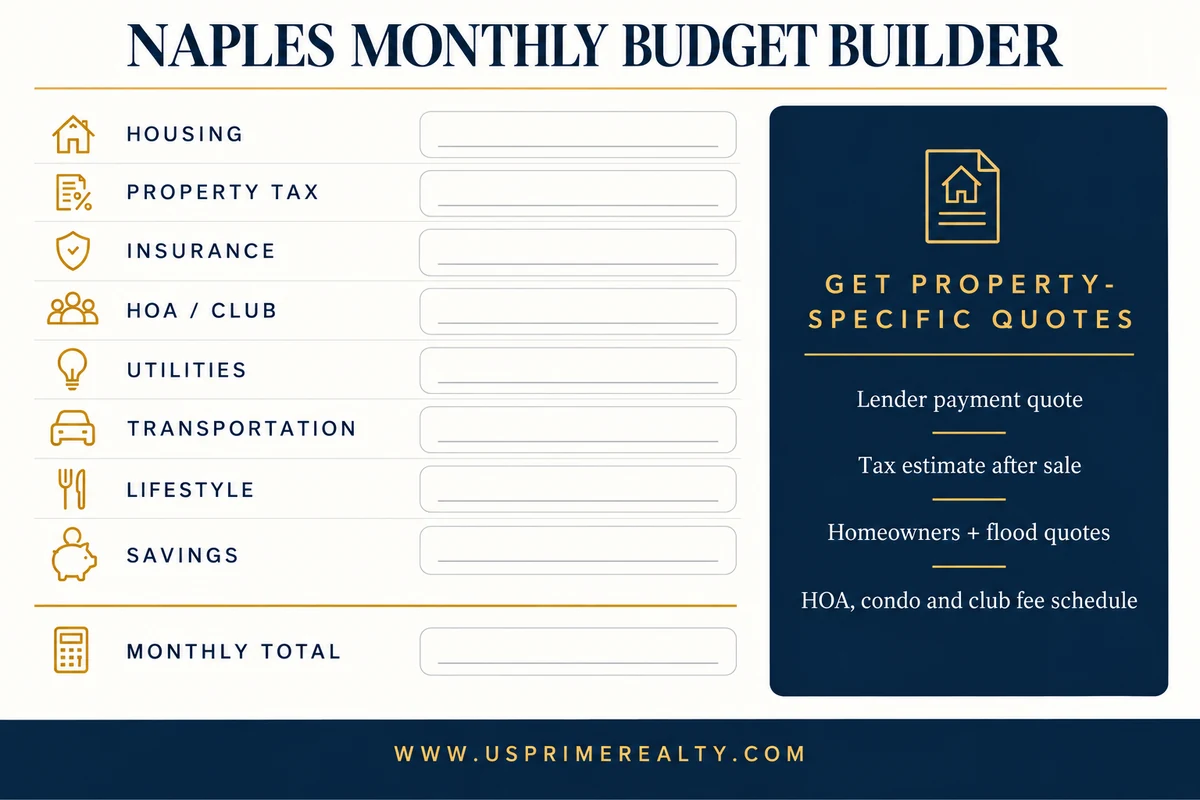
Build the monthly budget around the exact property
| Budget category | Start with | Verify before you commit |
|---|---|---|
| Housing | Actual lease or lender payment quote | Use the exact property, current terms and realistic occupancy period. |
| Property tax | Post-sale estimate | Do not assume the seller’s current bill will be your future bill. |
| Insurance | Written homeowners + flood quotes | Check wind/hurricane deductibles, roof/mitigation details and flood exposure. |
| HOA / condo / club | Current fee schedule | Include reserves, assessments, initiation/transfer charges and mandatory membership. |
| Utilities | Recent property history + provider rates | Electric, water/sewer, internet, pool equipment and seasonal AC use. |
| Transportation | Your real commute and vehicle costs | Fuel, insurance, maintenance, parking/tolls; compare CAT only where routes fit. |
| Lifestyle + savings | Your actual spending pattern | Food, dining, golf/boating, healthcare, travel, maintenance and emergency reserves. |
Naples Neighborhoods: Match the Lifestyle, Then Check the Costs
There is no single “best” Naples neighborhood for every buyer. A better approach is to match your routine to the area, then verify the fees, flood exposure, insurance and recent comparable sales for the exact property.
| Area / ZIP focus | What may draw you there | What to verify before you commit |
|---|---|---|
| Old Naples / Naples Beach 34102, 34103, 34108 | Walkability, beach proximity, dining, luxury and historic character | Higher purchase prices, flood/wind exposure, condo/HOA records, parking and recent property-level comps. |
| Pelican Bay / coastal North Naples | Beach-oriented lifestyle, condos and upscale amenities | Association structure, condo reserves/assessments, insurance, membership or amenity rules, exact beach-access logistics. |
| Park Shore / waterfront west of U.S. 41 | Waterfront and condo options near shopping and dining | Flood zone/elevation, building reserves, dock or marina rights where relevant, insurance and association fees. |
| North Naples 34109, 34110, 34119 | Newer homes, gated/golf communities, access to shopping and services | HOA/master association, club membership, roof/insurance, commute pattern and property-specific school-zone needs. |
| East Naples / Lely area 34112, 34113, 34114 | Planned communities, condos, golf and varied price points | CDD/special district where applicable, HOA/club fees, future development, commute and insurance. |
| Golden Gate Estates 34117, 34120 | Acreage, space and a less urban feel | Well/septic condition, drainage, wetland/flood issues, driveway maintenance, longer drives and utility setup. |
| Waterfront / boating properties | Dock or lift, canal or Gulf access, boating lifestyle | Seawall/dock inspection, water depth/bridge restrictions, permits, flood/wind coverage and storm preparation. |
Once you have two or three target areas, use the Naples community page and Florida property search to compare real listings, not generic neighborhood averages.
Jobs, Income and the Day-to-Day Practical Side
The local economy is not the same as a large Florida metro
The U.S. Bureau of Labor Statistics reported an average hourly wage of $30.79 in the Naples-Marco Island metro in May 2025, compared with $33.54 nationwide. The local employment mix also leans heavily toward service and lifestyle industries: food preparation and serving accounted for 14.5% of area employment, while sales and office/administrative support were 10.8% each. Management, healthcare practitioner and computer/math occupations posted much higher average wages, but they represent smaller shares of the market.
That does not mean professional work is absent; it means anyone relocating for a job should check the actual local market before assuming a Naples salary will mirror Miami, Tampa or a major Northeast city. Remote workers and retirees may experience Naples very differently from someone depending on the local wage base.
You can use transit, but most households still plan around a car
Naples and Collier County are largely car-oriented. Census QuickFacts lists a 22.4-minute mean commute for Naples city workers in 2020-2024. Collier Area Transit provides a low-cost alternative on served routes – currently $2 one way, $3 for a day pass and $40 for a 30-day fixed-route pass – but whether that can replace a car depends on where you live, work and shop.
The Risks Newcomers Consistently Underestimate
Hurricane and flood exposure is part of the ownership math
Flood risk in Naples is not one blanket condition. It changes parcel by parcel with elevation, flood zone, distance from open water and drainage. The safest way to evaluate it is to use the FEMA Flood Map Service Center for the address, then obtain a written flood quote. Florida’s Department of Financial Services is explicit that standard homeowners insurance does not cover flood damage.
For waterfront or coastal homes, also review wind coverage, the hurricane deductible, roof age, opening protection and storm-hardening features. A percentage hurricane deductible can create a large out-of-pocket amount on a high-value home, so ask the insurance professional for the deductible in dollars, not just as a percentage.
U.S. Prime Realty’s waterfront homes buyer guide and Florida hurricane-season home protection guide can help organize the property questions before you make an offer.
Condo reserves and special assessments deserve their own review
A condo with an attractive list price can still carry a heavy monthly or one-time cost if reserves, insurance or building work are changing. Before buying, read the current budget, reserve information, recent meeting minutes, insurance documents, pending assessments and major repair plans. Treat the association’s financial health as part of the property condition, not as paperwork for the last week before closing.
Is Living in Naples, FL Actually the Right Move for You?
A better test than an online ranking
Naples tends to appeal to people who actively want beach access, a quieter pace, polished neighborhoods, golf or boating, and a social calendar that peaks in winter. The tradeoffs are equally concrete: housing can be expensive, the city proper skews older, summer is hot and wet, coastal insurance and flood planning take work, and some communities add meaningful recurring fees.
The most useful test is simple: visit in two seasons, spend time outside the tourist core, and price the exact kind of home you would really live in. If you need to be near an office, drive the commute at the hour you would actually travel. If you want the beach, test the parking and access. If you want a golf or waterfront community, ask for the full dues and maintenance picture before you compare list prices.
Your next step before signing anything
Start with the Florida homebuying guide and a shortlist of two or three Naples areas. Then compare recent sales, property taxes after the transaction, insurance, flood exposure and every association or club charge. U.S. Prime Realty can help with the real-estate side of that comparison, while tax, legal, insurance and lending questions should be confirmed with the appropriate licensed professionals.
U.S. Prime Realty – Naples: For a property-specific comparison, contact U.S. Prime Realty at (239) 513-0011 or cc@usprimerealty.com, or use the contact page to request a local consultation. Serving Florida homes since 2008.
Frequently Asked Questions: Living in Naples, Florida in 2026
Is Naples, Florida expensive to live in?+
Is Naples, Florida expensive to live in?
Housing is the biggest reason Naples can feel expensive. NABOR reported a July 2026 median closed price of $590,000 across Collier County excluding Marco Island, while coastal and luxury ZIP codes can be far higher. Insurance, property taxes, HOA/club fees and lifestyle spending can widen the gap further.
What is the median home price in Naples in 2026?+
What is the median home price in Naples in 2026?
NABOR’s July 2026 report showed a $590,000 overall median closed price, with $745,000 for single-family homes and $400,000 for condominiums across its Collier County market excluding Marco Island. Use neighborhood and property-level comps for an actual purchase decision.
How much is rent in Naples, Florida in 2026?+
How much is rent in Naples, Florida in 2026?
HUD’s FY 2026 Fair Market Rent schedule lists $1,797 for a one-bedroom, $1,986 for a two-bedroom and $2,581 for a three-bedroom in the Naples-Marco Island MSA. Seasonal and furnished asking rents may be much higher.
Is Naples mostly a retirement city?+
Is Naples mostly a retirement city?
Naples city proper has a strong retirement demographic: 55.8% of residents were age 65 or older in the Census 2020-2024 estimates. The broader Naples area is more diverse, with families, workers and newer planned communities outside the city core.
How hot is Naples in summer?+
How hot is Naples in summer?
NOAA/NCEI climate normals show a normal July high of 90.8°F and low of 75.5°F at Naples Municipal Airport, with 7.77 inches of average July rainfall. August is similarly hot and wetter. Humidity and frequent summer storms are part of daily life.
Do Naples residents get free beach parking?+
Do Naples residents get free beach parking?
Eligible City of Naples and Collier County residents and property taxpayers can obtain annual beach parking permits. City visitor parking is currently $5 per hour at metered locations. Always check current City rules before relying on a specific access point.
Do I need flood insurance in Naples?+
Do I need flood insurance in Naples?
That depends on the property, flood zone, lender and your own risk tolerance. Standard homeowners insurance does not cover flood damage. Check the FEMA map for the address and obtain a separate flood quote before contract deadlines expire.
Is Naples easy to live in without a car?+
Is Naples easy to live in without a car?
It depends on the neighborhood and your routine. CAT fixed-route service is inexpensive, but the broader area is spread out and many households rely on a car for work, shopping, medical visits and beach trips.
Which Naples neighborhood should I choose?+
Which Naples neighborhood should I choose?
Start with lifestyle rather than a ranking. Old Naples and Naples Beach emphasize walkability and coastal access; North Naples offers many gated and newer communities; East Naples and Lely offer a broad mix; Golden Gate Estates offers acreage; waterfront areas add boating considerations. Verify fees, flood exposure, insurance and recent comps in every case.
What should I check before moving to Naples?+
What should I check before moving to Naples?
Price the exact housing option, estimate taxes after the transaction, get homeowners and flood quotes, review HOA/condo/club documents, test your commute, visit in both peak season and summer, and confirm how beach access and daily errands work from the property.
The Bottom Line on Living in Naples, Florida
Naples is a beautiful place to live, but it rewards people who look past the vacation version of the city. The beaches and dining are real. So are the summer humidity, seasonal traffic, insurance questions and sharp price differences between neighborhoods. A beachfront condo, a North Naples single-family home and an acreage property in Golden Gate Estates may share a mailing city while carrying completely different budgets and routines.
If you are still excited after looking at both sides of the picture, the next step is not another national ranking. It is a property-specific comparison. Browse current Naples listings, identify the few communities that fit your daily life, and build the true monthly cost before you decide. That is how you find out whether Naples is simply a place you love visiting – or the place you actually want to call home.
U.S. Prime Realty is a licensed Florida real estate brokerage (BK3153881), not a mortgage lender or an insurer. Any financing discussed in this guide is arranged through lender partners and is subject to lender approval; loan eligibility, rates and terms are determined by the lender. Insurance coverage and premiums should be confirmed with a licensed insurance professional.
More sources used in this guide: NABOR® market statistics; City of Naples – Naples Pier; Collier County Property Appraiser – Homestead Exemption; Collier County Property Appraiser – Save Our Homes and Portability; Florida Department of Financial Services – Homeowners Insurance Overview; FEMA Flood Map Service Center; U.S. Bureau of Labor Statistics – Naples-Marco Island wages; Florida Power & Light – Rates and Your Bill; Florida Department of Revenue – Sales and Use Tax; Florida Department of Revenue – Discretionary Sales Surtax Rates.
Important information note: Real estate prices, rents, insurance premiums, tax rules, HOA and club fees, utility rates, beach parking rules, transit fares and market conditions can change. This article is general educational information, not legal, tax, lending, insurance or investment advice. Verify property-specific costs and requirements with the appropriate official agencies and licensed professionals before making a housing decision.
Share This
About The Author

Isbely Glazer - Founder and Broker of U.S. Prime Realty
Isbely brings over 20 years of experience across Florida’s key markets. She leads with a client-first approach, combining deep market insight with a commitment to trust, results, and long-term relationships.
Business Info


Recent Posts

Naples, Florida Cost of Living: The Complete 2026 Breakdown
See the 2026 Naples, Florida cost of living: home prices, rent, taxes, insurance, utilities, transportation and neighborhood-specific costs.
Naples Florida Luxury Real Estate: 2026 Market Guide
Explore Naples Florida luxury real estate in August 2026: market data, most expensive neighborhoods, waterfront costs, insurance and buyer tips.
South Florida Condo vs. Single-Family Home: Which Makes More Financial Sense in 2026?
Compare South Florida condo vs. single-family home costs in 2026, including prices, HOA fees, insurance, reserves, financing, maintenance and resale.