Business Owner in Florida? No State Income Tax and 3.5% Down Home Loan Options
Florida Business Owner Home Financing
Are you a business owner in Florida? If business deductions make your tax-return income look lower than the cash flow your company actually produces, traditional mortgage qualification can feel frustrating. For eligible self-employed buyers, there may be 3.5% down home loan options in Florida and alternative ways to document income, depending on the loan program and lender requirements.
Florida’s lack of a personal state income tax is one reason the state attracts entrepreneurs and self-employed professionals. But when it is time to buy a home, the important question is not only what your business earns. It is how a lender calculates the income that can be used for mortgage qualification.
If your business is doing well but traditional tax-return income does not tell the whole story, it may be worth exploring another path. This guide explains the low-down-payment positioning, why business deductions can affect underwriting, how bank statements or other alternative documentation may be considered, and what to ask before moving forward.
Watch: 3.5% Down Home Loan Options for Florida Business Owners
Wondering how this could apply to your situation? Watch the short video to learn how eligible Florida business owners may be able to explore low-down-payment options and alternative income documentation.
Think this might apply to you? Call or text 239-513-0011, and let’s talk about your options.
What is in this guide
Can a Business Owner Get a Home Loan in Florida?
Yes, business owners and self-employed buyers can pursue home financing in Florida, but the documentation and underwriting path may look different from the process for a salaried W-2 employee. The audience can include business owners, self-employed professionals, entrepreneurs, 1099 earners, LLC or S-Corp owners, contractors, tradespeople and service-business owners.
The central issue is that business income and qualifying mortgage income are not always the same number. A company can generate healthy revenue or cash flow while legitimate deductions reduce the taxable income shown on a return. A lender still has to document stable, usable income under the requirements of the specific loan program.
That is why self-employed buyers should avoid assuming either that they will not qualify or that a low-down-payment program will automatically solve the problem. The right starting point is to understand how your income will be documented and what financing options may fit your exact profile. For broader context, see U.S. Prime Realty’s guide to buying a home in Florida.
Can You Buy a Home With 3.5% Down as a Business Owner?
For eligible business owners, the campaign is positioned around approximately 3.5% to 5% down-payment options. The exact minimum depends on the applicable loan program, lender requirements, borrower profile and property. A 3.5% down option should be treated as a possibility to explore, not a guarantee of approval or a universal minimum.

A smaller down payment can help preserve cash for reserves, moving expenses, repairs or business needs, but it also means financing a larger portion of the purchase price. Before deciding, compare the full payment, interest rate, fees, cash required to close and any reserve requirements.
Quick answer: A self-employed buyer may be able to explore a 3.5% down home loan in Florida, but availability depends on the program and the borrower’s qualifications. Ask the lender to confirm the exact down payment and documentation required for your situation.
Why Tax Deductions Can Affect Mortgage Qualification
Business owners often use legitimate deductions to calculate taxable income. The challenge is that traditional mortgage underwriting may also rely on tax-return income and supporting records when determining how much income can be counted for qualification. As a result, strong business activity does not always translate into the same qualifying income a borrower expects.

This does not mean tax returns never matter, and it does not mean lenders ignore taxes. It means the documentation method matters. Fannie Mae’s guidance on underwriting and documentation for self-employed borrowers is a useful reference for how detailed the traditional review can be.
Can Business Owners Use Alternative Income Documentation?
Depending on the program, eligible business owners may be able to explore alternative income documentation instead of relying only on the traditional tax-return approach. Bank statements are one example identified in the campaign guide. The lender may review deposits, business history and other required records to determine whether the program fits.
Documentation requirements vary by lender and program. Some borrowers may still be asked for tax returns, business records, profit-and-loss information, bank statements or other supporting documents. The important point is to ask what the lender needs before assuming any particular document can be omitted.
You can also review U.S. Prime Realty’s overview of Florida home financing options as you prepare for the home-search side of the process.
Who May Be a Fit for This Program?

This type of financing conversation may be worth exploring if you are a:
- Business owner
- Self-employed professional
- Entrepreneur
- 1099 earner
- LLC or S-Corp owner
- Contractor
- Tradesperson
- Service-business owner
Business-history note: The campaign guide says this program is typically best suited for established businesses with 2+ years of operating history, subject to lender guidelines. A lender should confirm whether your business history meets the selected program’s requirements.
Florida’s No Personal State Income Tax: What Business Owners Should Know
Florida does not impose a personal state income tax. That is an important part of the state’s business-owner appeal, but it should not be confused with mortgage qualification or interpreted to mean that buying a home is tax-free. Other taxes can still apply depending on the individual, property and business structure.
For the official state explanation, see the Florida Department of Revenue’s personal income tax FAQ. The mortgage decision is separate: a lender still evaluates your credit, income documentation, assets, debts, property and program eligibility.
What Documents Might Be Needed?
There is no single document list that applies to every self-employed mortgage. The lender and program determine what is required, so use the questions below to prepare for the conversation rather than treating them as a universal checklist.
Do I Need Tax Returns?
Possibly. Some programs may rely heavily on tax returns, while certain alternative-documentation programs may use other records. Do not assume tax returns are never required. Ask the lender exactly which documents apply to your program.
Can Bank Statements Be Used?
They may be used under certain programs for eligible borrowers. The lender determines the statement period, acceptable account types, deposit treatment and any additional records needed to support the application.
How Long Do I Need to Be in Business?
The campaign guide says the program is typically best suited for businesses with at least two years of operating history, subject to lender guidelines. Your lender should confirm the exact history requirement for the program under consideration.
What Other Documents Might a Lender Request?
A lender may request additional financial, business, asset or identity documentation based on the program and your circumstances. Fannie Mae’s home-loan documents guide offers useful general context for the types of records borrowers commonly prepare.
How the Business Owner Home Loan Process Works
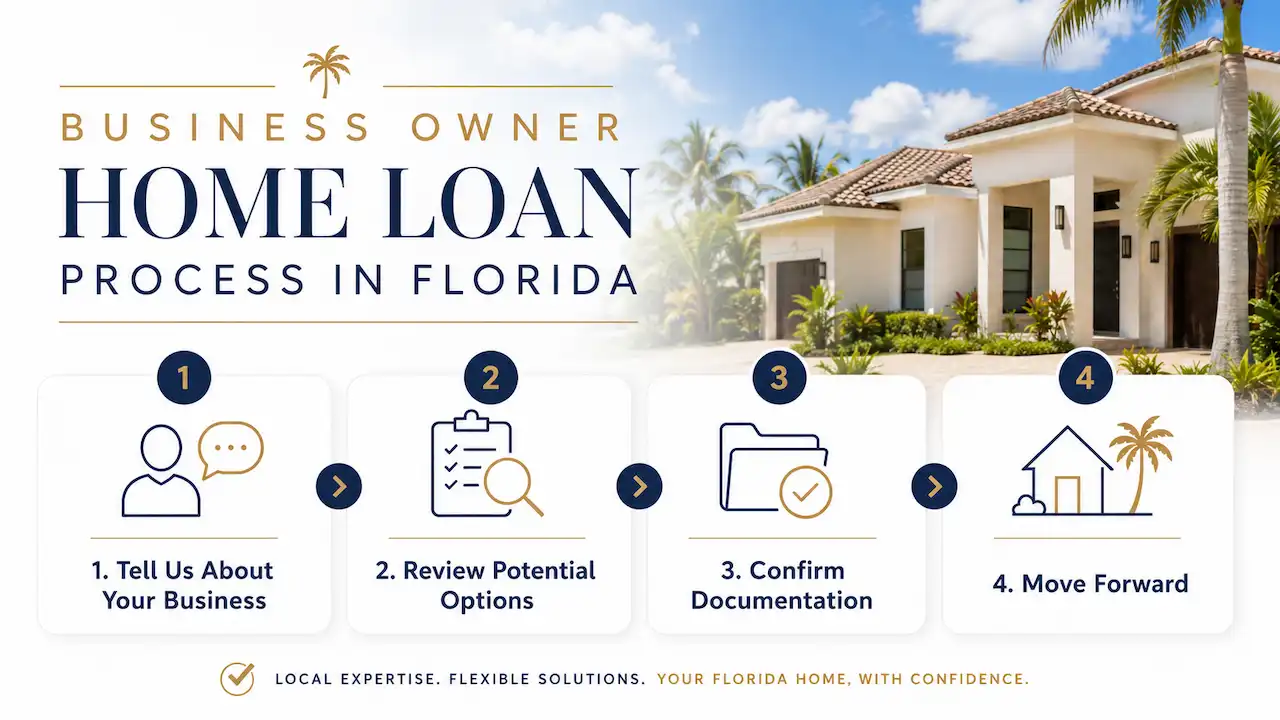
The campaign uses a simple four-step flow. The goal is to understand your business first, identify potential options, confirm the lender’s documentation requirements and then move forward with the home search when the financing path is clear.
1
Tell Us About Your Business
Share your business type, how long you have operated, how you are paid and what your homebuying goals look like.
2
Review Potential Options
Explore which low-down-payment or alternative-documentation programs may be relevant to your profile.
3
Confirm Documentation
Have the lender confirm the income records, business history, assets and other documents required for the selected program.
4
Move Forward
Once the financing path is established, work with a Florida real estate professional to search, tour and evaluate homes.
U.S. Prime Realty is a licensed Florida real estate brokerage, not a mortgage lender. Our role is to help with the property-search and real-estate transaction side of the process. Mortgage qualification, documentation approval and loan terms are handled by the lender.
Frequently Asked Questions
Can a business owner get a mortgage in Florida?+
Can a business owner get a mortgage in Florida?
Yes, business owners and self-employed borrowers can pursue mortgages in Florida. Qualification depends on the loan program, documentation, credit, assets, debts, property and lender underwriting.
Can I get a mortgage if my tax returns show low income?+
Can I get a mortgage if my tax returns show low income?
Possibly. Some programs may allow eligible self-employed borrowers to use alternative income documentation, such as bank statements. The lender must determine whether you qualify and what records are required.
Can I buy a house with 3.5% down if I’m self-employed?+
Can I buy a house with 3.5% down if I’m self-employed?
A 3.5% down option may be available under certain programs for eligible buyers, but it is not available to everyone. The lender should confirm the minimum down payment for your profile and property.
Can bank statements be used for a home loan?+
Can bank statements be used for a home loan?
Some alternative-documentation programs may use bank statements as part of the income review. Requirements vary by lender, so ask which statements, time period and supporting documents are required.
Do business owners need tax returns for a mortgage?+
Do business owners need tax returns for a mortgage?
It depends on the program. Traditional underwriting may rely on tax returns, while some eligible borrowers may have access to programs using alternative documentation. Never assume tax returns can be skipped unless the lender confirms it.
Do I need two years in business?+
Do I need two years in business?
The campaign guide says the program is typically best suited for established businesses with two or more years of operating history, subject to lender guidelines. Ask the lender to confirm the exact requirement.
Is 3.5% down available to everyone?+
Is 3.5% down available to everyone?
No. A 3.5% down option is program-specific and subject to borrower and property eligibility, documentation and lender approval. Some buyers may need a different down payment or a different loan program.
Ready to Explore Your Options?
Your tax returns do not necessarily tell the entire story of your business. If you are a Florida business owner, entrepreneur, self-employed professional or 1099 earner, it may be worth exploring whether an alternative home-loan option fits your situation.
Think this might apply to you? Call or text 239-513-0011, and let’s talk about your options.
Important program note: Down payment, documentation requirements, qualifying income, loan amount, rate, fees, reserves, eligibility and other terms vary by program, lender, borrower profile and property. A 3.5% down payment and alternative documentation are potential options, not guarantees. U.S. Prime Realty is a licensed Florida real estate brokerage and is not a mortgage lender; it does not originate loans or issue loan approvals. Equal Housing Opportunity.
Share This
About The Author

Isbely Glazer - Founder and Broker of U.S. Prime Realty
Isbely brings over 20 years of experience across Florida’s key markets. She leads with a client-first approach, combining deep market insight with a commitment to trust, results, and long-term relationships.
Business Info


Recent Posts

Florida Real Estate Investment Guide 2026: Top Cities for Property Investors
Florida real estate investment guide 2026: compare Miami, Orlando, Tampa, Cape Coral, Fort Myers, Naples and Jacksonville, plus rental costs and risks.
Moving to Florida in 2026: Why Homebuyers Continue to Choose the Sunshine State
Moving to Florida in 2026? Explore housing prices, taxes, lifestyle, top cities and hidden ownership costs before buying a Florida home.
What’s it really like to live in Orlando, Florida? The 2026 Guide
Moving to Orlando in 2026? Compare home prices, daily costs, neighborhoods, commutes, summer weather and the tradeoffs of living beyond the theme parks.