
Reconstruction Real Estate FAQ
This FAQ supports homeowners and investors navigating reconstruction after damage or disaster.
Reconstructing in real estate involves the significant renovation, rebuilding, or structural modification of existing properties to enhance their value, functionality, and aesthetic appeal. Whether driven by a desire for modernization, the need for structural repairs, or the goal of maximizing investment returns, these projects require meticulous planning and expert execution. At U.S. Prime Realty, we leverage years of “in the trenches” experience—founded in 2008 during a historic market shift—to provide the expert guidance needed to navigate these high-stakes projects.
Enter your information below to begin your download
For many property owners, there comes a moment when simple cosmetic updates are no longer enough to keep pace with structural demands or modern living standards. When an estate faces foundational challenges, severely outdated utilities, or restrictive floor plans, a more comprehensive approach is required to protect your asset’s long-term value. Navigating the boundary between major structural overhauls and entirely new builds involves unique legal, financial, and logistical considerations.
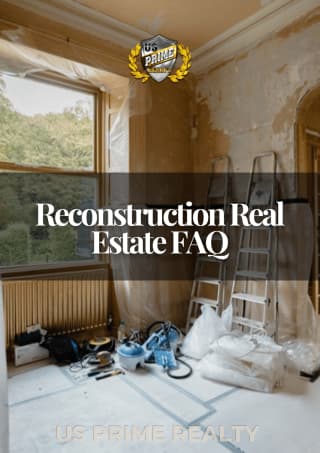
To provide property owners with a definitive roadmap, U.S. Prime Realty has published the Reconstruction Real Estate FAQ guide. This comprehensive, downloadable digital manual is designed to clear up confusion and help you make smart, highly profitable real estate decisions.
A fundamental topic addressed in the Reconstruction Real Estate FAQ is understanding exactly how a complete reconstruction differs from a standard home renovation. While a renovation focuses on improving existing frameworks through cosmetic updates like kitchen remodels or bathroom refreshes, a true reconstruction involves tearing down a property and rebuilding it entirely from the foundation up. Tearing a structure down to its framework or lot requires a comprehensive building permit rather than minor cosmetic approvals.
It also commands a higher financial commitment, typically ranging from one hundred and fifty to over five hundred dollars per square foot depending on whether you install standard, mid-range, or luxury finishes. However, in premium markets where new construction is rare or highly restricted, executing a thorough rebuild can increase your total property value by fifty to over one hundred percent.
Determining when a full reconstruction makes more sense than a layout renovation is a critical first step for property owners. The manual outlines specific indicators where a complete rebuild is the most cost-effective path, particularly when a structure suffers from compromised framing or severe water damage, or when existing spaces fail to comply with modern building safety codes.
Financially, if estimated renovation costs begin to approach seventy percent or more of a total rebuild budget, starting fresh becomes the smarter choice. This strategy allows you to keep an irreplaceable location or neighborhood you love while customizing the architectural design to your exact lifestyle preferences.
The downloadable guide also provides an upfront look at the timeline, municipal permitting, and temporary housing logistics required for a project of this scale. A typical rebuild lifecycle spans twelve to twenty-four months from initial design to final occupancy, progressing through distinct phases of planning, demolition, foundation excavation, framing, and interior finish work.
To keep the project secure, owners must manage a complex permitting matrix that includes demolition authorizations, zoning checks, setback variances, and neighborhood association approvals. Homeowners must also factor in the logistics of temporary housing, budgeting an additional two thousand to six thousand dollars monthly for short-term rental properties, corporate housing, or extended-stay accommodations while construction is underway.
Because financial security is paramount, the guide outlines precise construction funding options and risk-mitigation strategies. Property owners can leverage specialized construction-to-permanent loans, short-term converted mortgages, or cash-out refinancing against their existing equity, though most lenders require a twenty to thirty percent down payment and detailed architectural blueprints upfront.
To safeguard your investment against common industry risks—such as timeline delays or budget overruns—the text teaches owners how to properly vet bonded general contractors with at least five years of experience, maintain an ironclad fifteen to twenty-five percent contingency buffer, secure builder’s risk insurance, and navigate eventual property tax adjustments.
Transforming an aging structure into a modern real estate masterpiece requires professional guidance and disciplined execution. Founded in 2008 by CEO Carmen Isbely Glazer during a historic market downturn, U.S. Prime Realty is a full-service brokerage built on a foundation of absolute resilience, integrity, and concierge-level white-glove service. Our bilingual team is dedicated to providing you with the exact market insights and expert vendor networks needed to make bold, confident real estate moves.
Take complete control of your property’s future today. Download your free copy of the Reconstruction Real Estate FAQ guide. To schedule a private, one-on-one strategy consultation with a premier property specialist, contact U.S. Prime Realty by phone at +1 (239) 513-0011, email cc@usprimerealty.com, or click the button below to schedule your private consultation. We’d be happy to have you join our family as you begin your journey to find your dream home!