What’s it really like to live in Orlando, Florida? The 2026 Guide
Living guide · Orlando, Florida
Living in Orlando, Florida, can mean a walk around Lake Eola before work, dinner in a neighborhood restaurant and a theme-park visit when you actually feel like going. It can also mean a toll-road commute, a surprisingly large summer electric bill and an afternoon storm arriving just as you finish loading the car. Both versions belong in the moving decision.
The real question is whether the Orlando you can afford fits the life you want to lead. This 2026 guide looks at housing, neighborhoods, work, weather and the costs that do not show up in a listing photo. Start with the Orlando community guide and Florida property search so you can compare the discussion with available homes.
Quick answer: Living in Orlando works best when you choose the neighborhood around your daily routine. The city offers lakes, local dining, attractions and varied housing, but summer heat, driving time and ownership costs deserve equal attention. Compare the exact home and commute before deciding whether the move fits.
What is in this guide
- 2026 Orlando Living Snapshot
- The Community Vibe Changes Across the Map
- What Orlando Offers When You Are Off the Clock
- Living in Orlando Florida Through the Seasons
- The Real Cost of Living in Orlando in 2026
- Orlando Neighborhoods and Nearby Communities to Compare
- Jobs, Schools and the Practical Side of Moving
- The Tradeoffs Newcomers Can Miss
- Is Moving to Orlando the Right Fit for You?
- Frequently Asked Questions: Living in Orlando, Florida in 2026
- Finding Your Version of Orlando
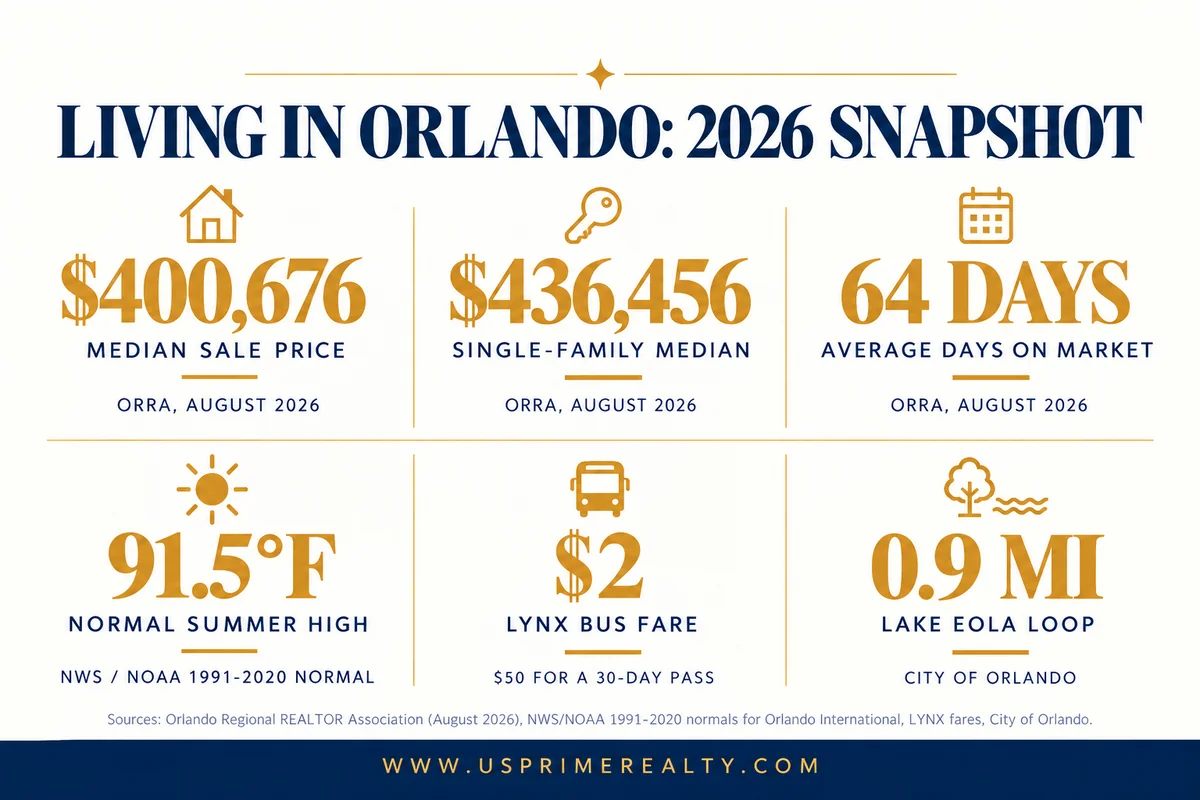
2026 Orlando Living Snapshot
| Living factor | 2026 / latest verified benchmark | Source / how to read it |
|---|---|---|
| Housing market | $400,676 overall median sale price | ORRA August 2026; reported regional market, not city only. |
| Single-family homes | $436,456 median sale price | ORRA August 2026; not an individual property valuation. |
| Condos / townhouses | $301,071 combined median sale price | ORRA August 2026; category combines two property types. |
| Market pace | 64 average days on market | ORRA August 2026; property-level results vary. |
| Summer weather | 91.5°F normal summer average daily high | NWS Orlando International; 1991–2020 normal. |
| Public transit | $2 LYNX ride; $50 30-day pass | Current published fares; confirm routes and hours. |
| Local lifestyle | Lakes, parks, neighborhood dining and attractions | Choose around your routine; beach trips require a drive. |
The Community Vibe Changes Across the Map
Orlando city and Greater Orlando are different searches
When someone says they live in Orlando, they may mean the city itself, an unincorporated Orange County neighborhood or a separate community nearby. Winter Park and Winter Garden are separate cities; Windermere is a separate town. Kissimmee is in neighboring Osceola County. That distinction affects local services, taxes, schools and the rules that apply to a home.
There is no single Orlando routine. A downtown apartment, a Lake Nona townhome, an older College Park house and a property near the resort corridor offer different daily lives. Choose a few real addresses and map your job, groceries, medical appointments and regular activities around them. The right location usually becomes clearer that way.
There is a local life beyond the attractions
Orlando has a neighborhood side that a theme-park trip rarely reveals. Think lakeside walks, independent restaurants, live performances, sports and small commercial districts where the same coffee shop becomes part of your week. You can enjoy the attractions without building your whole calendar around them.
The tradeoff is distance. A home advertised as close to Disney may be inconvenient for a job near UCF or in northeast Orlando. A central neighborhood may put restaurants within walking distance while leaving your workplace a long drive away. Before touring, decide which trips you make five days a week and which you make five times a year.
What Orlando Offers When You Are Off the Clock
For a useful introduction to everyday downtown life, start at Lake Eola Park. The City lists a 0.9-mile sidewalk around the lake, along with swan boats, outdoor performances and other amenities. It is the kind of place that helps explain why some residents choose the urban core rather than the resort corridor.
Elsewhere, the appeal may be a neighborhood trail, a nearby lake, a restaurant district or room for a backyard. Orlando is inland, so beach days require a drive. If ocean access is central to your move, compare that reality with your expectations before trading a coastal search for a Central Florida address.
Local-living detail: Test the trips you will make regularly. A neighborhood that puts groceries, work and a park within easy reach may fit better than a larger home that adds an unwelcome drive to every weekday.
Living in Orlando Florida Through the Seasons
The months that make outdoor plans easy
Cooler months are a major part of Orlando’s appeal. Outdoor meals, neighborhood walks and weekend events can become ordinary pleasures rather than vacation treats. Still, winter is not a promise of warm pool weather every day. Keep room in your expectations for chilly mornings and occasional cold spells.
Summer changes the schedule
The National Weather Service Orlando climate resources are a better guide than a sunny listing photo. Its 1991–2020 climate normals for Orlando International put the average June–August daily high at about 91.5°F. Heat, humidity and thunderstorms matter when you are choosing outdoor activities, maintaining a yard or budgeting for air conditioning.
A practical summer routine often puts walks and yard work earlier in the day and leaves afternoon plans flexible. Visit a home during warm weather if you can. Check shade, drainage, the air-conditioning system and how comfortable the outdoor space feels. A beautiful west-facing patio may get far less use than you expect.
The Real Cost of Living in Orlando in 2026
Home prices need a date and a market boundary
The Orlando Regional REALTOR® Association August 2026 report recorded an overall median sale price of $400,676. Single-family homes had a $436,456 median; the combined condo/townhouse category had a $301,071 median. These are figures for the association’s reported market, not prices for Orlando city alone or estimates for an individual neighborhood.
The report also counted 12,144 homes in inventory, 4.9 months of supply and an average of 64 days on market. That suggests room for careful comparison, but it does not mean every seller will negotiate. Condition, location and recent comparable sales still matter. A repaired roof or a lower recurring fee can be more valuable than a small discount.
Use the Orlando homes and community page to narrow your options, then ask for comparable sales for the same property type and nearby location. A regional median cannot tell you whether a particular lakefront home or downtown condo is fairly priced.
Renting first can make the move easier to evaluate
If you have not lived in Central Florida, an annual lease can give you time to test the commute and experience summer before buying. Compare current listings for the bedroom count and neighborhood you need. A metro rent average can hide big differences between older apartments, newer amenity buildings and detached houses.
Ask for the full monthly total: base rent, parking, pets, required service packages, utilities and renters insurance. If a lease offers a concession, compare both the effective first-year cost and the stated monthly rent. Use the Florida relocation guide to organize timing, moving expenses and the steps between arriving and settling in.
Taxes and recurring fees deserve their own budget
Do not assume the seller’s property-tax bill will become yours. Ask the county property appraiser for a purchase-based estimate and check eligibility for homestead benefits. The Florida Department of Revenue explains homestead exemptions, Save Our Homes and portability; the right treatment depends on the property and your circumstances.
Get an insurance quote for the exact address before committing. Roof age, construction, replacement cost, coverage and deductibles can change the premium. Inland does not mean weatherproof. The Florida insurance consumer guide explains coverage questions worth discussing with your insurance professional.
Then review HOA or condo dues and any Community Development District assessments. Ask what is included, whether there are multiple associations, and whether charges appear on the tax bill or arrive separately. For a new build, request the projected cost after completion; a tax figure based on vacant land will not describe the finished home’s ownership cost.
Budget reality: Compare the complete monthly cost, including post-purchase taxes, written insurance quotes, association or CDD charges, utilities, maintenance, tolls and parking. A lower list price does not always mean a lower cost of living.
Everyday spending depends on your routine
Electricity, water, internet, vehicle insurance and transportation can make two similar homes feel very different financially. Request recent utility history where available and identify the actual providers for the address. A pool, older air conditioner, larger floor plan or long daily drive can offset what looked like a cheaper housing choice.
Give entertainment its own line in the budget. Theme-park passes, parking, dining and visits from out-of-town guests can become regular expenses if you let them. Orlando offers lower-cost routines too, but they work best when you choose a neighborhood that puts the activities you enjoy within easy reach.
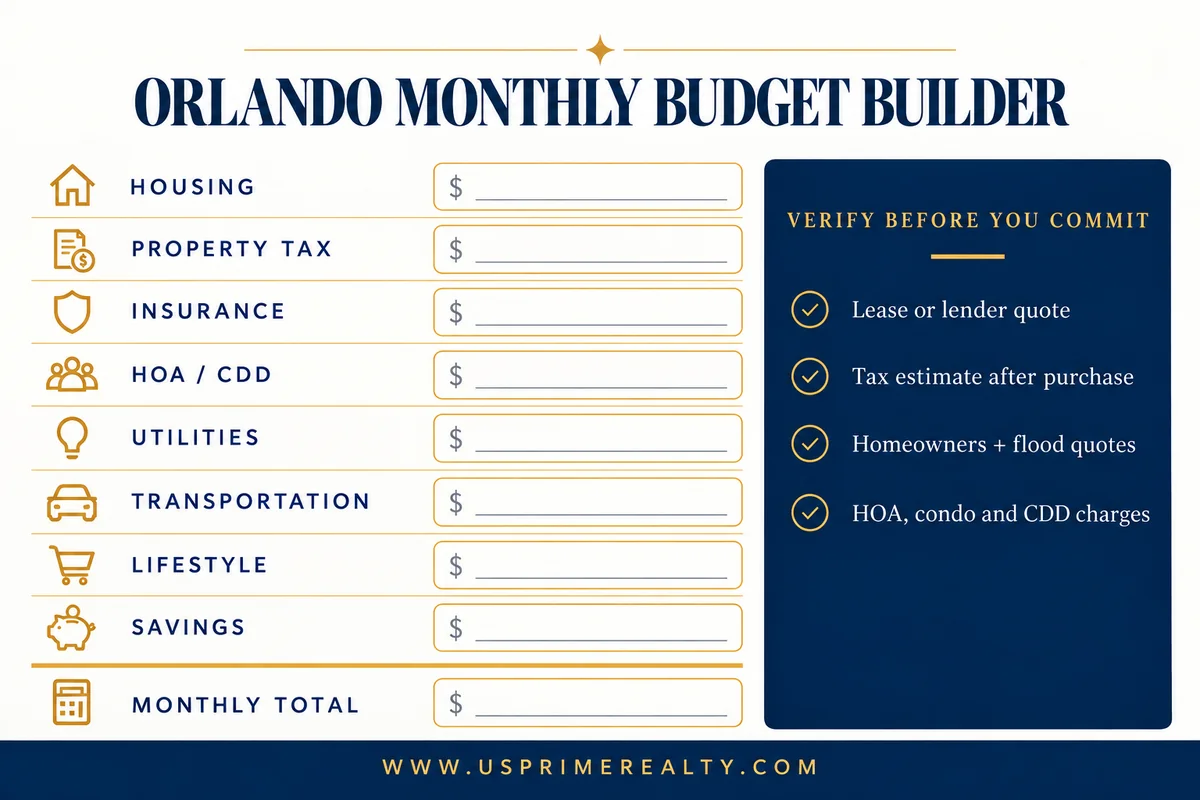
Build a Monthly Budget Around the Actual Home
| Budget category | Start with | Verify before you commit |
|---|---|---|
| Housing | Actual lease or lender quote | Use the exact home, down payment, rate and lease terms. |
| Property tax | Purchase-based estimate | Confirm county, exemptions and post-sale assessment treatment. |
| Insurance | Written homeowners and flood quotes | Check roof requirements, coverage limits and deductibles. |
| HOA / condo / CDD | Full current fee and assessment schedule | Identify separate associations, reserves and charges on the tax bill. |
| Utilities | Property history and actual providers | Include electric, water, internet, pool equipment and cooling. |
| Transportation | Actual commute and vehicle costs | Include fuel, insurance, maintenance, tolls, parking and transit connections. |
| Lifestyle and savings | Your real spending pattern | Include groceries, healthcare, childcare where needed, recreation and repairs. |
Orlando Neighborhoods and Nearby Communities to Compare
A useful shortlist starts with the places you need to reach and the kind of home you want. The areas below are starting points, not rankings. Prices, building condition, school assignments and association rules can vary within each one.
| Area / location focus | What may draw you there | What to verify before you commit |
|---|---|---|
| Downtown / Thornton Park | Urban setting, Lake Eola and restaurants | Parking, building fees, noise at different hours and actual walking routes. |
| College Park | Established streets and a neighborhood commercial district | Roof, plumbing, drainage, renovation history and condition of older homes. |
| Baldwin Park | Planned neighborhood with parks and local services | Association charges, parking rules and property-specific school assignment. |
| Lake Nona / southeast Orlando | Newer communities and proximity to southeast employment destinations | Exact work route, airport noise, tolls, HOA/CDD charges and nearby construction. |
| Winter Park / separate city | Established neighborhoods, lakes and Park Avenue | Municipal boundaries, older-home maintenance, price comparisons and lake rights. |
| Dr. Phillips / Windermere area | Dining, lake-oriented properties and southwest locations | Municipality, commute, association costs, shoreline rights and permitted uses. |
| Winter Garden / Horizon West area | Historic downtown options or newer planned neighborhoods | These are distinct settings; compare road access, construction, fees and school boundaries. |
After choosing two or three areas, compare homes through the Florida property search. Verify the municipality and county for every address, especially when a listing uses “Orlando” as a broad regional description.
Jobs, Schools and the Practical Side of Moving
Match the housing payment to the job you actually have
Tourism is visible, but it is not the only employment story. Healthcare, education, professional services and technical work are part of the broader region. The U.S. Bureau of Labor Statistics reported a mean hourly wage of $29.76 in Orlando–Kissimmee–Sanford in May 2025, compared with $33.54 nationally. That is a metro-wide mean, not a typical salary for every occupation.
Before relocating, compare actual offers, benefits, work schedules and the commute. Remote workers should confirm employer rules, internet availability and a reliable workspace. Households with children should confirm the assigned schools directly with the relevant school district for the address and enrollment year; neighborhood names and listing descriptions are not enrollment guarantees.
A car is useful but transit can fit some routines
Many Orlando housing searches work best when they include a realistic driving budget. LYNX currently lists a $2 single fare, $4.50 all-day pass and $50 30-day pass. SunRail serves a north–south corridor through communities including downtown Orlando, Winter Park and Kissimmee. Check the current timetable and your first and last connections rather than assuming a station nearby solves every trip.
The Tradeoffs Newcomers Can Miss
Inland homes still need a flood and storm review
Look up the address through the FEMA Flood Map Service Center, then ask about drainage, prior water intrusion and insurance options. A location outside a mapped high-risk area does not establish zero flood risk. Flood maps are a starting point for the review, not a substitute for inspection and property-specific advice.
The Florida Department of Financial Services explains that standard homeowners policies do not cover flood damage. Ask for homeowners and flood quotes separately, and have the agent explain the hurricane deductible in dollars. Review roof condition, trees, opening protection and an outage plan as part of the same conversation.
For a lakefront property, also confirm shoreline condition, dock permits, access rights and any restrictions on boating or other uses. A lake view does not automatically include permission to add a dock. Bring these questions into the Florida homebuying process early enough to investigate before your contract deadlines.
Association rules can change how you use the property
Read the budget, meeting minutes, reserve information, insurance details and pending assessments before buying a condo. For any association, check pets, parking, leasing and renovation rules. If rental income is part of your plan, verify local zoning, permits and association restrictions for the exact address. Being near a theme park does not establish permission for short-term rentals.
Is Moving to Orlando the Right Fit for You?
The advantages and drawbacks are practical
Orlando may fit well if you want a broad choice of neighborhoods, access to attractions and cultural events, and a lifestyle built around lakes, parks and year-round activities. The drawbacks are just as tangible: summer heat, driving time, tolls, property carrying costs and areas where growth brings construction or changing traffic patterns.
Try an ordinary weekday before you decide. Drive from a candidate home to work during the actual commute, run a grocery errand and come back after dark. If possible, repeat the trip in rain. Then spend a weekend locally without visiting a theme park. That gives you a better picture of living here than a packed vacation itinerary.
What to check before signing a lease or purchase contract
Put the costs in writing: housing, taxes, insurance, associations, utilities and transportation. Confirm school assignment if relevant, inspect the home, read the community rules and leave room for repairs and moving expenses. The Florida homebuying guide gives you a framework; a property-specific comparison turns it into a decision.
U.S. Prime Realty – Orlando: Compare neighborhoods and properties with U.S. Prime Realty. Call or text 239-513-0011, email cc@usprimerealty.com or request a local consultation. Serving Florida homes since 2008.
Frequently Asked Questions: Living in Orlando, Florida in 2026
Is Orlando, Florida, a good place to live?+
Is Orlando, Florida, a good place to live?
It can be if the neighborhood, commute and total housing cost suit your routine. Attractions, parks and varied housing choices are real advantages. Summer weather, traffic and recurring ownership costs are the tradeoffs to test before moving.
What is the median home price in Orlando in 2026?+
What is the median home price in Orlando in 2026?
ORRA’s August 2026 reported market had a $400,676 overall median sale price, with a $436,456 single-family median and $301,071 for condos/townhouses combined. These are regional market measures, not a valuation of a specific home.
How much does it cost to rent in Orlando?+
How much does it cost to rent in Orlando?
The answer depends on neighborhood, bedrooms, building age and lease terms. Compare current annual listings and ask for the total including required fees, utilities, parking and pets. Use the stated rent as well as any concession-adjusted first-year figure when comparing options.
Which Orlando neighborhoods should I consider?+
Which Orlando neighborhoods should I consider?
Downtown, College Park, Baldwin Park and Lake Nona offer different versions of city living. Winter Park, Winter Garden and Windermere are separate nearby communities worth comparing. Start with your commute, housing needs and budget rather than choosing from a universal “best” list.
How hot is Orlando in summer?+
How hot is Orlando in summer?
Expect hot, humid conditions and plans that need flexibility around thunderstorms. NWS lists a normal summer average daily high of 91.5°F at Orlando International for the 1991–2020 period. Shade, cooling systems and summer utility use deserve attention when touring homes.
Does living in Orlando mean living near Disney?+
Does living in Orlando mean living near Disney?
Not necessarily. Greater Orlando covers a wide area, and a home convenient to downtown, UCF or Lake Nona may not be convenient to the resort corridor. Map the actual trip at the times you plan to travel.
Do I need flood insurance in Orlando?+
Do I need flood insurance in Orlando?
Requirements depend on the lender, property and flood designation; the decision also depends on your risk tolerance. Inland properties can flood. Review the FEMA map, ask about drainage and get a separate flood quote because standard homeowners coverage excludes flood damage.
Can you live in Orlando without a car?+
Can you live in Orlando without a car?
Some routines work with walking, LYNX, SunRail and other connections, especially when home and work line up well. Many households still find a car useful. Test the complete trip and current operating hours before choosing a home on that assumption.
Can I rent out a home near the theme parks?+
Can I rent out a home near the theme parks?
Do not assume so. Long-term and short-term rental rules differ, and local zoning and association restrictions both matter. Confirm permitted uses, licensing, taxes and minimum lease terms for the exact property before relying on rental income.
Should I rent before buying in Orlando?+
Should I rent before buying in Orlando?
Renting can be useful if you are unfamiliar with the region or unsure about your work location. It lets you experience traffic, weather and neighborhood routines first. Compare the moving and lease costs with the benefit of having more time to choose.
Finding Your Version of Orlando
A good Orlando move is often less about finding the city’s most talked-about neighborhood and more about finding a home that makes Tuesday easier. Can you get to work without a drive you resent? Will you use the amenities you are paying for? Does the budget still work after insurance, taxes and repairs?
If the answers look promising, browse Orlando homes and community information and shortlist a few properties. U.S. Prime Realty can help you compare locations and real estate options. Call or text 239-513-0011, email cc@usprimerealty.com or request a consultation. Serving Florida homes since 2008.
Important information note: Market figures, rents, insurance, taxes, association charges, transit schedules and rules can change. This article is general educational information. Confirm property-specific costs and legal, tax, insurance and lending questions with the relevant agencies and licensed professionals.
Share This
About The Author

Isbely Glazer - Founder and Broker of U.S. Prime Realty
Isbely brings over 20 years of experience across Florida’s key markets. She leads with a client-first approach, combining deep market insight with a commitment to trust, results, and long-term relationships.
Business Info


Recent Posts

Florida Real Estate Investment Guide 2026: Top Cities for Property Investors
Florida real estate investment guide 2026: compare Miami, Orlando, Tampa, Cape Coral, Fort Myers, Naples and Jacksonville, plus rental costs and risks.
Moving to Florida in 2026: Why Homebuyers Continue to Choose the Sunshine State
Moving to Florida in 2026? Explore housing prices, taxes, lifestyle, top cities and hidden ownership costs before buying a Florida home.
Orlando Florida Luxury Real Estate: 2026 Market Guide
Explore Orlando Florida luxury real estate in 2026: prices, Windermere, Winter Park, Lake Nona, 2026 housing data, lakefront costs and buyer tips.