Florida Home Insurance in 2026: Costs, Coverage & Tips for Homebuyers
Home insurance · Florida homebuyers
Florida home insurance in 2026 remains one of the most important costs to understand before buying a house in the state. Premiums can vary by thousands of dollars a year based on county, construction type, roof condition, replacement cost, wind-mitigation features, deductibles and the insurance company willing to write the property.
For homebuyers, insurance is not a detail to leave until closing. It can affect the monthly housing budget, lender approval and even whether a particular property is practical to own. U.S. Prime Realty’s Florida homebuying guide explains how insurance, inspections and other ownership costs fit into the purchase process.
The 2026 market is showing signs of stabilization, but Florida home insurance costs are still highly local. The Florida Office of Insurance Regulation (OIR) reports significant county-by-county differences, which is why buyers should compare a property’s condition and insurance quote alongside its purchase price. Buyers considering coastal properties should also review separate flood insurance costs in Florida and the added ownership factors discussed in U.S. Prime Realty’s waterfront homes in Florida guide.
Quick answer: Florida home insurance in 2026 does not have one standard price. OIR market data as of March 31, 2026 shows average annual homeowners premiums including wind of about $3,525 in Hillsborough County, $3,576 in Lee, $3,610 in Orange, $5,534 in Collier, $5,975 in Miami-Dade, $6,136 in Broward and $6,323 in Palm Beach. Your actual quote can be higher or lower. A typical homeowners policy may cover the dwelling, other structures, personal property, liability and additional living expenses, while flood coverage is generally separate. Get property-specific quotes early and review the hurricane deductible before you commit.
What is in this guide
- What Florida home insurance costs in 2026
- What Florida homeowners insurance covers
- Florida hurricane deductibles
- Wind mitigation and your insurance cost
- Flood insurance and Citizens rules in 2026
- 8 ways to control Florida home insurance costs
- Florida home insurance buyer checklist
- Frequently asked questions
Watch: Florida Home Insurance Costs & Buyer Tips
A short video explains the 2026 cost snapshot, what homeowners insurance usually covers, how hurricane deductibles work and what buyers should ask before closing.
What Florida Home Insurance Costs in 2026
OIR’s July 2026 Property Insurance Stability Report uses market data reported as of March 31, 2026. For county averages, OIR calculates total homeowners premium divided by the number of policies. The agency also cautions that an individual premium varies by insurer, insured value, coverage terms and deductibles.
The table below highlights major Florida markets frequently considered by homebuyers. The figures are average annual homeowners premiums including wind coverage, not guaranteed quotes.
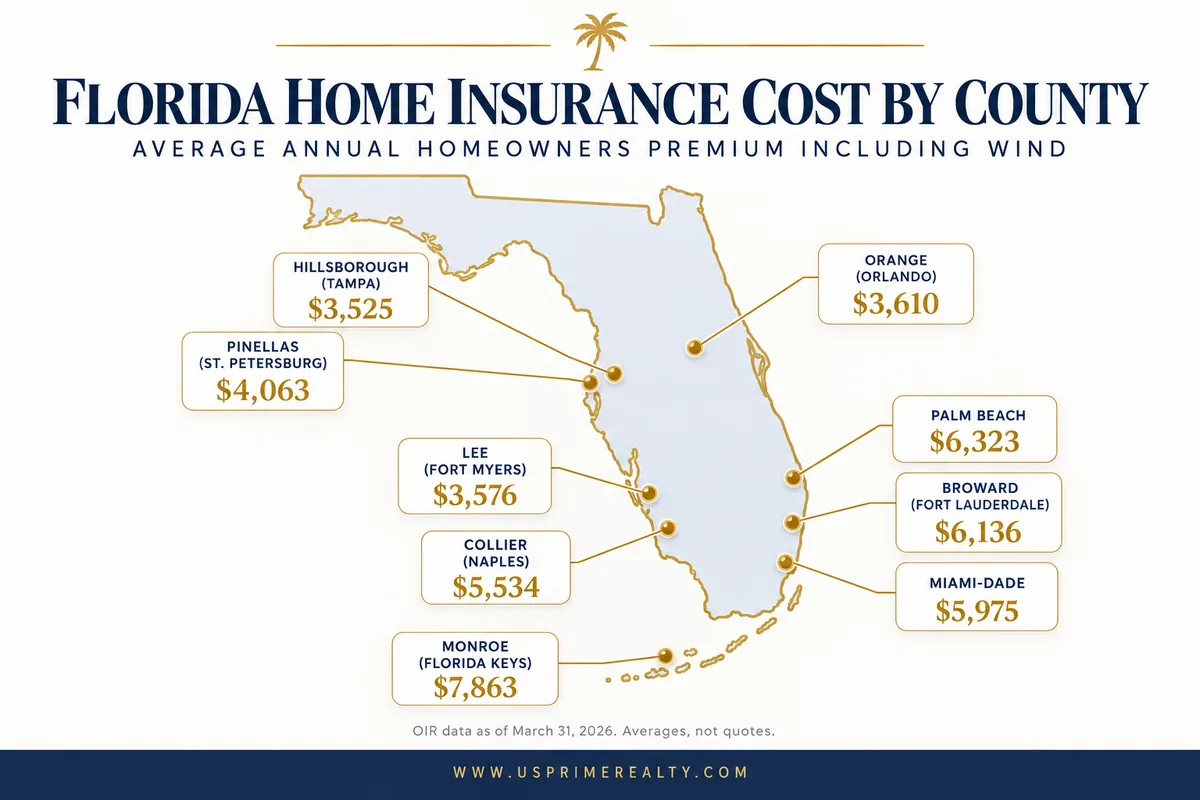
| County / Buyer Market | Avg. Annual Premium Incl. Wind | Buyer Context |
|---|---|---|
| Hillsborough (Tampa area) | $3,525 | Lower than major South Florida coastal counties in this snapshot |
| Lee (Fort Myers area) | $3,576 | Property-specific wind and flood exposure still matter |
| Orange (Orlando area) | $3,610 | Inland location does not eliminate wind or insurance risk |
| Pinellas (St. Petersburg area) | $4,063 | Coastal exposure can affect pricing and availability |
| Collier (Naples area) | $5,534 | Coastal and higher-value properties can require careful shopping |
| Miami-Dade | $5,975 | Wind, replacement cost and coastal exposure can drive premiums |
| Broward (Fort Lauderdale area) | $6,136 | Compare private-market options and deductibles early |
| Palm Beach | $6,323 | Higher coastal averages make quote timing important |
| Monroe (Florida Keys) | $7,863 | Highest of these selected markets in the OIR snapshot |
Source note: Florida Office of Insurance Regulation, July 2026 Property Insurance Stability Report; data as of March 31, 2026. These county averages are market snapshots and should not be used as a substitute for a property-specific insurance quote.
Why Florida Home Insurance Premiums Vary So Much
Two homes with the same sale price can have very different Florida homeowners insurance costs. Insurers evaluate the risk and expected cost to repair or rebuild the structure, not only the purchase price.
- Location and wind exposure: County, ZIP code, distance from the coast and local catastrophe exposure can influence pricing and carrier availability.
- Dwelling replacement cost: Coverage A is based on the estimated cost to rebuild the home, which can differ from market value.
- Roof age, material and condition: A roof can affect both eligibility and premium, especially when an insurer requires additional documentation or an inspection.
- Wind-mitigation features: Impact protection, roof-to-wall connections, roof deck attachment, roof shape and secondary water resistance may qualify for credits when properly documented.
- Deductibles and policy terms: Higher deductibles may reduce premium but increase the cash a homeowner must absorb after a covered loss.
- Property type and occupancy: Single-family homes, condos, second homes, rentals and older properties can be underwritten differently.
OIR’s CHOICES rate comparison tool can help consumers view sample average rates by Florida county. OIR notes that the figures are illustrative and recommends getting an official quote from an insurer or licensed insurance agent.
What Does Florida Homeowners Insurance Cover?
A Florida homeowners insurance policy can include several types of protection, but the exact limits, exclusions and endorsements vary. Buyers should review the declarations page and policy forms instead of assuming every policy covers the same risks.
1. Dwelling and Other Structures
Dwelling coverage, often called Coverage A, generally protects the insured structure against covered causes of loss. Other structures coverage may apply to detached features such as a fence, shed or detached garage, subject to the policy terms and limits.
2. Personal Property
Personal property coverage can help replace or repair covered belongings after a covered loss. Limits, valuation methods and special sublimits may apply to jewelry, art, electronics, collectibles and other high-value items.
3. Personal Liability and Medical Payments
Liability coverage may help when the homeowner is legally responsible for covered bodily injury or property damage to others. Medical payments coverage can apply to certain smaller injuries regardless of fault, subject to the policy.
4. Additional Living Expenses
If a covered loss makes the home uninhabitable, loss-of-use or additional-living-expense coverage may help with eligible temporary housing and related costs. Confirm the limit and time period before you buy.
5. Windstorm and Hurricane Coverage
Many Florida homeowners policies include wind coverage, but coverage structure can vary by insurer and location. In some situations, windstorm coverage may be written separately. Buyers should confirm whether wind and hurricane losses are covered and how the hurricane deductible applies.
6. Ordinance or Law Coverage
Rebuilding after a major loss may require upgrades to meet current building codes. Florida’s Department of Financial Services explains that regulated insurers include at least 25% Ordinance and Law Coverage relative to the dwelling amount and must offer 50%. Review the exact amount and cost in the quote using the state’s homeowners insurance shopping guidance.
7. Flood Insurance Is Usually Separate
Standard homeowners insurance generally does not cover flooding. Buyers in coastal, low-lying or flood-prone areas should price flood coverage separately and review U.S. Prime Realty’s Florida flood insurance cost guide before finalizing the ownership budget.
Florida Hurricane Deductibles: What Homebuyers Need to Know

Florida’s hurricane deductible rules are different from the ordinary all-perils deductible. Authorized insurers generally must offer hurricane deductible options of $500, 2%, 5% or 10% of dwelling or structure limits, subject to statutory exceptions. For homes insured at $250,000 or more, for example, the insurer does not have to offer the $500 option. Surplus-lines policies can follow different terms, so buyers should read the declarations page carefully.
The most important point is that a percentage hurricane deductible is based on the insured dwelling or structure limit, not the size of the claim. A home with $400,000 of Coverage A and a 2% hurricane deductible would have an $8,000 hurricane deductible. A 5% deductible on the same Coverage A amount would be $20,000.
For personal residential policies with the same insurer or insurer group, Florida’s hurricane deductible generally applies on a calendar-year basis to covered hurricane losses. Buyers should confirm how the deductible would work under the specific policy and whether they could comfortably pay it after a storm.
Buyer budget note: A lower premium is not automatically a better deal if the policy has a deductible, exclusion or coverage limit that would be difficult to absorb after a loss. Compare total protection, not only the annual price.
Wind Mitigation Can Affect Florida Home Insurance Cost
Wind mitigation is one of the most important insurance topics for Florida homebuyers. OIR’s Wind Mitigation Resources explain that qualifying wind-resistant features can produce insurance premium savings. The state’s updated Uniform Mitigation Verification Inspection Form OIR-B1-1802 became effective April 1, 2026 and is valid for up to five years when there are no material structural changes or inaccuracies.
A wind-mitigation inspection can document features such as roof deck attachment, roof-to-wall connection, roof geometry, secondary water resistance and opening protection. The actual credit depends on the property, inspection results, insurer and current rating plan.
Homebuyers should also review U.S. Prime Realty’s Florida hurricane season home-protection guide for practical questions to ask about the roof, windows, garage door and other storm-readiness features before closing.
Flood Insurance and Citizens Rules in 2026
Flood risk and homeowners insurance are related, but they are not the same coverage. The National Flood Insurance Program states that flood insurance typically has a 30-day waiting period after purchase, with specific exceptions including certain mortgage transactions. Buyers can review the official FloodSmart policy guidance and should not wait until a storm is approaching to investigate coverage.
For Citizens Property Insurance Corporation policies, 2026 flood-coverage requirements are especially important. For most Personal Residential policies that include wind coverage and are outside the Special Flood Hazard Area, Citizens requires flood insurance when Coverage A is $400,000 or more for policies effective in 2026. Homes in a Special Flood Hazard Area with applicable Citizens wind coverage are already subject to flood requirements. Citizens states that the phase-in expands to all applicable policies regardless of value in 2027. Condominium unit-owner policies, tenant content policies and policies that exclude windstorm or hail have stated exemptions.
These Citizens rules are not the same as a blanket requirement for every private homeowners policy in Florida. Buyers should confirm the rules that apply to the insurer, mortgage and specific property.
8 Ways Homebuyers Can Control Florida Home Insurance Costs
1. Get Insurance Quotes Before Your Contract Deadlines
Do not wait until the final days before closing. Start obtaining property-specific quotes as soon as you have an address and enough property information. That gives you time to compare options and investigate underwriting concerns.
2. Review Roof Age and Condition Early
Ask for permits, roof age, material and available inspection records. If the insurer raises a roof concern, you want enough time to understand whether repair, replacement or additional documentation could change eligibility or price.
3. Ask for Existing Wind-Mitigation and Inspection Reports
If the seller has a current wind-mitigation report, review it with the insurance professional. Your insurer may still require its own documentation, but existing reports can help identify features and questions to verify.
4. Compare More Than One Carrier and Policy Structure
Compare coverage limits, deductibles, exclusions, endorsements, financial strength and the insurer’s status, not just the premium. An admitted carrier and a surplus-lines carrier can have different regulatory and guaranty-fund implications.
5. Compare Hurricane Deductibles in Dollars
Convert the percentage into a dollar amount using Coverage A. A buyer who sees “2%” should understand the exact cash exposure before choosing the policy.
6. Budget Flood Insurance Separately
Check the flood zone, lender requirements, elevation information when relevant and both NFIP and available private-flood options. A low homeowners premium can be misleading if the separate flood premium is ignored.
7. Verify Replacement Cost and Major Exclusions
Make sure the dwelling limit reflects a reasonable rebuilding estimate and ask about water, roof, screened-enclosure, ordinance-or-law and other limitations that could matter for the specific home.
8. Compare the Total Monthly Ownership Cost
Insurance belongs in the same affordability calculation as mortgage principal and interest, property taxes, HOA or condo fees, flood coverage and maintenance. Use U.S. Prime Realty’s Florida communities guide to compare locations, then evaluate the actual insurance profile of each property separately.
Florida Home Insurance Buyer Checklist
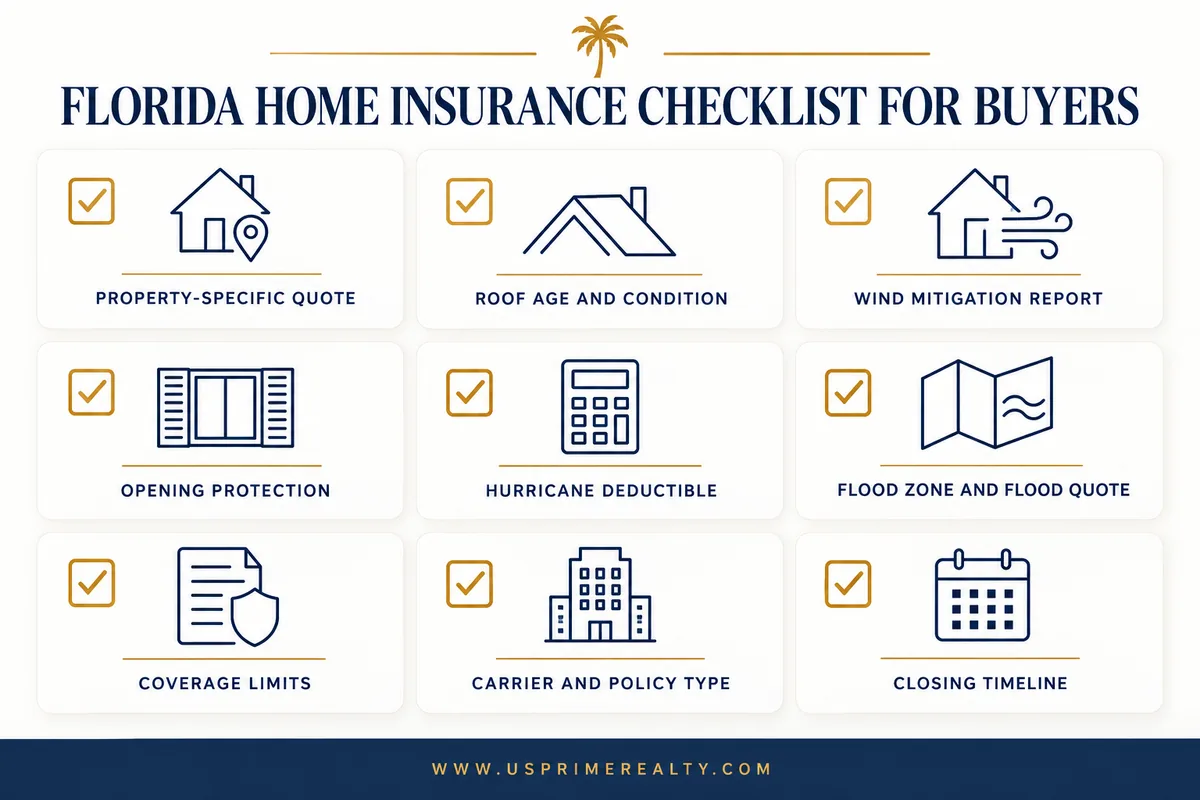
| Item | What to Check | Why It Matters |
|---|---|---|
| Property address | Obtain a real insurance quote, not a statewide estimate | Premiums vary substantially by county and property |
| Roof | Age, permit history, material, condition and insurer requirements | Can affect eligibility, credits and price |
| Wind mitigation | Current OIR-B1-1802 form or inspection when appropriate | May document features eligible for wind credits |
| Openings | Impact-rated windows/doors or approved shutters and documentation | Opening protection can matter to wind rating |
| Hurricane deductible | Percentage and exact dollar amount | Shows your out-of-pocket exposure after a covered hurricane |
| Flood | Flood zone, lender rules, Citizens rules and separate quote | Homeowners insurance generally excludes flood |
| Coverage limits | Dwelling, personal property, liability, ALE and ordinance/law | The cheapest policy may not provide adequate protection |
| Carrier / policy type | Admitted vs. surplus lines, exclusions and endorsements | Regulatory protections and policy terms can differ |
| Closing timeline | Binder, proof of insurance and lender requirements | Insurance delays can affect financing and closing |
Buying a Florida Home? Make Insurance Part of the Property Decision
A home can look affordable based on the listing price and mortgage payment but become much more expensive once insurance, flood coverage, taxes and HOA costs are included. That is especially important for older homes, high-value homes and coastal or waterfront properties.
Start with U.S. Prime Realty’s Florida property search to compare active homes, then use the Florida homebuying guide to organize inspections, insurance and closing steps. Buyers considering oceanfront, Intracoastal or canalfront homes can also use the waterfront homes in Florida guide to evaluate additional ownership questions.
U.S. Prime Realty is a licensed Florida real estate brokerage, not an insurance company. The brokerage can help with the real-estate side of the process, including property searches, local market comparisons, showings, offers and transaction coordination. Insurance coverage, underwriting, premiums and policy advice should be confirmed with a licensed insurance professional and the applicable insurer.
Your Next Step
For Florida homebuyers, the best time to investigate insurance is before a property becomes an expensive surprise. Compare the home’s price, condition, wind protection, flood exposure, deductible and insurance quote as one ownership decision.
If you are considering buying, selling or relocating in Florida, contact U.S. Prime Realty or find a Florida real estate agent for local real-estate guidance. For insurance questions, work with a licensed insurance agent or company and verify current policy terms before binding coverage.
Frequently Asked Questions
How much is home insurance in Florida in 2026?+
How much is home insurance in Florida in 2026?
OIR data shows major county differences; selected 2026 averages including wind range widely. Your actual premium depends on the property, insurer, limits and deductibles.
Does Florida homeowners insurance cover hurricanes?+
Does Florida homeowners insurance cover hurricanes?
Many policies include wind and hurricane coverage, but terms differ. Confirm wind coverage, exclusions and the hurricane deductible on the declarations page.
Does homeowners insurance cover flood damage in Florida?+
Does homeowners insurance cover flood damage in Florida?
Usually not. Flood insurance is generally purchased separately through the NFIP or a private flood insurer.
What is a hurricane deductible in Florida?+
What is a hurricane deductible in Florida?
It applies to covered hurricane losses. A percentage deductible is based on the dwelling or structure coverage amount, so ask for the exact dollar amount.
Can wind mitigation lower Florida home insurance premiums?+
Can wind mitigation lower Florida home insurance premiums?
Qualifying features may earn credits or discounts when documented. Florida’s updated OIR-B1-1802 inspection form became effective April 1, 2026.
What should I check before buying a house in Florida for insurance?+
What should I check before buying a house in Florida for insurance?
Check the roof, wind mitigation, opening protection, flood exposure, quotes, hurricane deductible, coverage limits and any required inspections.
Does Citizens require flood insurance in 2026?+
Does Citizens require flood insurance in 2026?
For applicable Citizens policies with wind coverage, 2026 rules include a $400,000 Coverage A threshold outside Special Flood Hazard Areas, subject to stated exemptions.
Is U.S. Prime Realty an insurance company?+
Is U.S. Prime Realty an insurance company?
No. U.S. Prime Realty is a licensed Florida real estate brokerage. Confirm insurance advice and policy terms with licensed insurance professionals and insurers.
Important information note: Insurance premiums, coverage forms, underwriting rules, Citizens requirements, flood rules, deductibles, wind-mitigation credits and insurer availability can change. County figures in this article are OIR market averages as of March 31, 2026 and are not quotes. This article is general educational information and is not insurance, legal, financial or engineering advice.
Share This
About The Author

Isbely Glazer - Founder and Broker of U.S. Prime Realty
Isbely brings over 20 years of experience across Florida’s key markets. She leads with a client-first approach, combining deep market insight with a commitment to trust, results, and long-term relationships.
Business Info


Recent Posts

Pre-Construction Properties in Florida: Discover New Homes for Sale Across the State
Discover pre-construction properties in Florida, from Miami and Sunny Isles condos to Naples, Cape Coral and Orlando new homes. Explore options with U.S. Prime Realty.
New Construction vs. Pre-Construction Homes in Florida: Which Is Right for You?
New construction vs. pre-construction homes in Florida: compare costs, timelines, deposits, builder incentives and risks before you buy.
Florida Flood Zones: What Homebuyers Need to Know Before Buying a Home
Buying a home in Florida? Learn how FEMA Florida flood zones, flood insurance, elevation, seller disclosures and Citizens requirements can affect your costs and risk.