South Florida Condo vs. Single-Family Home: Which Makes More Financial Sense in 2026?
Condo vs. house · South Florida buyers
A South Florida condo vs. single-family home decision in 2026 should be based on more than the listing price. Condos often provide a lower entry point in Miami-Dade, Broward and Palm Beach counties, but association dues, reserve funding, insurance, possible special assessments and project-level financing can materially change the real cost. Single-family homes usually require more upfront capital and place the full responsibility for insurance, roof, exterior and other maintenance on the owner, but they can offer more control over long-term expenses and property decisions.
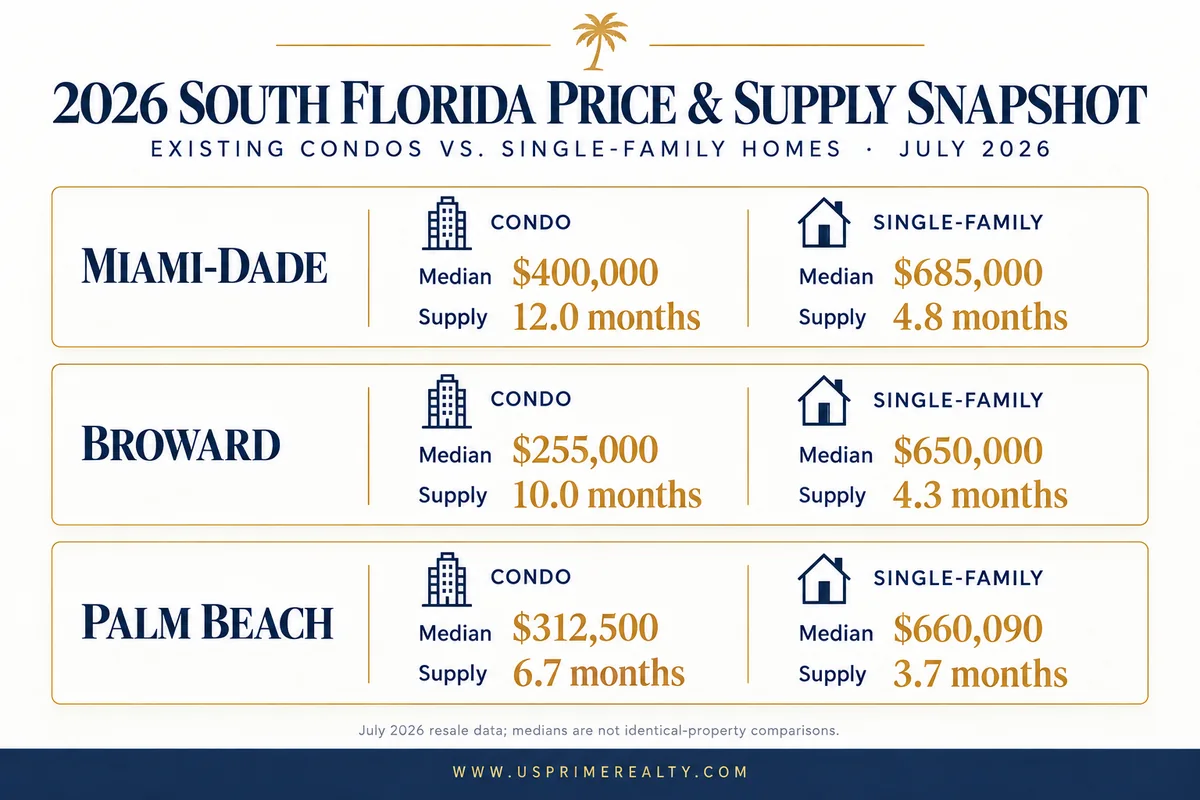
The latest county-level releases available when this guide was drafted use July 2026 sales data. In Miami-Dade, the median sale price was $400,000 for existing condos and $685,000 for single-family homes. In Broward, the medians were $255,000 and $650,000. In Palm Beach County, they were $312,500 and $660,090. These medians are not apples-to-apples comparisons of identical locations, sizes or condition, but they show why many buyers start with condos when purchase price is the first constraint.
If you are still deciding based mainly on lifestyle, amenities and space, start with U.S. Prime Realty’s South Florida Condo or House: Smart 2026 Buyer Guide. This article takes a different angle: the numbers, risk factors and documents that determine which property type makes more financial sense.
Quick answer: A condo can make more financial sense when the lower purchase price meaningfully reduces the mortgage and the building has manageable dues, adequate reserves, reasonable insurance, no major pending assessment and financing that fits the buyer. A single-family home can make more financial sense when the buyer can absorb the higher purchase price and direct maintenance costs in exchange for greater control, simpler property-level financing and fewer shared-building financial risks. The better choice is property-specific, not just property-type-specific.
What is in this guide
- Watch: the 2026 condo vs. house cost test
- What the 2026 South Florida market says
- The 7 financial tests
- The 5-year total cost of ownership test
- When a condo can make more financial sense
- When a single-family home can make more financial sense
- 2026 condo financing and the building
- Condo reserves and special assessments
- Miami-Dade, Broward and Palm Beach
- Quick financial fit table
- Frequently asked questions
Watch: The 2026 South Florida Condo vs. House Cost Test
A short video can walk buyers through the five numbers to compare before making an offer: purchase price, monthly housing payment, insurance, shared or direct maintenance, and future capital costs.
What the 2026 South Florida Market Says About Condos vs. Single-Family Homes
Price is only one part of the decision, but current inventory also matters because it affects negotiation, time on market and the risk of overpaying. July 2026 data shows that single-family homes remained tighter than condos across the three largest Southeast Florida counties.
| County | Existing condo median | Single-family median | Condo supply | Single-family supply |
|---|---|---|---|---|
| Miami-Dade | $400,000 | $685,000 | 12.0 months | 4.8 months |
| Broward | $255,000 | $650,000 | 10.0 months | 4.3 months |
| Palm Beach | $312,500 | $660,090 | 6.7 months | 3.7 months |
Source note: MIAMI REALTORS® + RWorld July 2026 county market releases for Miami-Dade, Broward and Palm Beach County, published August 17, 2026. Countywide medians and months of supply are market snapshots, not comparisons of identical properties.
What this means financially: condo buyers may have more room to compare buildings, negotiate price or seller concessions, and walk away from weak association finances, especially in Miami-Dade and Broward. Single-family buyers may face tighter supply and stronger competition, but they are not buying into the financial condition of a condominium association. Market leverage is useful only if the underlying property remains affordable after all recurring and future costs are included.
The 7 Financial Tests That Decide Which Property Type Makes More Sense
1. Purchase Price and Down Payment
Condos can reduce the amount of cash needed simply because the purchase price is often lower in the same broad metro area. A lower price can reduce the down payment, loan amount, interest expense and property-tax exposure. But a lower purchase price does not guarantee a lower monthly cost if association dues are high or a major assessment is pending.
Use U.S. Prime Realty’s Florida property search to compare condos and single-family homes within the same neighborhood, price band and commuting area rather than comparing countywide medians alone.
2. Mortgage and Project Financing
A single-family mortgage is underwritten primarily around the borrower and the property. Condo financing can add a second layer: the project itself. Lenders may review association finances, insurance, critical repairs, litigation, occupancy, reserves and other project-level requirements.
In 2026, Fannie Mae updated condo project standards, including expanded project-review waivers in some cases, retirement of the Limited Review process for loan applications on or after August 3, 2026, and enhanced reserve-related requirements. The change does not mean every condo is harder to finance; it means buyers should verify project eligibility early because the building can affect loan execution.
3. HOA Dues, Reserves and Special Assessments
Condo dues may cover services a house owner would pay separately for, such as exterior maintenance, landscaping, common-area utilities, security, amenities, building staff, master insurance and reserve contributions. That makes the headline HOA number incomplete by itself. The right question is what the fee covers, whether the budget is realistic, and whether reserves are adequate for the building’s future obligations.
Florida condominium law now places greater emphasis on structural reserve planning for many three-habitable-story-or-higher residential condominium buildings. The 2026 Florida Statutes, Section 718.112, addresses structural integrity reserve studies and reserve funding. The Florida DBPR condominium FAQs also summarize the study requirements and timing. Buyers should review the actual building records rather than assume a low monthly fee means a low long-term cost.
4. Insurance and Flood Exposure
Insurance works differently for a condo unit and a detached house. Florida’s Department of Financial Services homeowners insurance overview explains that owner-occupied single-family homes commonly use an HO-3 form, while condominium unit owners generally use an HO-6 form for unit-level property and liability. Condo owners also indirectly pay for the association’s master insurance through dues or assessments. A house owner generally carries the building coverage directly.
Flood risk can affect either property type. Review the FEMA Flood Map Service Center and obtain actual insurance quotes before the inspection or financing contingency expires. For coastal condos, also ask how the master policy, deductibles and association responsibilities could flow through to unit owners after a loss.
5. Maintenance and Capital Repairs
A condo can make exterior maintenance more predictable because the association coordinates shared systems and common elements. The tradeoff is that owners give up some control over timing and cost. A single-family owner controls more of the maintenance calendar, but every roof, exterior surface, HVAC system, drainage issue, pool component, landscape expense and storm repair ultimately belongs to that owner.
For the financial comparison, do not treat “no HOA fee” as “no maintenance cost.” Create a realistic annual repair reserve for the house and compare it with the condo’s dues plus any known or likely assessments.
6. Resale Liquidity and Negotiating Leverage
In July 2026, condo inventory was materially higher than single-family inventory in Miami-Dade and Broward. That can help a buyer negotiate, but the same supply can also mean more competition when it is time to resell. Single-family supply was tighter across all three counties, which can support resale demand, although price, neighborhood, condition and insurance remain decisive.
7. Rental Rules and Investment Cash Flow
For investors, condo association rental restrictions can change the economics more than the purchase price. Minimum lease periods, waiting periods, application fees, tenant approval rules, limits on the number of leases per year and short-term rental restrictions all matter. Single-family homes may offer more control, but local zoning, HOA restrictions, insurance and property-management costs can still limit returns.
For a broader market view, see U.S. Prime Realty’s South Florida real estate investment guide.
Use a 5-Year Total Cost of Ownership Test, Not Just a Monthly Payment
A financially sound comparison should put both properties on the same time horizon. Five years is a useful planning window because it forces the buyer to include recurring expenses, major repairs or assessments, principal paydown and expected transaction costs instead of focusing only on the first month.
Condo 5-year cost
= down payment + closing costs + mortgage interest + property taxes + HO-6 insurance + HOA dues + parking/storage fees + special assessments + interior maintenance − principal paid down − net sale proceeds.
Single-family 5-year cost
= down payment + closing costs + mortgage interest + property taxes + homeowners/wind/flood insurance + HOA if any + roof/HVAC/exterior reserve + landscaping/pool/pest control + repairs − principal paid down − net sale proceeds.
Do not assume a future appreciation rate in the base-case calculation. Run the comparison first with flat resale value, then add conservative upside and downside scenarios. That shows whether the purchase still works without depending on price growth.
| Cost area | Condo: include | Single-family: include | What to verify before offer |
|---|---|---|---|
| Purchase / financing | Price, down payment, condo project eligibility | Price, down payment, property eligibility | Pre-approval and lender-specific conditions |
| Taxes | County tax estimate; homestead if applicable | County tax estimate; homestead if applicable | Property appraiser estimate after sale |
| Insurance | HO-6 + share of master-policy cost through dues | Homeowners/wind + flood if applicable | Written quotes, deductibles and exclusions |
| Shared / exterior costs | Monthly association dues | HOA if any + direct exterior costs | Exactly what the HOA or condo fee covers |
| Capital repairs | Reserve funding + assessments | Roof, HVAC, plumbing, exterior, pool | Age, condition and remaining useful life |
| Flood / storm | Building exposure + unit coverage responsibilities | Property elevation, drainage + building coverage | FEMA map + insurer requirements |
| Rental economics | Association and municipal rules | HOA and municipal rules | Lease restrictions and realistic rent |
| Exit / resale | Building health + competing units | Neighborhood demand + property condition | Recent comparable sales and inventory |

When a South Florida Condo Can Make More Financial Sense
A condo can be the financially stronger choice when the lower purchase price is not offset by weak building finances. The strongest condo candidates usually combine a fair price with transparent association records, stable insurance, realistic reserves and a fee structure that replaces expenses the buyer would otherwise pay separately.
- The purchase price is meaningfully below comparable single-family options in the same location.
- The monthly association fee fits the budget even after future increases are stress-tested.
- There is no large unresolved special assessment, or the assessment is fully understood and priced into the offer.
- The association has completed required inspections and reserve studies and can provide current financial records.
- The building is acceptable to the buyer’s lender and insurance carrier.
- The buyer values amenities, security or waterfront access enough that the included services replace separate spending.
- Rental rules match the buyer’s actual plan if the property will be leased.
Buyers focused on Miami high-rises can also review U.S. Prime Realty’s South Beach apartments and condo cost guide for a closer look at HOA fees, association finances, insurance and assessments.
When a Single-Family Home Can Make More Financial Sense
A single-family home can be the financially stronger choice when the buyer can afford the higher entry price and wants to control maintenance, improvements and resale strategy directly. The absence of a condo association does not eliminate costs; it changes who controls them and how they arrive.
- The buyer plans to stay long enough for the higher upfront cost to be absorbed over a longer ownership period.
- The home has a sound roof, HVAC, plumbing, electrical system and exterior, reducing near-term capital risk.
- Insurance and flood costs are known before closing and remain affordable in the buyer’s stress-tested budget.
- The buyer wants renovation freedom, a yard, private dock, expansion potential or other features that may support long-term utility and resale.
- There is no high-cost community HOA, or the HOA provides enough value to justify its fee.
- The buyer values avoiding project-level condo financing and shared-building assessment risk.
- The neighborhood has durable demand for detached homes and the property is not functionally obsolete for the area.
2026 Condo Financing: Why the Building Can Affect Your Loan
Condo financing is not simply a mortgage on an individual unit. Under Fannie Mae condo project standards, lenders may need to determine the project review type, project eligibility and insurance compliance. Fannie Mae’s March 2026 lender letter expanded some waiver options but also retired Limited Review for loan applications on or after August 3, 2026 and strengthened reserve-related requirements.
For a buyer, the practical lesson is simple: ask the lender to review the building as early as possible. A low rate quote does not help if the lender later determines that the project does not fit the loan program. Cash buyers avoid mortgage-project review, but they still inherit the association’s financial condition, rules and future assessments.
FHA buyers can also use the HUD condominium approval tools to investigate project approval status and should discuss single-unit approval possibilities with an FHA-approved lender when applicable.
Florida Condo Reserves and Special Assessments: What Buyers Should Read Before Closing
The financial health of the association can be more important than the unit’s finishes. A beautifully renovated condo in a poorly funded building can expose the owner to rising dues, assessments, financing obstacles or resale difficulty. Buyers should request and review the association package early enough to make an informed contract decision.
- Current annual budget and recent financial statements.
- Structural Integrity Reserve Study (SIRS), when applicable, and the funding schedule used by the association.
- Milestone inspection reports and repair recommendations, when applicable.
- Current reserve balances and the components those reserves are intended to fund.
- Pending or approved special assessments, including payment schedules and who is responsible at closing.
- Master insurance declarations, deductibles and major exclusions.
- Board and member meeting minutes for evidence of major repair discussions, insurance issues or planned projects.
- Pending litigation and lender questionnaires or project eligibility issues.
- Rental, pet, parking, renovation and leasing rules that could affect use and resale.
Important condo due-diligence note: A reserve study or clean-looking budget does not guarantee that no future assessment will occur. Building condition, insurance, project scope, deductibles, construction costs and board decisions can change. Have the appropriate attorney, lender, insurer, inspector or association professional review documents that affect your purchase.
How the Financial Tradeoff Looks Across Miami-Dade, Broward and Palm Beach
Miami-Dade: Lower Condo Entry Price, More Condo Inventory
July 2026 data showed a $400,000 existing-condo median versus $685,000 for single-family homes, with 12 months of condo supply compared with 4.8 months for single-family homes. This gives condo buyers more negotiating leverage on average, but building-level reserves, insurance and financing remain critical. Explore the U.S. Prime Realty Miami community page for local property options and ownership considerations.
Broward: The Widest Countywide Median Price Gap in This Snapshot
Broward’s July 2026 median was $255,000 for existing condos and $650,000 for single-family homes. Condo supply was 10 months versus 4.3 months for detached homes. That can create opportunities for condo buyers who are disciplined about association due diligence. For local examples, see U.S. Prime Realty’s Fort Lauderdale community guide and Aventura guide for nearby condo-heavy and waterfront markets.
Palm Beach: Condos Closer to a Balanced Market
Palm Beach County’s July 2026 median was $312,500 for existing condos and $660,090 for single-family homes. The condo market had 6.7 months of supply, closer to balanced conditions, while single-family supply was 3.7 months. That means buyers should not assume every South Florida condo market offers the same negotiating power; county, city, building and price tier can behave differently.
Quick Financial Fit: Condo or Single-Family Home?
| Buyer priority | Condo may make more sense when… | Single-family may make more sense when… |
|---|---|---|
| Lower upfront purchase price | The unit is substantially less expensive and HOA costs remain manageable | The buyer can afford the higher price without stretching reserves |
| Monthly predictability | Dues cover meaningful services and the association is well funded | The buyer prefers to self-fund repairs and control timing |
| Financing simplicity | The project clearly fits the chosen loan program | Avoiding condo project review is a priority |
| Storm / insurance planning | Master coverage is strong and unit responsibilities are clear | A full property policy is quoted and affordable |
| Renovation / control | Limited customization is acceptable | Freedom to improve, expand or reconfigure matters |
| Seasonal ownership | Security, staff and shared maintenance reduce remote-management needs | The buyer has reliable property-management services |
| Investment use | Rental rules support the strategy and dues still allow positive economics | Rental flexibility and control are more important than amenities |
| Resale flexibility | The building has strong finances, demand and financeability | Detached-home demand is durable in the target neighborhood |
What U.S. Prime Realty and Isbely Glazer Can Help With
U.S. Prime Realty is a licensed Florida real estate brokerage. The team can help buyers compare actual condos and single-family homes by purchase price, association costs, property taxes, market inventory, building documents, neighborhood demand and resale considerations. Buyers can start with the Florida homebuying guide, browse the Florida property search, or review the South Florida investment guide.
For a property-specific comparison, contact U.S. Prime Realty at +1 (239) 513-0011 or cc@usprimerealty.com. A useful buyer comparison should combine the listing, association documents, insurance quotes, lender feedback, inspection findings and recent comparable sales.
U.S. Prime Realty is a real estate brokerage, not a mortgage lender or an insurer. Any financing discussed in this guide is subject to lender approval, and loan eligibility, project approval, rates and terms are determined by the lender. Insurance coverage and premiums should be confirmed with a licensed insurance professional.
Your Next Step: Compare Two Real Properties Side by Side
Before deciding that condos or houses are financially better, choose one realistic condo and one realistic single-family home in the same target area and compare them on the same five-year horizon. Ask the lender for payment estimates on both, obtain insurance quotes, request the condo association package, estimate house maintenance reserves, and compare exit conditions using current market data.
That process turns a generic “condo vs. house” debate into a decision based on the actual properties you can buy.
Important information note: Real estate prices, mortgage guidelines, insurance premiums, flood requirements, condominium reserves, association fees, special assessments, property taxes and local market conditions can change and vary by property. This article is general educational information and is not legal, tax, lending, insurance, engineering or investment advice. Verify property-specific costs with the appropriate licensed professionals before making a purchase decision.
Frequently Asked Questions
Is a condo cheaper than a single-family home in South Florida in 2026?+
Is a condo cheaper than a single-family home in South Florida in 2026?
Countywide July 2026 medians were lower for existing condos than for single-family homes in Miami-Dade, Broward and Palm Beach. But a lower purchase price does not automatically mean lower total ownership cost. HOA dues, master insurance, reserves, special assessments and financing can materially change the comparison.
Are South Florida condos a better deal because there is more inventory?+
Are South Florida condos a better deal because there is more inventory?
More condo inventory can create negotiating leverage, especially in Miami-Dade and Broward, but inventory alone does not make a property a good deal. Buyers still need to evaluate the building budget, reserves, insurance, assessments, financing eligibility and resale demand.
What condo documents should I review before buying in Florida?+
What condo documents should I review before buying in Florida?
Review the current budget, financial statements, reserve study when applicable, milestone inspection information when applicable, reserve balances, special assessments, master insurance, recent meeting minutes, litigation disclosures, rental rules and other association records provided for the transaction.
Are condos harder to finance in 2026?+
Are condos harder to finance in 2026?
Not necessarily, but condo financing can require project-level review in addition to borrower underwriting. Fannie Mae changed its condo project standards in 2026, including retiring Limited Review for loan applications on or after August 3, 2026 while expanding some waiver options. Ask your lender to review the building early.
Does a low HOA fee mean a condo is financially healthier?+
Does a low HOA fee mean a condo is financially healthier?
No. A low fee can be attractive, but buyers should examine what it covers and whether the association is funding future obligations adequately. An unusually low fee can become expensive later if major repairs are not being reserved for.
Does a single-family home avoid HOA costs completely?+
Does a single-family home avoid HOA costs completely?
Not always. Many detached homes are located in homeowner associations and have regular dues or assessments. Even without an HOA, the owner must directly fund roof, exterior, landscaping, pool, HVAC and other property maintenance.
Is condo insurance always cheaper than homeowners insurance?+
Is condo insurance always cheaper than homeowners insurance?
The policies cover different responsibilities. Condo unit owners commonly carry HO-6 coverage while the association has a master policy; the owner helps fund that master coverage through association expenses. Single-family owners generally insure the building directly. Compare the full insurance cost, deductibles and uncovered responsibilities rather than only the unit-level premium.
Which is better for a South Florida investment property?+
Which is better for a South Florida investment property?
It depends on the specific property and rental strategy. Condos may offer lower entry prices and easier exterior maintenance, but association fees and rental rules can reduce returns. Single-family homes may provide more control and flexibility but typically require more direct maintenance and a higher purchase price.
How should I compare a condo and a house financially?+
How should I compare a condo and a house financially?
Use the same ownership period and include mortgage interest, taxes, insurance, HOA dues, reserve or repair costs, assessments, rental expenses if applicable, expected selling costs and principal paydown. Run a base case with no assumed appreciation so the purchase does not depend on future price growth.
What is the most important question before choosing a condo or house?+
What is the most important question before choosing a condo or house?
Ask which specific property leaves you with the strongest financial margin after all predictable costs and realistic future risks are included. Property type matters, but the building, neighborhood, insurance, financing and condition usually determine the result.
Share This
About The Author

Isbely Glazer - Founder and Broker of U.S. Prime Realty
Isbely brings over 20 years of experience across Florida’s key markets. She leads with a client-first approach, combining deep market insight with a commitment to trust, results, and long-term relationships.
Business Info


Recent Posts

Pre-Construction Properties in Florida: Discover New Homes for Sale Across the State
Discover pre-construction properties in Florida, from Miami and Sunny Isles condos to Naples, Cape Coral and Orlando new homes. Explore options with U.S. Prime Realty.
New Construction vs. Pre-Construction Homes in Florida: Which Is Right for You?
New construction vs. pre-construction homes in Florida: compare costs, timelines, deposits, builder incentives and risks before you buy.
Florida Flood Zones: What Homebuyers Need to Know Before Buying a Home
Buying a home in Florida? Learn how FEMA Florida flood zones, flood insurance, elevation, seller disclosures and Citizens requirements can affect your costs and risk.